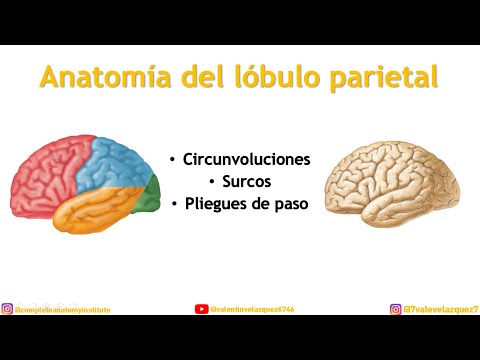
ANATOMÍA DEL LÓBULO PARIETAL - Surcos, circunvoluciones y pliegues de paso
Anatomy of the Parietal Lobe
Overview of the Parietal Lobe
- The parietal lobe is situated anteriorly to the occipital lobe, inferiorly to the frontal lobe, and posteriorly to the temporal lobe.
- It is separated from these lobes by specific fissures: Rolando (central), Silviana (lateral), and external perpendicular fissures.
Structure and Features
- The interparietal or intraparietal sulcus originates at the angle formed by the Rolando and Silviana fissures, extending upward and backward.
- This sulcus creates a concave border that delineates various gyri within the parietal lobe.
Gyri of the Parietal Lobe
- The ascending parietal gyrus, also known as post-central gyrus, is bounded superiorly by Silviana fissure and anteriorly by Rolando fissure; it relates closely to Brodmann area 4 (motor area).
- This gyrus consists of three segments: superior (head), middle (body), and inferior (foot). A notable feature includes connections with frontal areas via fronto-parietal sulci.
Additional Structures
- The superior parietal gyrus lies above the intraparietal sulcus, containing several important anatomical features such as superior occipital passage folds.
- The inferior parietal gyrus is divided into two segments by Jensen's sulcus: supramarginal gyrus (upper) and angular gyrus (lower). These structures are crucial for sensory integration.
Functional Relationships
- The parietal lobe has significant connections with motor pathways including pyramidal tracts for voluntary movement, as well as sensory pathways for processing tactile information.