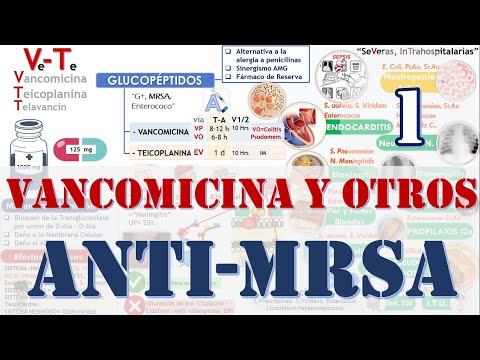
VANCOMICINA, BACITRACINA, FOSFOMICINA, CICLOSERINA - Anti-MRSA - (Glucopeptidos 1 Fármacos)
Introduction and Overview
Greetings and Context
- The speaker opens with a warm greeting to online students, wishing them blessings for the new year. They express hope for academic success in subjects like ecology.
- The video marks the conclusion of a series on pharmacology, specifically focusing on inhibitors of cell wall synthesis. This is the first part of a larger discussion on peptides and other drugs affecting bacterial walls.
Pharmacological Focus
Key Concepts in Pharmacology
- The session will cover pharmacological groups, their characteristics, and action spectra to facilitate comparison with other drugs. Emphasis is placed on understanding mechanisms of action related to antibiotic resistance, particularly methicillin-resistant Staphylococcus aureus (MRSA).
- A reminder is given that while studying pharmacology, microbiology should not be overlooked as it directly relates to antibiotics and their effectiveness. This connection often gets underrepresented in pharmacology textbooks.
Engagement with Audience
Community Interaction
- The speaker acknowledges messages from viewers across social media platforms like Facebook, Instagram, and YouTube, fostering community engagement by inviting comments for shout-outs to universities or friends.
- A special mention is made for a friend involved in basic medicine studies who has an Instagram page dedicated to interesting medical content. Viewers are encouraged to follow this account for additional insights while using Instagram.
Understanding Peptide Groups
Mechanisms of Action
- The discussion transitions into how peptide groups act against bacteria by targeting specific steps in bacterial cell wall synthesis—specifically inhibiting peptidoglycan formation through various mechanisms such as blocking precursor transport out of the cell.
- It’s noted that certain antibiotics can inhibit different stages of peptidoglycan synthesis beyond just transpeptidation processes; examples include vancomycin and fosfomycin which target earlier steps in the synthesis pathway.
Chemical Structures and Resistance
Antibiotic Development
- An overview of penicillin's structure serves as a reference point for discussing antibiotic resistance due to beta-lactamase enzymes that degrade its efficacy against bacteria. Newer antibiotics have been developed targeting different mechanisms due to this resistance issue.
Vancomycin Mechanism of Action and Clinical Use
Overview of Vancomycin's Mechanism
- Vancomycin acts on a step prior to transpeptidation, inhibiting the synthesis of bacterial cell walls.
- The drug targets specific subunits involved in cell wall formation, preventing their assembly into peptidoglycan chains.
- An enzyme called transglycosylase is crucial for linking these subunits; vancomycin inhibits this process.
- By blocking the action of transglycosylase, vancomycin prevents the formation of essential peptidoglycan structures in bacteria.
General Characteristics and Pharmacokinetics
- A summary video provides an overview to help retain key concepts about vancomycin's mechanism and effects.
- Vancomycin is primarily administered intravenously; oral administration is reserved for specific conditions like Clostridium difficile colitis.
- It has minimal metabolism and is eliminated via renal pathways, raising concerns about nephrotoxicity due to its renal clearance.
Adverse Effects and Resistance Mechanisms
- Key adverse effects include "red man syndrome," nephrotoxicity, cardiovascular issues (e.g., tachycardia), and neurological symptoms (e.g., headache).
- Resistance mechanisms involve modifications at the site of action rather than enzymatic degradation as seen with beta-lactam antibiotics.
Indications for Use
- Primary indications include infections caused by methicillin-resistant Staphylococcus aureus (MRSA), endocarditis, sepsis, and prophylaxis in penicillin-allergic patients.
- Oral vancomycin is specifically indicated for treating C. difficile infections; it can also be used topically for skin infections.
Classification and Related Antibiotics
- Vancomycin belongs to a class of glycopeptide antibiotics alongside teicoplanin; both are effective against gram-positive bacteria.
- Other related agents include fosfomycin and cycloserine, which have distinct mechanisms but may be used in similar clinical scenarios.
Antimicrobial Spectrum and Resistance Mechanisms
Overview of Antimicrobial Agents
- The discussion begins with the effectiveness of certain antibiotics against gram-positive bacteria, particularly methicillin-resistant Staphylococcus aureus (MRSA), emphasizing that these drugs are reserved for specific indications.
- It is noted that while some antibiotics target gram-positive bacteria, they can also be effective against certain gram-negative bacteria, highlighting the importance of understanding their spectrum of activity.
Correlation Between Clinical Presentation and Microbial Resistance
- The speaker correlates clinical symptoms with bacterial resistance patterns, indicating that lower urinary tract infections often involve gram-negative bacilli.
- A recommendation is made to print a provided image for reference while studying pharmacology, which aids in linking microbiology concepts with pharmacological treatments.
Understanding Antibiotic Resistance
- The conversation shifts to comparing different strains of bacteria based on their resistance profiles, specifically why MRSA is categorized separately due to its unique resistance mechanisms.
- Historical context is given regarding the development of penicillins and how bacterial evolution led to the emergence of beta-lactamase enzymes that confer resistance.
Development of New Antibiotics
- The emergence of beta-lactamase-resistant antibiotics like oxacillin is discussed as a response to increasing bacterial resistance.
- The modification in bacterial targets leading to methicillin resistance illustrates an ongoing arms race between antibiotic development and microbial adaptation.
Current Treatment Strategies for Resistant Infections
- The need for new classes of antibiotics such as fifth-generation cephalosporins is emphasized due to their efficacy against resistant strains like MRSA.
- Novel therapeutic agents such as glycopeptides are highlighted for their effectiveness against resistant Staphylococcus aureus strains.
Conclusion on Bacterial Resistance Dynamics
- A summary points out that Staphylococcus aureus has become one of the most resistant pathogens known today, necessitating careful consideration in treatment approaches.
Antibiotic Mechanisms and Applications
Overview of New Antibiotics
- A new drug has been approved in the United States that is more effective than vancomycin, particularly for treating methicillin-resistant Staphylococcus aureus (MRSA).
- This new class of antibiotics, known as peptide drugs, is specifically designed for severe hospital-acquired infections and can be synergistic with aminoglycosides for enterococci.
Mechanism of Action of Vancomycin
- Vancomycin primarily disrupts cell wall formation but may also damage messenger RNA (mRNA) synthesis and the cell membrane.
- The mechanism involves binding to D-alanyl-D-alanine residues, which are crucial for peptidoglycan synthesis in bacterial cell walls.
Pharmacokinetics of Vancomycin
- Vancomycin can be administered parenterally for systemic infections or orally for specific cases like pseudomembranous colitis.
- It has a good distribution across tissues and effectively crosses the blood-brain barrier, making it suitable for treating MRSA meningitis.
Spectrum of Activity
- The antibiotic is effective against gram-positive bacteria including Streptococcus, Staphylococcus, and Enterococcus species.
- Historically developed to combat enterococci, vancomycin faces challenges due to some strains developing resistance.
Clinical Indications
- Indicated for conditions such as febrile neutropenia caused by E. coli or Pseudomonas aeruginosa, as well as endocarditis linked to Staphylococcus aureus.
- Commonly used in osteomyelitis and septic arthritis in children due to its effectiveness against skin flora like Staphylococcus epidermidis.
Adverse Effects and Considerations
- Prophylactic use is recommended before surgeries involving skin flora to prevent endocarditis or bacteremia.
- Caution is advised regarding pseudomembranous colitis associated with antibiotic use; vancomycin can be an effective treatment option when given orally.
Vancomycin and Its Effects
Understanding Red Man Syndrome
- Red Man Syndrome can occur when vancomycin is administered too quickly, leading to adverse immune responses.
- Slow administration (60-90 minutes) of vancomycin is crucial to prevent this syndrome, which can result in severe complications like glottic edema and anaphylactic shock.
Immune Responses and Drug Reactions
- The text discusses various drug reactions including vasculitis, eosinophilia, headache, fatigue, and Stevens-Johnson syndrome as potential side effects of vancomycin.
- Stevens-Johnson syndrome's unpredictability makes it difficult to anticipate patient reactions; it may arise from individual idiosyncrasies.
Toxicity Concerns with Vancomycin
- Vancomycin poses risks such as nephrotoxicity and cardiovascular issues; caution is advised when combining it with aminoglycosides due to these risks.
- Enterococci have developed resistance to vancomycin by altering their membrane interactions, complicating treatment strategies.
Polypeptides in Treatment
Mechanism of Action for Topical Treatments
- Polypeptide treatments like bacitracin are primarily used topically for skin and mucosal infections due to their mechanism that interferes with transporters.
- Bacitracin should be applied every 6 to 8 hours; it can also be formulated for ocular use in cases like conjunctivitis.
Absorption Considerations
- Topical applications generally do not absorb unless significant trauma or burns are present; oral administration is ineffective for absorption.
Spectrum of Activity
Coverage Against Bacterial Infections
- Bacitracin has a broad spectrum covering both gram-positive and some gram-negative bacteria but is particularly effective against gram-positive strains due to its action on cell walls.
Indications for Use
- Common indications include treating superficial skin infections caused by Staphylococcus aureus and Streptococcus pyogenes.
Interactions with Other Antibiotics
Combination Therapy Insights
- Neomycin (an aminoglycoside effective against gram-negatives), when combined with bacitracin, enhances coverage against resistant strains like Pseudomonas aeruginosa.
Adverse Effects Awareness
- Systemic administration of certain antibiotics carries a risk of nephrotoxicity; careful monitoring is essential during treatment.
Mechanisms of Action Overview
Inhibitory Actions on Bacterial Synthesis
Mechanisms and Pharmacokinetics of Cyclosporine and Vancomycin
Cyclosporine's Mechanism of Action
- Cyclosporine acts by mimicking a ghost, positioning itself at the site of alanine, which is crucial for bacterial recognition. This allows it to bind effectively.
- The drug ultimately inhibits the synthesis of new peptidoglycan subunits, impacting bacterial cell wall formation.
Pharmacokinetics Overview
- Cyclosporine is administered orally every eight hours; it has a high protein elimination rate through urinary pathways.
- It is effective against gram-positive cocci, including methicillin-resistant Staphylococcus aureus (MRSA), as well as various gram-negative bacilli.
Applications in Tuberculosis Treatment
- Cyclosporine serves as a second-line treatment option for tuberculosis, particularly effective against Mycobacterium tuberculosis and other resistant strains.
- Caution is advised due to potential hepatotoxicity; its use indicates that patients may not respond well to first-line treatments.
Drug Selection Considerations
- Medications are categorized by efficacy: first-choice drugs are marked in green while second-choice options like cyclosporine are highlighted in yellow.
Turn any video into a summary like this
YouTube links, meetings, lectures — with transcripts, search, and chat.