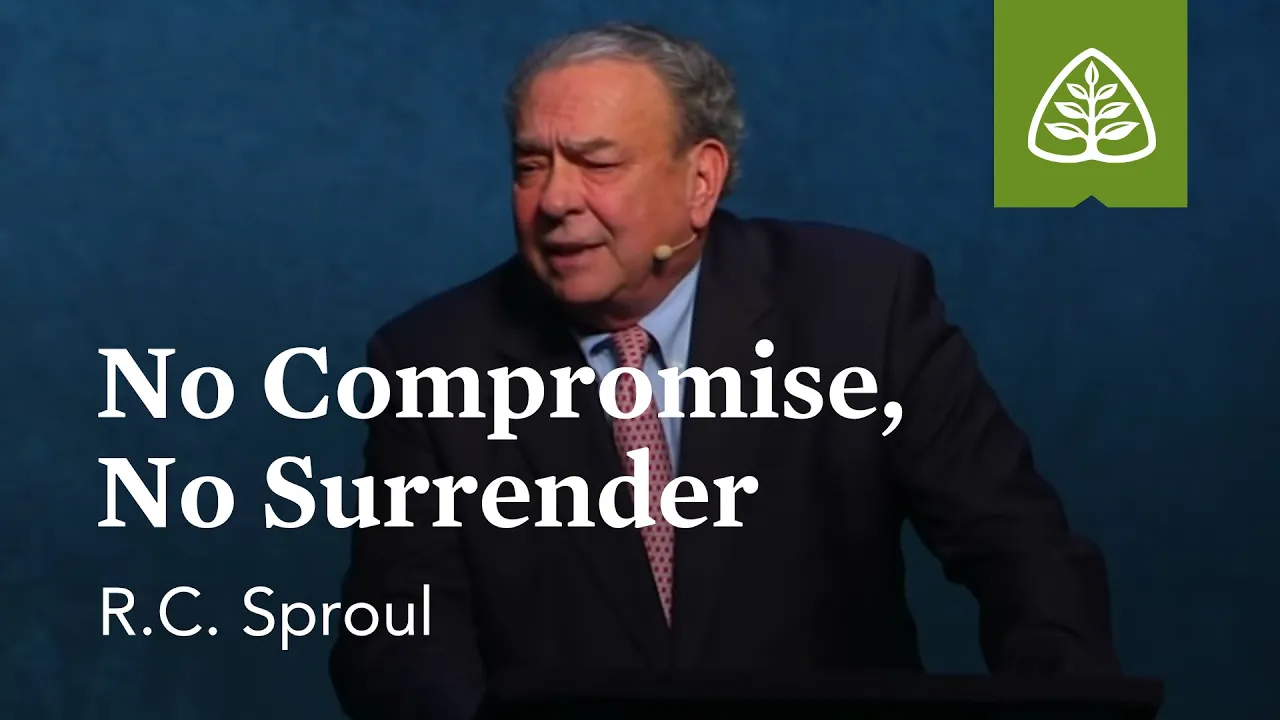
R.C. Sproul: No Compromise, No Surrender
Introduction and Reading from the Gospel of Luke
The speaker introduces the conference and reads from the Gospel according to St. Luke, chapter 24, verses 46-53.
Reading from the Gospel of Luke
- The speaker reads from Luke 24:46-53.
- The reading includes Jesus' words about his suffering, death, and resurrection, as well as repentance and remission of sins being preached in his name to all nations.
- The reading concludes with Jesus blessing his disciples before ascending into heaven.
Polycarp's Martyrdom
The speaker discusses the martyrdom of Polycarp, a bishop in Smyrna who was arrested for being a Christian during the reign of Roman Emperor Marcus Aurelius.
Historical Background
- The speaker provides historical context by discussing events that took place in Asia Minor at Smyrna in 155 AD.
- He describes how Polycarp was appointed Bishop of Smyrna by John the Apostle himself.
Polycarp's Arrest and Trial
- Polycarp was arrested for being a Christian and stirring up people to Christianity.
- He had a vision of himself in flames before he was arrested.
- At his hearing before Proconsul Quadratus, he refused to deny Christ or recant his Christianity despite facing execution.
Martyrdom
- Bishop Latimer turned to Ridley during their execution by burning at stake saying “Play the man” which is what Polycarp heard when he had a vision of himself in flames.
- Polycarp was told to recant his Christianity or be fed to wild beasts. He refused and was burned at the stake.
- The proconsul did not want to make an elderly man a martyr, but Polycarp refused to deny Christ.
- The stands were packed with a hostile crowd against Polycarp including local Jews who resented his teaching of Christianity as well as Pagans who hated him for the same cause.
Conclusion
The speaker concludes by praying that the Holy Spirit may illumine the meaning of the text he read and empower listeners to stand fast for the truth of God's word.
Prayer
- The speaker prays that the Holy Spirit may illumine the meaning of Luke 24:46-53 and empower listeners to stand fast for God's word.
Polycarp's Martyrdom
This transcript discusses the martyrdom of Polycarp, a Christian bishop in Smyrna who was executed for his faith in 155 AD.
The Threat and Refusal to Acquiesce
- Quadratus threatened to burn Polycarp at the stake if he refused to acquiesce.
- Polycarp refused and responded by saying that Quadratus' fire would last no more than an hour, but the fires of God's judgment would never go up.
The Request to Deny Christ
- Quadratus asked Polycarp to say "away with the atheists" with respect to Christians.
- Polycarp complied and pointed to pagans in the stand, saying "away with the atheists".
- This infuriated Quadratus, who ordered Polycarp's execution by burning him at the stake.
The Execution
- They took Polycarp to the center of the arena and attempted to nail his hands to the stake.
- However, he said he didn't need nails and would stand there and take what comes.
- Instead of nails, they bound him with ropes and tied him to the stake before setting it on fire.
- The flames were blown by a strong wind around Polycarp but did not touch or burn him.
- Out of frustration, an executioner plunged a dagger into his chest and killed him.
Two Words That Could Have Saved His Life
- When arrested, all Polycarp had to do was say "Kaiser Kurios" (Caesar is Lord) to escape death.
- He choked before he could utter those words because they repudiated Jesus as Lord.
Who Is Lord?
- The issue of Polycarp's martyrdom was who is the Lord.
- Saying "Iesuos Kyrios" (Jesus is Lord) was the earliest creed of Christendom and to say "Kaiser Kurios" was to repudiate it.
- Paul said in 1 Corinthians that no one can say Jesus is Lord except in the Holy Spirit.
Ellipses
- The statement from Paul that no one could say Jesus is the Lord except in the Holy Spirit was elliptical.
- It meant that no one could say Jesus is the Lord and mean it unless they had the Holy Ghost within them.
Overall, this transcript discusses Polycarp's martyrdom and his refusal to deny Christ. It also explores the issue of who is Lord and what it means to say "Iesuos Kyrios".
The Three Meanings of the Term "Lord"
RC Sproul explains the three meanings of the term "Lord" in the New Testament.
Common Meaning
- The common meaning of "Lord" is a simple title used to address someone respectfully.
- Example: People call RC Sproul "Sir," but he has never been knighted by the Queen of England.
Secondary Meaning
- In the New Testament, "Lord" refers to someone who owns or purchases a slave.
- Christ is called "Kyrios" because He has rescued us from bondage to sin and Satan and purchased us with His blood.
- Christians are not their own; they belong to Christ.
Imperial Usage
- The third meaning of "Lord" is an imperial usage that translates the Old Testament language with respect to God.
- In Hebrew, God is called "Adonai," which means Lord. In Greek, this word is translated as "Kurios."
- When Adonai is translated with respect to Jesus, Kurios takes on an imperial meaning.
The Title "Lord" in the Old Testament
RC Sproul discusses how the title "Lord" was used in the Old Testament and how it relates to Jesus in the New Testament.
Adonai Reserved for God
- In many occasions in the Old Testament, God is referred to as Adonai.
- Adonai means Lord and was reserved for God alone.
Psalm 110
- Psalm 110 says, “The Lord said to my Lord, ‘Sit thou at my right hand.’”
- The first instance of Lord refers to Yahweh (God's name), while the second instance refers to Adonai (supreme title).
Translation into Greek
- In Greek, Adonai is translated as Kurios.
- When the New Testament writers come to translate Adonai with respect to Jesus, the term Kyrios has an imperial meaning.
The Name Above Every Name
RC Sproul explains the significance of the name "Kurios" and how it relates to Jesus.
Philippians 2:5-9
- In Philippians 2:5-9, Paul writes about Christ's humility and obedience.
- God exalted Him and gave Him the name that is above every name.
- This name is not "Jesus," but rather "Kurios."
Every Knee Shall Bow
- At the name of Jesus, every knee shall bow.
- This means that God has given Jesus the title "Kurios," which means sovereign one.
The Origin of the Word "Church"
RC Sproul discusses where the word "church" comes from and its significance in the New Testament.
Ecclesia
- The Greek word for church is "Ecclesia," which means those who are called out.
Kuriokey
- The English word "church" comes from a different Greek word, "Kuriokey."
- Kuriokey means those who belong to the Kurios (Lord).
People of the Lord
- At the heart of the testimony in the New Testament to the church is those who belong to Christ.
The Ascension of Jesus
RC Sproul talks about Luke's account of Jesus' ascension into heaven and what it signifies.
Luke 24:50-53
- Luke describes how Jesus led His disciples out as far as Bethany and blessed them before ascending into heaven.
- The disciples worshipped Him and returned to Jerusalem with great joy.
Acts 1:9-11
- Luke also wrote the book of Acts, which begins with the same account of Jesus' ascension.
- The angels tell the disciples that Jesus will come back in the same way He left.
The Joy of the Ascension
In this section, the speaker talks about how the disciples were able to rejoice after Jesus' ascension despite their initial sorrow and despair.
Rejoicing in Departure
- The disciples were initially overcome with sorrow when Jesus told them He was leaving.
- The idea of Jesus' humiliation and departure was difficult for them to accept.
- Despite being a crisis moment, the disciples rejoiced after Jesus' ascension because they understood where He was going.
- They knew that it was better for Him to leave so that He could be coronated as King of Kings and Lord of Lords.
The Other Side of Ascension
- From the book of Revelation, we see the other side of ascension where John is given insight into heaven's inner chambers.
- The Lamb who was slain tears open books that had hidden all secrets, and many angels around the throne respond with worship.
The Lordship of Christ
In this section, the speaker talks about the importance of bearing witness to Jesus as the only Lord and King. He emphasizes that no Christian should ever negotiate the Lordship of Christ.
Bearing Witness to Our King
- Christians are called to bear witness to Jesus as the only Lord and Sovereign.
- According to Acts 1:8, believers receive power so that they can be witnesses for Jesus in Jerusalem, Judea, Samaria, and even to the outermost parts of the earth.
- The speaker mentions Polycarp, Ridley and Latimer as examples of those who had courage and faith in following their Lord even unto martyrdom rather than bowing down to an emperor.
- Christians should not compromise their king for luxury or any other reason.
Worshiping God Forever
- The song of Angels, martyrs, and the church is always about giving power and glory to God who sits upon His throne forever.
- A four living creature said "Amen!" while twenty-four elders fell down and worshiped Him who lives forever and ever according to Revelation 5:14.
Turn any video into a summary like this
YouTube links, meetings, lectures. With transcripts, search, and chat.