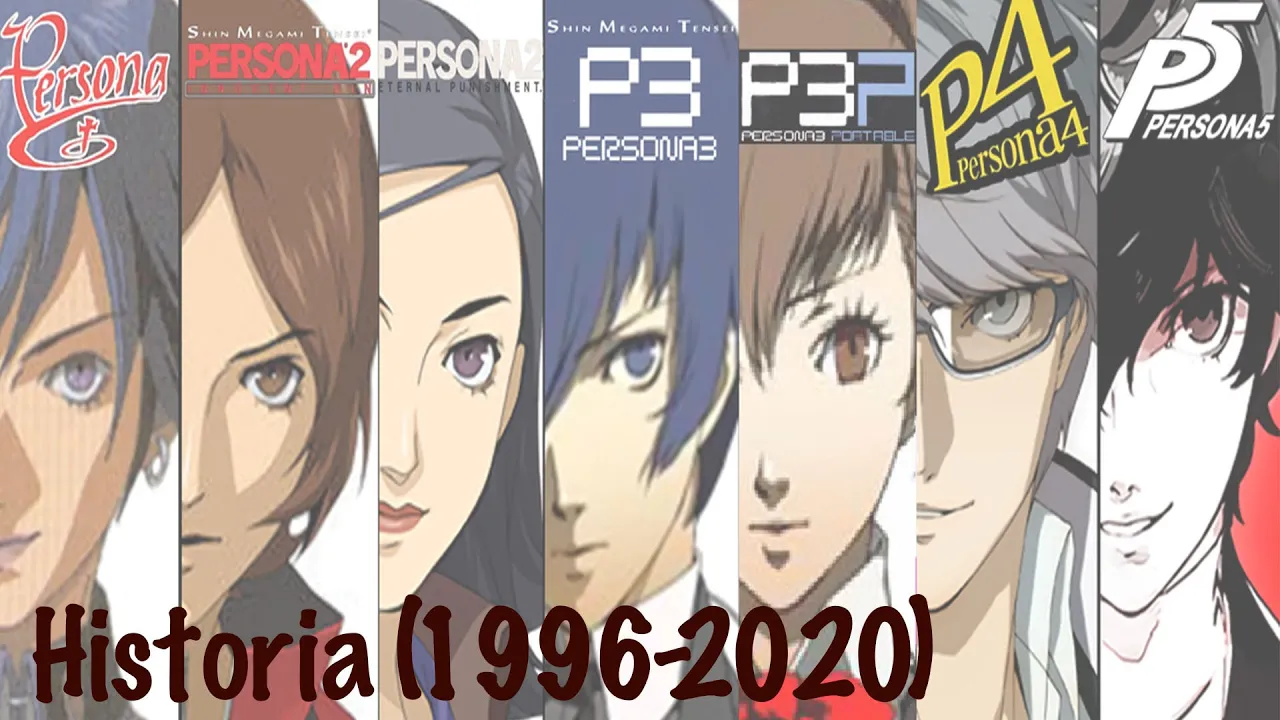
Historia de la saga PERSONA (Hasta el 2020) #P5R
Introduction
The video introduces the topic of the Persona game series and announces that Persona 5 Royal will be released soon with Spanish subtitles. The creator also mentions a 24-hour marathon on their channel.
Persona Game Series
- The Persona game series started in 1996 with the release of "Megami Ibunroku Persona" for the PlayStation.
- The game focuses on a group of high school students who have the ability to summon manifestations of their personalities called "Personas."
- The first game had different camera perspectives, including an overhead view for exploring the city, a first-person view for dungeon exploration, and an isometric view for interacting with the environment.
- Players could negotiate with demons to recruit them as allies, although this feature was removed in later games and reintroduced in Persona 5.
- The protagonist's design underwent changes in later versions, such as a reddish skin tone and red hair.
Origins of the Series
This section discusses how the Persona series originated from another game called "Shin Megami Tensei" and its spin-off "Revelations: Persona."
Shin Megami Tensei and Revelations: Persona
- In 1994, Atlus released "Shin Megami Tensei," a role-playing game for Super Nintendo. They wanted to reach a wider audience and created a spin-off called "Revelations: Persona" (known as "Megami Ibunroku Persona" in Japan).
- While Shin Megami Tensei focused on demonic themes, Revelations: Persona centered around a group of high school students.
- Due to its success, Atlus decided to create a new saga that functioned as a spin-off but had more appeal by featuring relatable student protagonists.
- On September 20, 1996, "Megami Ibunroku Persona" was released in Japan for the PlayStation, marking the beginning of the Persona series.
Persona and Revelations: Persona
This section discusses the release of "Persona" in different regions and its gameplay features.
Release and Gameplay
- "Persona" was released on October 25, 1997, in the United States as "Revelations: Persona."
- The game follows a group of high school students from St. Hermelin High who participate in a game called "Persona." They encounter a character named Philemon, who grants them the power to summon Personas.
- The game had visual changes for Western players to better connect with the characters. The protagonist's design was altered, and Eriko Kirishima's name was changed to Maki Sonomura.
- In 2009, a remake of "Persona" titled "Shin Megami Tensei: Persona" was released for PSP. It featured improved gameplay mechanics and adjustments to difficulty.
- Additionally, there were spin-offs such as mobile games and novels based on the main game.
Remakes and Spin-offs
This section discusses remakes of previous games in the series and additional spin-off titles.
Remakes and Spin-offs
- In 2006, Atlus released a mobile RPG called "MegaTen Colosseum," which served as a continuation of "Revelations: Persona."
- A novel adaptation titled "Megami Ibunroku Persona: Shadow Maze" was also published.
- Two years after the release of the first game, "Persona 2: Innocent Sin" came out in Japan on June 29, 1999. It focused on Tatsuya Suou, a student at Seven Sisters High School, and his encounters with the Joker.
- "Persona 2: Eternal Punishment" was released as a direct sequel to "Innocent Sin" on June 29, 2000. The game featured Maya Amano as the protagonist and explored events from the previous game.
- Both "Persona 2" games received remakes for PSP in 2011, which included improvements in loading times and text speed.
Conclusion
The video concludes by mentioning the release of Persona 5 Royal and its upcoming marathon on the creator's channel.
Persona Series Continuation
- The Persona series continued with subsequent releases, including Persona 3, Persona 4, and Persona 5.
- Each game introduced new characters, stories, and gameplay mechanics while maintaining the core elements of summoning Personas and exploring social relationships.
- The popularity of the series has led to spin-offs in various forms such as anime adaptations, manga adaptations, and merchandise.
Timestamps have been used to link relevant sections of the transcript.
Persona 3 and its Spin-offs
This section provides an overview of Persona 3 and its spin-offs.
Persona 3 (2006)
- Persona 3 was released in 2006 for PlayStation 2.
- The game introduced a new director, Katsura Hashino, who took over the series.
- The protagonist, named Makoto Yuki or customizable by the player, returns to his city after the death of his parents.
- He joins a special extracurricular group called SEES (Specialized Extracurricular Execution Squad), which investigates a phenomenon called Tartarus.
- The game features a system of summoning and fusing personas, as well as a calendar system and social links.
Persona Portable (2009)
- Persona Portable was released in 2009 for PSP.
- It added changes such as the ability to choose the protagonist's gender and control companions in battle.
Persona 3 Dancing Moon Night (2018)
- Persona 3 Dancing Moon Night is a rhythm game spin-off released in 2018 for PlayStation 4 and PlayStation Vita.
- It takes place within a dream world called "Club Velvet."
Other Spin-offs
- There were other spin-offs such as "Persona 3 The Night Before," a web-based RPG, and several mobile games.
- Four movies were released between 2013 and 2016, adapting the story of the main game.
- The protagonist appeared in other games like Super Smash Bros. Ultimate.
Introduction to Persona 4
This section introduces Persona 4.
Persona 4 (2008)
- Released in Japan on July 10, 2008, and later in America on December 9, it is the fifth main game in the series.
- Persona 4 maintains many aspects of its predecessors, including graphics and gameplay mechanics.
- The protagonist, named Yu Narukami or customizable by the player, moves to a new city to live with his detective uncle and cousin.
- The story revolves around solving a murder mystery connected to a world inside televisions called the "TV World."
- The game explores themes of friendship and self-discovery.
Improvements in Persona 4
- Persona 4 introduced improvements such as enhanced fusion mechanics, the ability to control companions in battle, and more character interactions.
Conclusion
These notes provide an overview of Persona 3 and Persona 4, including their spin-offs and key features.
New Section
This section discusses the features and limitations of Persona 4 Golden, a game released in 2012. It also mentions the bankruptcy of Index Holding, the parent company of Atlus, and the subsequent release of spin-off games related to Persona 4.
Features and Limitations of Persona 4 Golden
- Persona 4 Golden is an enhanced version of Persona 4 with added content such as a new semester, a new playable character, cinematic scenes, new songs, and improved graphics. It received positive reviews and was considered the definitive way to experience the story.
- The game has a calendar system that requires time management as there are time limits for missions.
- Despite its excellence, there is a risk of losing progress due to possible glitches or system crashes.
Spin-off Games Related to Persona 4
- Following the success of Persona 4, several spin-off games were released. The first one was Persona 4 Arena, a fighting game developed by Atlus and Arc System Works. It takes place after the events of Persona 4 and includes characters from both Persona 3 and Persona 4.
- A sequel to Persona 4 Arena called Persona 4 Arena Ultimax was also released. It concludes the story of Persona 3 and includes all missing characters from both games.
- Another spin-off game called Persona Q: Shadow of the Labyrinth was released exclusively for Nintendo 3DS. It combines characters from both Persona 3 and Persona 4 in a labyrinth filled with shadows.
- Additionally, there was a rhythm game called Persona 4: Dancing All Night developed by Dingo (later taken over by Atlus). It takes place after the events of Persona 4 Golden and focuses on Rise's return to the music world.
- These spin-off games had various adaptations such as mobile card games, anime series (including one for Persona 4 Golden), manga adaptations, novels, and stage plays.
New Section
This section introduces Persona 5, the sixth main game in the series. It discusses its development process, release dates, and the protagonist's journey in Tokyo.
Development and Release of Persona 5
- Persona 5 was developed immediately after the release of Persona 4 but faced multiple delays. Initially planned as a PlayStation 3 exclusive, it eventually released on both PlayStation 3 and PlayStation 4.
- The game was announced in 2014 but was released on September 15, 2016, in Japan and April 4, 2017, in America.
- The development team included director Katsura Hashino, composer Shoji Meguro, and character designer Shigenori Soejima.
Protagonist's Journey in Tokyo
- The protagonist of Persona 5 is a silent character known as "Joker" or "Ren Amamiya." He moves to Tokyo due to a false accusation and is sentenced to live there for a year under probation.
- He resides in the attic of Café Leblanc owned by Sojiro Sakura. On his first day at Shujin Academy, he encounters mysterious events involving an app called "Metaverse Navigator" on his phone.
- The game focuses on social inequality and explores people's deep desires. Unlike previous games with random dungeons, Persona 5 features known locations called "Palaces," which represent how individuals perceive reality.
- By defeating shadows within these Palaces and changing the heart of their owners, the characters can bring about confession and redemption.
New Section
This section concludes the discussion on Persona series by mentioning appearances of Persona characters in other games and concerts held by Atlus.
Appearances of Persona 4 Characters
- Characters from Persona 4 have made appearances in other games as guests or cameos. For example, the protagonist and Aigis appear in "Dissidia: Final Fantasy" as playable characters.
- The protagonist also appears in "Star Ocean: The Last Hope" as a boss character named "Dreadnought," and in "Persona 5 Royal" as a costume for the main character.
- Additionally, characters from Persona 4 Arena appear in the game "BlazBlue Cross Tag Battle."
Atlus Concerts
- Atlus has organized concerts featuring music from the Persona series. These concerts are held approximately every two years and serve as a platform to announce upcoming games.
Conclusion
The transcript provides an overview of Persona 4 Golden, spin-off games related to Persona 4, the development and release of Persona 5, and appearances of Persona characters in other games. It also mentions Atlus concerts that showcase music from the series.
Overview of the Game
The game focuses on improving combat dynamics and aesthetics, with enhanced attacks and joint attacks. It has received critical acclaim with a Metacritic score of 93/100 and was nominated for Game of the Year in 2017.
Features and Release
- Persona 5 was announced during the Persona Super Live concert in 2017.
- It was released as a standalone game for PlayStation Vita and PlayStation 4 in May 2018.
- The game is a spin-off that features a dream sequence where characters compete in a dance competition.
- Persona 5 Royal, an enhanced version of the original game, was released in Japan in October 2019 and worldwide in March 2020.
- Persona Q2: New Cinema Labyrinth, a portable game featuring characters from Persona 3, 4, and 5, was released in November 2018.
Persona 5 Royal
Persona 5 Royal is an improved version of the original game. It includes new content such as a new semester, changes to the story, new endings, new characters, locations to improve skills, and a new mode called "Shift" which allows players to view cinematics and customize their surroundings.
Key Features
- Released on October 31st for Japan and March 31st for the rest of the world.
- Includes additional content like a new semester, changes to the story, new endings, and a new character.
- Introduces a new location to improve skills and advance certain parts of the story.
- The "Shift" mode serves as a gallery where players can view cinematics from the game.
- Offers customization options for controlling other characters and playing card games.
Persona 5 Scramble
Persona 5 Scramble is a direct sequel to Persona 5 and features action RPG gameplay instead of turn-based combat. It was developed by Atlus in collaboration with Koei Tecmo.
Key Features
- Released on February 20th, 2020, in Japan for PlayStation 4 and Nintendo Switch.
- Changes the gameplay from turn-based combat to action RPG or "musou" style.
- Adds two new playable characters and continues the story after the events of Persona 5.
- Characters travel to different cities in Japan during the game's storyline.
Conclusion and Future Possibilities
The transcript concludes by mentioning that there may be future additions to the Persona series, such as a new mainline game (Persona 6) for the next generation of consoles. It also highlights various appearances of Persona 5 characters in other games and media.
Future Possibilities
- With the arrival of new console generations, it is likely that a new mainline game will be released in the future.
- Several appearances of Persona 5 characters have been made in other games, including collaborations with Sonic Forces and Super Smash Bros Ultimate.
- The transcript ends by acknowledging that more content related to Persona 5 may still be released.
Timestamps are provided for each section based on their corresponding timestamps in the transcript.