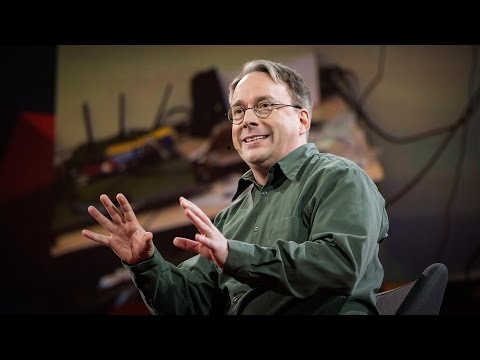
The mind behind Linux | Linus Torvalds | TED
Linux and Open Source: A Conversation with Linus Torvalds
The Impact of Linux on Technology
- Chris Anderson highlights the extensive reach of Linux, noting its presence in millions of computers and over a billion active Android devices.
- Linus Torvalds humorously describes his office as unremarkable, emphasizing that the most interesting feature is a walking desk he no longer uses.
Working Environment and Philosophy
- Torvalds prefers a quiet workspace with calming colors to minimize external stimulation, focusing on silence rather than powerful hardware.
- He shares that he often works alone in his home, valuing solitude for concentration while enjoying the company of his cat.
The Genesis of Linux
- Torvalds explains that he initially developed Linux as a personal project without any collaborative intentions or awareness of open source at the time.
- He reflects on how feedback from others transformed his perspective, leading him to embrace open-source principles after being introduced by a friend.
Transition to Open Source Collaboration
- Initially concerned about commercial interests exploiting his work, Torvalds eventually decided to share it publicly despite these fears.
- Contributions began not with code but ideas; receiving feedback was pivotal for him as it validated his efforts and encouraged further development.
Growth and Community Engagement
- The moment when others showed interest in his project marked a significant turning point for Torvalds, fostering an appreciation for community involvement despite not being inherently social.
- He notes that the growth from 10 to 100 contributors felt monumental compared to later expansions; community engagement was more crucial than sheer numbers.
Git: A Tool for Managing Software Development
The Evolution of Open Source: From Linux to Git
The Scale of Collaboration in Kernel Development
- The kernel development involves around 1,000 contributors for each release every two to three months, highlighting the complexity and scale of collaboration.
- Linus Torvalds expresses frustration with CVS, a source-code maintenance tool he disliked, leading him to seek alternatives that were more radical and innovative.
- Git was created as a solution for managing the complexities of maintaining Linux, showcasing Torvalds' need for effective tools in large-scale projects.
Personal Insights into Linus Torvalds' Background
- Torvalds reflects on his childhood programming experience, describing himself as a "prototypical nerd" who preferred puzzles like the Rubik's Cube over social interactions.
- He shares anecdotes about his family dynamics, revealing how his sister helped him navigate social situations due to his introverted nature and focus on technical subjects.
Stubbornness as a Driving Force
- Torvalds identifies stubbornness as a key trait that has influenced his work ethic; he emphasizes persistence in completing tasks rather than easily shifting focus.
- His long tenure at one company in Silicon Valley is noted as unusual; it underscores his commitment and stability compared to the typical job-hopping culture.
Conflict and Quality Control in Development
- While discussing conflicts during Linux development, Torvalds admits that being myopic regarding others' feelings sometimes led to hurtful interactions but acknowledges this aspect of himself.
- He highlights the diversity within open-source communities where differing personalities can collaborate effectively despite personal disagreements.
The Role of Taste in Coding
- Torvalds introduces the concept of "taste" in coding quality by comparing examples of code structures; he suggests that good taste leads to better coding practices.
Understanding the Nuances of Linked Lists and Code Design
The Complexity of Removing Entries in a Singly-Linked List
- The discussion highlights the intricacies involved in removing an entry from a singly-linked list, emphasizing the distinction between handling the first entry versus entries in the middle.
- Changing pointers is crucial: if it's the first entry, you must update the pointer to point to the new first entry; for middle entries, you need to adjust the previous entry's pointer.
- The speaker notes that sometimes problems can be reframed to eliminate special cases, leading to cleaner code without unnecessary conditional statements.
The Concept of "Good Taste" in Coding
- Good taste in coding is described as an ability to recognize larger patterns and instinctively know effective solutions.
- The conversation shifts towards personal attributes, suggesting that being a skilled coder also involves having vision and determination beyond technical skills.
Vision vs. Engineering Mindset
- The speaker expresses discomfort with being labeled a visionary, identifying more as an engineer focused on practical problem-solving rather than grand future plans.
- A comparison is made between Tesla and Edison; while Tesla represents visionary ideas, Edison symbolizes hard work and practical achievements.
Reflections on Open Source Software
- When asked about feelings regarding companies profiting from his software contributions, he expresses contentment with his situation and acknowledges that open source was essential for Linux's success.
- He reflects positively on his choices related to open source despite its challenges.
Future of Open Source Beyond Software
- There are mixed feelings about whether open source principles can be applied effectively outside of coding due to complexities in other fields.
Turn any video into a summary like this
YouTube links, meetings, lectures. With transcripts, search, and chat.