Escalas: concepto de escala, tipos de escalas y ejercicios. Tecnología.
Introduction to Scales in Maps and Plans
In this section, the concept of scales in maps and plans is explained. The relationship between real dimensions and the dimensions represented in drawings is discussed, along with the interpretation of scale values.
Understanding Scales
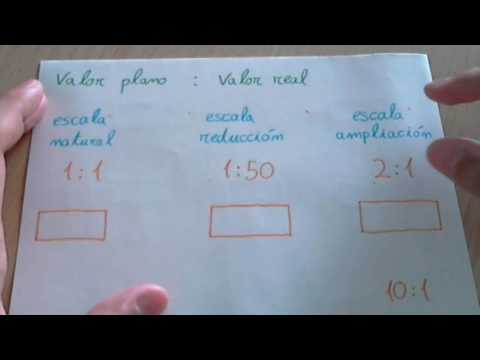
- A scale represents the mathematical relationship between real dimensions and dimensions depicted in a drawing or map.
- It consists of two numbers separated by a colon, where one number refers to the value in the drawing (plano) and the other number refers to the real value.
- When representing something on a plane, it is either enlarged or reduced using a specific ratio or proportion called scale.
- There are three important types of scales: natural scale (1:1), reduction scale, and enlargement scale.
Natural Scale
This section explains the concept of a natural scale where physical object sizes coincide with their real sizes.
Natural Scale
- In a natural scale, the size of an object in a drawing is equal to its actual size.
- For example, if an object measures 1 centimeter in both the drawing and reality, then it follows a 1:1 scale.
Reduction Scale
This section discusses reduction scales where objects are represented smaller than their actual size.
Reduction Scale
- In a reduction scale, objects are depicted smaller than their actual size.
- For example, if there is a reduction scale of 1:50, it means that 1 centimeter on the drawing represents 50 centimeters in reality.
- To calculate measurements using a reduction scale, you can use proportional calculations like cross-multiplication.
Enlargement Scale
This section explains enlargement scales where objects are represented larger than their actual size.
Enlargement Scale
- In an enlargement scale, objects are depicted larger than their actual size.
- For example, if there is an enlargement scale of 2:1, it means that 2 centimeters on the drawing represent 1 centimeter in reality.
- Measurements can be calculated using proportional calculations like cross-multiplication.
Example Exercise - Calculating Real Size
This section provides an example exercise to calculate real sizes using a given scale.
Exercise - Calculating Real Size
- Given a scale of 1:200 and a building facade measuring 15 centimeters on the drawing, we need to determine its real size.
- Using the scale ratio, we can set up a proportion and solve for the real size.
- In this case, 1 centimeter on the drawing represents 200 centimeters in reality.
- By multiplying 15 by 200 and dividing by 1, we find that the real facade size is 3000 centimeters or 30 meters.
Example Exercise - Representing a Processor
This section presents another example exercise involving representing a processor at a specific scale.
Exercise - Representing a Processor
- A processor is represented at a scale of 5:1.
- If one side of the processor measures 2 centimeters on the drawing, we need to determine its size in reality.
- Using the given scale ratio, we find that 2 centimeters on the drawing represent 1 centimeter in reality.
- Therefore, the actual measurement would be half of what is shown on the drawing.
These notes provide an overview of scales in maps and plans. The concept of scales, including natural scale, reduction scale, and enlargement scale, is explained. Two example exercises are provided to demonstrate how to calculate real sizes using scales.
New Section
The speaker discusses how to calculate the actual measurement of a scaled object.
Calculating the Actual Measurement
- The speaker explains that to calculate the actual measurement, we can use the rule of three.
- By multiplying and dividing using cross multiplication, we can determine the real size of an object.
- In this case, the speaker multiplies by 35 and divides by 51 to find the actual measurement.
- The result is 0.7 centimeters or 7 millimeters.
- It is important to note that the scaled measurement appears smaller because it was enlarged on a scale.
Timestamps are provided for each bullet point in accordance with the transcript.