Principio fundamental del conteo - Principio de la multiplicación
Introduction to Combinatorial Principles
Understanding the Multiplication Rule
- The multiplication rule, also known as the fundamental principle of counting, is introduced with a focus on examples for better comprehension.
- An event can occur in 'm' different ways; for instance, rolling a die has 6 possible outcomes (1 through 6).
- Another event, such as flipping a coin, can occur in 'n' ways; here, it has 2 outcomes (heads or tails).
- The total number of ways both events can happen simultaneously is calculated by multiplying the number of outcomes: m * n. In this case, it's 6 (die) * 2 (coin) = 12 total combinations.
Example Scenarios
- A detailed breakdown shows how each outcome from rolling the die pairs with each coin flip to confirm there are indeed 12 unique combinations.
- A new example introduces clothing choices: having three pairs of pants and four shirts leads to calculating outfit combinations using the same multiplication principle.
Clothing Combinations
Calculating Outfit Options
- To determine how many different outfits can be created with three pants and four shirts, we multiply: 3 (pants options) * 4 (shirt options), resulting in 12 possible outfits.
- Each specific pant option can be paired with all shirt options. For example, if one chooses light blue pants, they have four shirt choices available.
Exploring Non-Simultaneous Events
Different Modes of Transportation
- The discussion shifts to transportation methods: two bicycles, three bus routes, four cars from friends’ parents, or walking as a single option.
Understanding Exclusionary Events in Counting Principles
The Concept of Exclusive Choices
- The speaker explains that when choosing how to go to school, one must select from exclusive options (e.g., two bicycles, a bus, or walking). Only one option can be chosen at a time.
- If one chooses to walk, they cannot also take the bus or ride a bicycle. This illustrates the principle of mutually exclusive events in decision-making.
Fundamental Counting Principle
- The key term for determining if the fundamental counting rule applies is whether "and" or "or" is used between events. Using "or" indicates that the events are mutually exclusive.
- For mutually exclusive choices like transportation methods (bicycle, bus, car, walking), the total number of ways to choose is found by summing the options rather than multiplying them.
Example Calculation
- An example calculation shows that there are 10 different ways to get to school by adding up all possible transport options: 2 bicycles + 3 buses + 4 cars + 1 walking route = 10 total options.
Practice Exercises and Engagement
- The speaker encourages viewers to practice with exercises provided at the end of the video and emphasizes understanding whether multiplication or addition rules apply based on event exclusivity.
Exploring Coin and Dice Combinations
Introduction to New Concepts
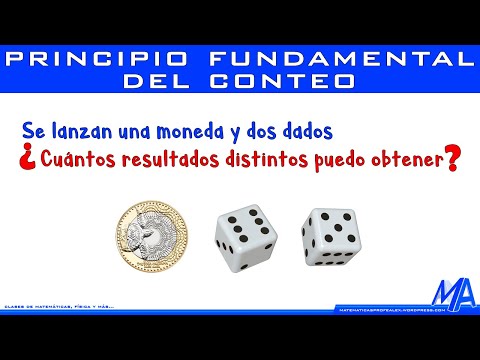
- After engaging viewers, the speaker introduces a new concept related to launching a coin and two dice as part of upcoming lessons on permutations and variations.
Setting Up Possibilities
- The setup involves identifying possibilities for each item: one coin (2 outcomes: heads/tails) and two dice (6 outcomes each).
Total Outcomes Calculation
- To find total outcomes when launching both items together, multiply their individual possibilities: 2 times 6 times 6 = 72. This demonstrates applying multiplication for independent events.
Creating Unique License Plates
License Plate Configuration
- A scenario is presented where unique license plates consist of two letters followed by one digit. There are 26 letters available and 10 digits (0 through 9).
Options for Each Position
- Each letter position allows any of the 26 letters since repetition is allowed. Thus:
- First letter: 26 options
- Second letter: another set of 26 options
- Digit: 10 options
Final Calculation for Plates
- The total combinations for creating these plates would be calculated as 26 times 26 times 10 = 6760, illustrating how multiplication applies when considering multiple positions with repetitions allowed.
Conclusion and Further Learning Opportunities
Encouragement for Continued Learning
Turn any video into a summary like this
YouTube links, meetings, lectures — with transcripts, search, and chat.