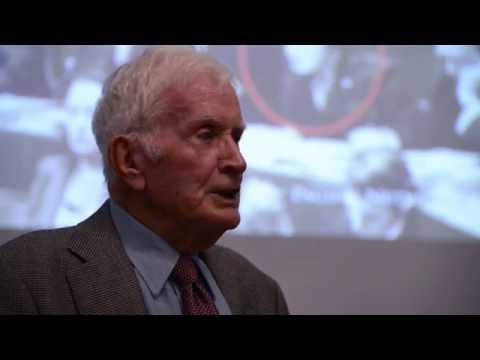
Siegfried Ramler, interpreter at Nuremberg, in London with AIIC
Introduction to the Event
Opening Remarks
- The speaker expresses gratitude for the audience's presence and acknowledges the event organizers.
- The speaker introduces their background as a barrister involved in international courts, emphasizing the importance of high-quality interpretation.
Importance of Interpretation
- Highlights the extraordinary quality of simultaneous interpretation experienced in various courts.
- Mentions playful interactions between barristers and interpreters, illustrating a unique rapport developed over time.
Context of the Lecture
Nuremberg Trial Significance
- The lecture commemorates the approaching 70th anniversary of the Nuremberg Trials, focusing on historical significance.
- Discusses a poster show prepared by an association highlighting remarkable interpreters from the Nuremberg process.
Personal Connection to History
- The speaker shares their interest in connecting with interpreters from that era while finishing a book about key figures involved in the trials.
- Introduces Siegfried Ramler, who interpreted during significant interrogations related to Hans Frank before the trial began.
Siegfried Ramler's Experience
Interpreting Historical Figures
- Describes an enlightening conversation with Siegfried Ramler, who interpreted for Hans Frank during pre-trial interrogations.
- Emphasizes Ramler’s unique position to recount experiences directly linked to pivotal historical events involving war crimes.
Background on Hans Frank
- Provides context about Hans Frank’s role as governor-general of occupied Poland and his eventual execution for crimes against humanity.
Siegfried Ramler's Journey
Early Life and Migration
- Ramler’s life journey is noted, beginning in Vienna before moving to London and eventually participating in Nuremberg trials.
Reflections on Nuremberg Trials
- Acknowledges previous speakers' enthusiasm regarding challenges faced by interpreters at such historic events.
Significance of Pre-Trial Interrogations
Role in Historical Context
- Discusses how pre-trial interrogations were crucial for understanding leaders’ positions post-war, likening them to conducting an autopsy for historical analysis.
How a 22-Year-Old Became an Interpreter at Nuremberg
Background and Context
- The speaker reflects on their studies and war work during the chaotic period in London as World War II was ending.
- They describe the post-war situation in Europe, highlighting the urgency to prepare for the Nuremberg Trials amidst chaos.
- The challenge of managing four languages (English, German, French, Russian) during the trial is introduced, emphasizing the need for innovative solutions.
Development of Simultaneous Interpretation
- The concept of simultaneous interpretation was proposed by visionary figures like Leandoster to address language barriers effectively.
- Despite initial difficulties and mistakes, this new system proved successful and became foundational for international conferences today.
Personal Journey to Nuremberg
- At just 22 years old, the speaker worked with a battalion of older soldiers in Germany, bridging communication gaps during military operations.
- Their attachment to a mobile battalion led them to Erlangen and eventually to an opportunity at the Nuremberg Palace of Justice.
Decision-Making Under Pressure
- After expressing interest in joining the trial team at Nuremberg, they faced resistance from their commanding officer who insisted they remain with their battalion.
- A pivotal decision was made when they chose not to board a plane back to London after receiving orders; this act would change their life significantly.
Transition into Interpreting Role
- Following their decision to stay behind, they were quickly immersed in pre-trial interrogations without formal training as an interpreter.
- The speaker's fluency in English and native language positioned them well for interpreting roles despite lacking structured training.
The Impact of Childhood Experiences on Legal Proceedings
Personal Reflections on Historical Events
- The speaker recalls being 14 years old during the German annexation of Austria in March 1938, witnessing the arrival of German troops and the display of swastikas.
- The emotional conflict arises as Baldo Von Shirak, once a governor during the annexation, is now a defendant in a trial, prompting personal reflections on past events.
- The speaker references Kristallnacht (Night of Broken Glass), triggered by the assassination of a German diplomat by a Polish Jewish boy, leading to widespread violence against Jews in Germany and Austria.
- Hitler's reaction to the diplomat's death included orders for violent reprisals against Jewish communities, resulting in significant destruction and loss.
- A vivid memory is shared about observing SS men marching outside his home while feeling anxious for his family's safety.
Cumulative Experiences Leading to Escape
- The speaker describes multiple traumatic experiences that shaped their childhood in Vienna, culminating in an opportunity to join a Kindertransport aimed at rescuing Jewish children from Nazi persecution.
- In December 1938, legislation allowed for 10,000 children from Austria and neighboring countries to escape before borders closed due to impending war.
- Reflecting on what could have been if he had not escaped; many children faced extermination in concentration camps like Auschwitz.
Transitioning into Professional Life
- Upon entering legal proceedings years later, the speaker felt no initial concerns about maintaining impartiality despite their emotional history; they focused instead on performing well amidst challenging tasks.
- The complexities of interpreting legal language presented challenges that required collaboration with colleagues for effective communication.
Current Endeavors and Future Plans
- Currently active as a senior fellow at East-West Center in Hawaii, focusing on educational exchanges between China and the United States over the last two decades.
- Engages with Chinese scholars through programs designed to foster understanding between cultures while also facilitating U.S. scholars' visits to China.
Reflection on Aging and Legacy
- As he approaches his 90th birthday, there’s contemplation about retirement from professional duties while reflecting on past contributions.
Interpreting History: The Role of an Interpreter at the Nuremberg Trials
Introduction to the Interpreter's Duty
- Siegfried Ramler introduces himself as an interpreter, affirming his commitment to accurately translate questions and responses between English and German.
- He recalls entering a small room at 22 years old, tasked with interpreting for Hans Frank, who was accused but not yet convicted of mass murder.
Emotional and Linguistic Challenges
- Ramler emphasizes that his primary concern was linguistic rather than emotional; he focused on how to effectively handle the challenge of interpretation.
- He describes the courtroom setting, noting the presence of judges from various countries including Britain, France, and Russia.
Distinction Between Interrogation and Trial
- The interrogation process differed from the trial; it involved sequential questioning rather than simultaneous interpretation.
- During interpretation, Ramler reflects on maintaining eye contact with Hans Frank, likening it to any typical conversation despite the gravity of their discussion.
Responsibilities Beyond Interpretation
- In addition to interpreting, Ramler assisted court reporters by providing them with accurate spellings of place names and individuals mentioned during proceedings.
- His role was crucial in ensuring that transcripts were prepared correctly for all four languages used in the trial (English, French, Russian, German).
Accuracy in Language Interpretation
- At day's end, transcripts were produced quickly but lacked polish; they needed to be accurate enough to avoid significant errors due to the trial's serious nature.
- Corrections were sometimes made by those being interrogated regarding interpretations; this highlighted challenges faced by interpreters.
Nuances in Language Use
- Ramler discusses specific terminology used by Nazi leaders that required careful interpretation. Terms like "Final Solution" had grave implications that needed precise translation.
Discussion on Judicial Processes and Interpretation
The Role of Judges in Tribunal Discussions
- The German Defense Council emphasized the need for a swift registration of terms, leading to discussions between prosecution and defense.
- Chief Justice Lawrence intervened, suggesting that the tribunal would consider these matters later, reflecting a typical judicial approach.
Interpreter Decision-Making
- Interpreters individually interpreted words based on context rather than reaching a consensus among themselves.
- Interpreters had to make split-second decisions regarding their interpretations during proceedings.
Emotional Influence on Interpretation
- Personal feelings towards defendants could subconsciously affect interpreters' choices, potentially skewing interpretations positively or negatively.
- Mistakes made by interpreters were acknowledged and discussed among them, highlighting the challenges faced during trials.
Dynamics Among Defendants
Relationships Within the Defendant Group
- Observers noted strong negative sentiments towards certain defendants like Julius Streicher, who was largely isolated from others in the dock.
- The defendant group was diverse; understanding their characteristics is crucial for analyzing trial dynamics.
Military Leadership's Perspective
- Military leaders recognized strategic mistakes made by Hitler that jeopardized lives and military positions during wartime.
- High-ranking officers expressed agreement on confronting Hitler about his decisions but felt unable to voice objections due to fear of treason.
Reflections on Historical Context
Confrontation with Authority
- Leaders like Kaito found it impossible to challenge Hitler directly despite recognizing critical errors in strategy.
Closing Remarks and Book Promotion
Interrogation Insights: Understanding Hans Frank's Testimony
The Context of the Interrogation
- The discussion revolves around the interrogation of Hans Frank, focusing on his claims and the interpreter's perspective on truthfulness during the proceedings.
- The text being referenced is a translation of Frank's statements made in September 1945, highlighting his role as Governor-General of occupied Poland.
Frank's Defense Strategy
- Frank attempts to deflect responsibility by claiming that the SS did not allow his workers to participate in Jewish campaigns, suggesting a lack of control over events.
- He describes ghettos as an attempt to maintain order, asserting that Jews had their own parts of towns and were under police protection.
Acknowledgment of Difficulties
- Frank admits that ghettos faced severe challenges, particularly in Warsaw regarding food shortages, leading to mass transportation of Jews eastward.
- Despite this acknowledgment, he claims he fought against these actions until the end, which was met with skepticism by the court.
Interpreter’s Experience and Perspective
- The interpreter reflects on their role during the trial, emphasizing that their job was to provide accurate translations rather than judge truthfulness.
- They express difficulty in completely separating personal reactions from professional duties while listening to such grave testimonies.
Collective vs. Individual Guilt
- Discussion highlights a distinction between collective guilt (Germany as a whole being guilty for atrocities) versus individual guilt (defendants denying personal accountability).
- Frank and others acknowledged collective guilt but rejected individual responsibility for their actions or decisions made during the war.
Observations from Courtroom Dynamics
- The interpreter recalls their experience sitting through cross-examinations and how they were instructed not to express judgment about what they witnessed.
The Legacy of Germany's Nazi Period
Reflections on Interest and Experience
- The speaker reflects on the intense interest observed in a young individual, suggesting that such focus may be unusual for their age.
- A significant moment is highlighted when Hans Frank discusses Germany's guilt, marking an important point in understanding the legacy of the Nazi period.
Understanding Atrocities and Cultural Contradictions
- The discussion shifts to the paradox of how a nation known for its cultural achievements could descend into atrocities during the Nazi regime.
- The speaker explores this contradiction, questioning how a society with rich artistic and literary traditions could fall into moral decay under totalitarian rule.
Legal and Moral Implications
- Emphasis is placed on the absence of checks on behavior and legal procedures as critical factors enabling such atrocities to occur.
- The speaker argues that these issues are not unique to Germany but represent broader human problems requiring collective reflection.
Audience Engagement
- The conversation opens up to audience questions, inviting engagement while encouraging concise inquiries for efficiency.
Personal Impressions from Nuremberg Trials
- An audience member asks about personal impressions regarding defendants' truthfulness during interrogations; it’s noted that interrogators did not discuss credibility.
- The speaker explains that discussing testimony believability was outside their role as interpreters or court reporters.
Life During Trials: A Contrast of Normalcy and Atrocity
- Despite ongoing trials, life continued at social venues like the Grand Hotel where various nationalities mingled post-court sessions.
- Social interactions included informal discussions among attendees who had been involved in serious proceedings, highlighting a stark contrast between daily life and trial events.
Cultural Representations in Film
Nuremberg Trials: Insights and Interpretations
Fraternization and Personal Relationships
- The discussion highlights that personal relationships, such as love affairs, continued during the Nuremberg Trials despite the serious context of the proceedings.
- Clarification is made regarding the absence of overt relationships between characters portrayed by actors in a film about Nuremberg, indicating a focus on professionalism.
Language Proficiency Among Defendants
- A student inquires about the English proficiency of defendants like Göring and Keitel, questioning how this impacted interpretation during trials.
- It is noted that some languages, including Polish, required separate interpretation processes due to their rarity among main trial languages.
Interpretation Process at Nuremberg
- The interpretation was simultaneous with three interpreters for Russian, French, and English; however, no single language served as a primary relay for all others.
- Very few defendants spoke sufficient English to correct any misinterpretations made by interpreters.
Reflections on International Criminal Justice
- Doug Wilson asks Siegfried about his views on developments in international criminal justice stemming from Nuremberg and his impressions of subsequent tribunals like those for Yugoslavia and Rwanda.
Justice Jackson's Role at Nuremberg
- Discussion shifts to Justice Robert Jackson’s role as Chief Prosecutor; he is recognized for his oratory skills but criticized for not thoroughly preparing for specific details of the trials.
- Jackson's opening statement is praised as one of the great legal writings of the 20th century but it is acknowledged that he lacked attention to detail during proceedings.
Goring's Cross-examination Experience
Nuremberg Trials: Insights and Reflections
Misinterpretations of the Nuremberg Trials
- The public perception of the Nuremberg Trials in the Rhineland was skewed, conflating it with local issues rather than recognizing it as an engineering challenge related to the Rhine River.
- Criticism arose regarding Robert Jackson's preparation for the trials; he was noted to have made several mistakes due to insufficient homework on details.
- Lord Justice Lawrence, presiding judge at Nuremberg, is highlighted for his exceptional work during the trials.
Personal Accounts and Historical Documentation
- Marjorie Lawrence, wife of Judge Lawrence, maintained a detailed scrapbook throughout the trial, which has been preserved in volumes.
- The scrapbook included various documents and articles, notably one by journalist Janet Flanner that criticized Robert Jackson's effectiveness during the trials.
Impact of Criticism on Reputation
- Janet Flanner’s article in The New Yorker provided a scathing review of Jackson's performance, which reportedly devastated him upon reading it.
- This criticism had significant repercussions on Jackson's reputation across the United States.
Reflections on International Criminal Justice
- The discussion transitions to contemporary international criminal justice systems; there are mixed feelings of pride and concern about current developments stemming from Nuremberg.
- Nuremberg is viewed as a foundational moment for establishing international law and morality despite its imperfections.
Challenges Faced by Interpreters During Trials
- A participant reflects on their experiences interpreting at Nuremberg compared to modern standards; they note longer working hours without adequate preparation or training.
Nuremberg Trials: Perceptions and Relationships
Status of Interpreters in the Courtroom
- A translator from the European Commission raises concerns about the status of interpreters, noting that their visibility is often diminished in international tribunals.
- The question highlights how court interpreters are perceived by other courtroom actors (lawyers, defendants, judges) and whether this perception changed over time.
Personal Experiences at Nuremberg
- The speaker reflects on personal relationships formed during the trials, emphasizing strong friendships with colleagues that have lasted beyond the trials.
- There was a sense of mutual civility among professionals, leading to significant social interactions outside of work, such as skiing trips and music festivals.
Professional Respect and Emotional Impact
- The speaker expresses that despite witnessing shocking events, they maintained a professional demeanor without allowing emotions to interfere with their role as linguists.
- A question arises regarding trauma experienced after four years at Nuremberg; the speaker acknowledges feelings but emphasizes professionalism over emotional responses.
Cold War Context and Its Influence
- An inquiry into the atmosphere with Soviet colleagues reveals complexities influenced by geopolitical tensions post-WWII.
- The importance of media representation during the trials is discussed, highlighting global interest in Nuremberg's proceedings.
Political Dynamics Affecting Justice
- As Cold War tensions escalated, U.S. interests began to overshadow the significance of Nuremberg trials, creating political challenges for justice.
Interpreters' Emotional Challenges During Trials
The Impact of Trauma on Interpreters
- Elena from Portugal raises a question about interpreters experiencing emotional breakdowns during their work, highlighting the unique nature of the event.
- It is confirmed that some interpreters felt overwhelmed and requested to be relieved from interpreting duties, opting instead for translation work due to emotional strain.
- The intensity of the horror they were exposed to contributed significantly to their fatigue, suggesting that both trauma and exhaustion played roles in their inability to continue.
A Notable Incident with an Interpreter
- A specific incident is recounted involving a talented simultaneous interpreter who struggled with pronouncing a vulgar word in court, showcasing the emotional toll of her role.
- The interpreter's refusal to say the word led to a moment where another individual had to step in, illustrating how personal values can conflict with professional responsibilities.
Reflections on Unique Experiences
- The discussion shifts towards acknowledging the unique experiences shared by individuals who have witnessed historical events firsthand, emphasizing the significance of their contributions.
- An expression of gratitude is conveyed towards those sharing their stories, recognizing the emotional weight carried by these narratives and the importance of preserving such memories.
Turn any video into a summary like this
YouTube links, meetings, lectures. With transcripts, search, and chat.