Volúmenes y capacidades pulmonares
Introduction to Volumes and Lung Capacities
In this video, we will explore volumes and lung capacities, which are essential for understanding respiratory physiology and studying respiratory pathology. We will also touch on spirometry. The lungs function as a parenchymal organ that inflates with air, allowing gas exchange at the alveolar or capillary level to oxygenate the blood and eliminate excess CO2.
Volumes of the Lungs
- The lung does not fully inflate or deflate during normal breathing but manages different volumes based on requirements.
- A person at rest typically breathes in volumes of only 500 milliliters, known as tidal volume.
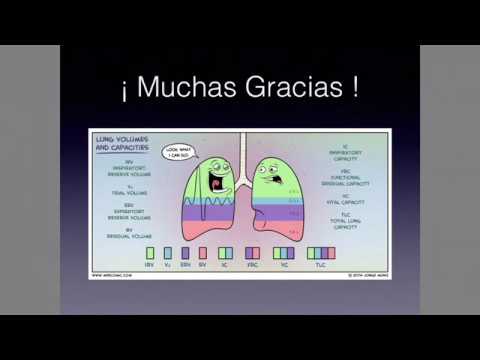
- Inspiratory reserve volume (IRV) is the additional air that can be inhaled after a normal inspiration. It is about 3000 milliliters.
- Expiratory reserve volume (ERV) is the additional air that can be exhaled after a normal expiration. It is approximately 1100 milliliters.
- Residual volume (RV) is the air remaining in the lungs after maximum expiration. It cannot be accessed voluntarily.
Lung Capacities
- Capacities are derived from the sum of different lung volumes.
- Inspiratory capacity (IC) is the sum of tidal volume and inspiratory reserve volume (IRV), totaling around 3500 milliliters.
- Functional residual capacity (FRC) is the sum of expiratory reserve volume (ERV) and residual volume (RV), amounting to approximately 3200 milliliters.
- Vital capacity (VC) represents the maximum amount of air a person can exhale after a maximum inhalation. It includes inspiratory reserve volume (IRV), tidal volume, and expiratory reserve volume (ERV). VC averages around 4600 milliliters.
- Total lung capacity (TLC) is the maximum volume of air the lungs can hold, including residual volume (RV). It is approximately 5800 milliliters.
Other Important Volumes
- Minute respiratory volume is the product of respiratory rate and tidal volume. A normal value is around 6 liters per minute.
- Dead space volume refers to the air that enters the body but does not participate in gas exchange. It can be divided into alveolar dead space and anatomical dead space.
- Alveolar dead space represents air that reaches the alveoli but does not undergo gas exchange due to factors like membrane integrity or lack of blood supply.
- Anatomical dead space refers to air that does not reach the alveoli and remains trapped in the upper respiratory tract.
Remember to refer to the video for a visual representation and further details on these concepts.
Conclusion
This section concludes the video by summarizing key points discussed, encouraging viewers to ask questions, and providing additional resources for reference.
- The video covered volumes and capacities related to lung function, which are crucial for understanding respiratory physiology.
- It highlighted various volumes such as tidal volume, inspiratory reserve volume, expiratory reserve volume, and residual volume.
- Capacities were also explained, including inspiratory capacity, functional residual capacity, vital capacity, and total lung capacity.
- Other important concepts mentioned were minute respiratory volume and dead space volume.
- For any doubts or questions, viewers are encouraged to leave comments on the video.
- Additional resources from Medcom are provided for further study.
Please refer to the video for a comprehensive understanding of these topics.