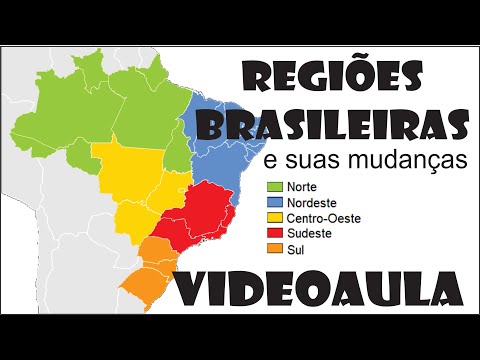
Regiões Brasileiras | Mudanças nas divisões
Understanding Brazilian Regions
Overview of Brazil's Territorial Diversity
- The Brazilian territory is extensive, fostering natural and cultural diversity across the country. Each of the five regions is formed by federative units that share similarities in natural, economic, and cultural aspects.
Factors Influencing Regional Differences
- Variations in land surface result from numerous factors that reflect how natural phenomena occur and how human societies occupy and organize space. Understanding these differences is crucial for studying regional characteristics.
Importance of Regional Divisions
- To differentiate spaces within a territory and establish boundaries, studies are necessary to identify environmental, social, and economic aspects that characterize each region. This division into smaller parts is essential for effective governance.
Evolution of Regionalization in Brazil
- The official regionalization by IBGE has undergone several changes over time to better represent the country's reality as both population and territory evolve. Historical maps illustrate these shifts in political divisions since the 1940s.
Changes Over Time
- Significant alterations have occurred in regional classifications; for instance:
- The Center-West region was not recognized until later.
- States like Rio de Janeiro shifted from South to West.
- Maranhão and Piauí transitioned from North to Northeast since 1970.
Historical Context of Regional Divisions
Official Division Established in 1970
- Since 1970, Brazil has been divided into five main regions: North, Northeast, Center-West, Southeast, and South. This division reflects significant political changes post-1988 Constitution which further solidified this structure.
Alternative Regionalizations
- Besides IBGE's classification, other researchers have proposed different regional frameworks:
- In 1967, geographer Pedro Jeide categorized Brazil into geoeconomic regions based on social and economic criteria.
- Notably identified three areas: Northeast (low development), Amazon (rich natural resources), Center-South (urbanized with developed economy).
Developmental Insights
- The Northeast has seen improvements despite historical low development levels.
- The Amazon's rich biodiversity influences its economy primarily through extractive activities.
- The Center-South stands out as the most urbanized area but also faces significant social inequality challenges.
This structured summary provides a comprehensive overview of the key concepts discussed regarding Brazilian regions while linking back to specific timestamps for easy reference during study or review sessions.