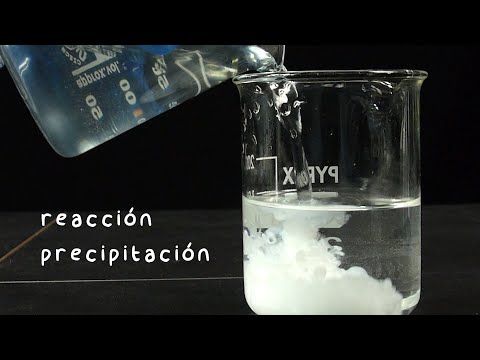
Experimento de Química. Reacción de Precipitación de Hidróxido de Calcio
Chemical Reaction Experiment: Calcium Chloride and Sodium Hydroxide
Introduction to the Experiment
- The presenter introduces himself as Simón and outlines the experiment involving a chemical reaction between calcium chloride and sodium hydroxide in an aqueous medium.
- He mentions the specific quantities used: 11.1 grams of calcium chloride and 8 grams of sodium hydroxide, explaining that these amounts will be clarified later.
Dissolution Process
- Upon mixing calcium chloride with water, an exothermic reaction occurs, releasing heat; the temperature rises to 30.9°C.
- Similar thermal effects are observed when dissolving sodium hydroxide, which raises the temperature to 36.2°C; caution is advised due to vapor release during large-scale reactions.
Precipitation of Calcium Hydroxide
- Mixing both solutions results in a beautiful precipitation of calcium hydroxide (also known as slaked lime), which initially remains suspended before settling at the bottom over time.
- The presenter prepares to filter out the liquid phase using a Buchner funnel setup connected to a vacuum source for efficient filtration.
Filtration Setup
- A detailed description of the filtration apparatus is provided, highlighting its design differences from standard setups for better suction capabilities.
- The filtering process begins with gravity filtration enhanced by suction; distilled water can be used for washing.
Final Product Handling
- After filtration, both precipitated and dissolved forms of calcium hydroxide are obtained; precautions against CO2 exposure are discussed since it reacts with calcium hydroxide to form calcium carbonate.
- The presenter demonstrates how to dry the product using a vacuum desiccator while explaining its components and functionality.
Drying Process Explanation
- Observations on how atmospheric pressure aids in maintaining vacuum conditions within the desiccator are shared; this prevents air from entering during drying.
- A diaphragm pump is utilized for creating a gentle vacuum suitable for drying without risking contamination from water vapor.
Conclusion and Applications
- Once dried, calcium hydroxide can be stored properly or dissolved in water to create limewater for further experiments like CO2 detection in educational settings.