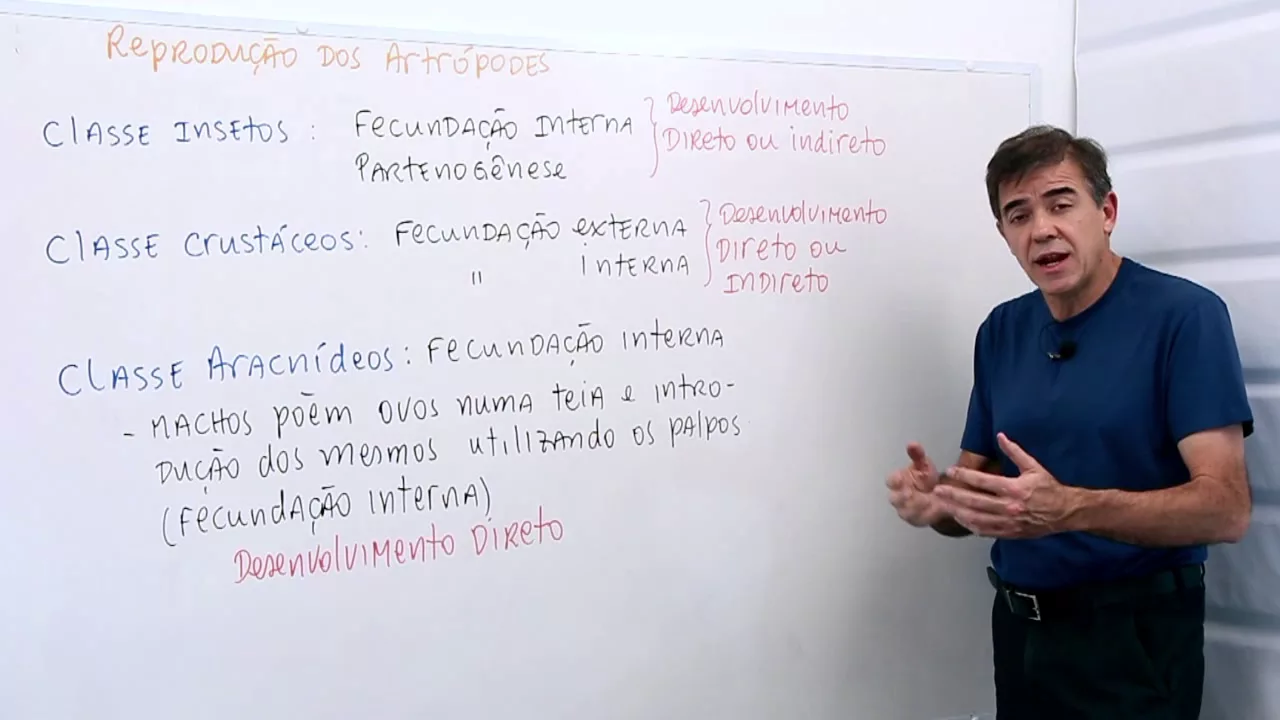
Reprodução dos artrópodes
Reproduction in Arthropods
Overview of Arthropod Classes
- Professor Heitor discusses the classification of arthropods into five classes, highlighting three main groups: insects, crustaceans, and arachnids. Other less significant groups include centipedes and millipedes.
Insect Reproduction
- The most numerous group among arthropods is insects, which exhibit internal fertilization as an adaptation to terrestrial life. This allows them to reproduce without relying on water.
- Insects can have either direct or indirect development; direct development results in offspring resembling their parents, while indirect development involves a larval stage.
Crustacean Characteristics
- Crustaceans are primarily aquatic but include some terrestrial species like the garden pill bug (often confused with a mammal).
- They typically engage in external fertilization, releasing gametes into the water. However, some species practice internal fertilization by copulating and depositing eggs within the female.
Development Patterns in Crustaceans
- Crustacean development can also be direct or indirect; for example, crabs undergo direct development from eggs while shrimp may have multiple larval stages before reaching maturity.
Arachnid Reproduction
- Arachnids such as spiders commonly exhibit internal fertilization. Males transfer sperm using specialized appendages and females store it until they lay eggs.
- Spiders typically do not have a larval stage; instead, they hatch directly into juvenile forms that resemble adults.
Unique Reproductive Strategies