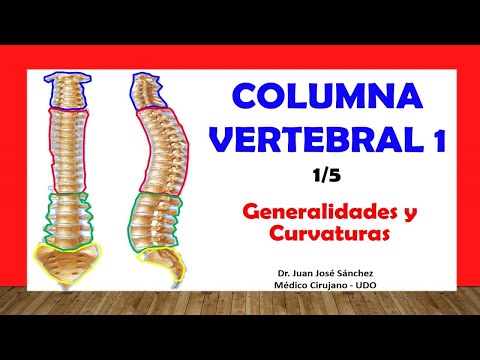
🥇 COLUMNA VERTEBRAL 1/5 - Generalidades, Curvaturas. Fácil y Sencillo
Introduction to the Vertebral Column
In this section, Juan José Sánchez introduces the topic of the vertebral column and its importance in anatomy. He explains that the vertebral column is a long structure that provides support and flexibility to the body. It also houses and protects the spinal cord.
Generalities of the Vertebral Column
- The vertebral column is a support structure that allows us to stand upright.
- It consists of a series of bones called vertebrae.
- There are 24 presacral vertebrae, which are divided into three groups: cervical (7 vertebrae), thoracic (12 vertebrae), and lumbar (5 vertebrae).
- The sacrum bone, formed by the fusion of five vertebrae, is also considered part of the vertebral column.
- The coccygeal bone, formed by the fusion of four vertebrae, is another component of the vertebral column.
Curvatures of the Vertebral Column
- The vertebral column has natural curvatures that contribute to its flexibility and weight-bearing capacity.
- There are four main curvatures: cervical lordosis (concave anteriorly), thoracic kyphosis (convex anteriorly), lumbar lordosis (concave anteriorly), and sacral kyphosis (convex anteriorly).
- These curvatures help distribute weight evenly along the spine and maintain balance.
Conclusion
The introduction provides an overview of the vertebral column as a support structure for standing upright. It highlights the different groups of presacral vertebrae and their respective curvatures. Understanding these generalities sets a foundation for further exploration into specific characteristics and functions of each group in subsequent videos.
New Section
The transcript discusses the lumbosacral angle and the different curvatures of the spine, including primary and secondary curvatures. It explains how these curvatures are formed and their importance for spinal function.
Lumbosacral Angle
- The lumbosacral angle refers to the curvature of the spine when viewed from a lateral (side) perspective.
- The spine is not completely straight but has a curvature, which serves as a spring-like mechanism for damping.
- The lumbosacral angle is part of the primary curvatures, which include the dorsal and sacral curvatures.
- These primary curvatures are always concave forward or convex backward.
- They follow the same axis of curvature as in the embryonic stage.
Primary Curvatures
- Primary curvatures consist of the dorsal (thoracic) and sacral curvatures.
- They are concave forward or convex backward in shape.
- These primary curvatures are called so because they follow the same axis of curvature as in embryonic development.
Secondary Curvatures
- Secondary curvatures consist of cervical (neck) and lumbar (lower back) curvatures.
- They are interspersed with primary curvatures, creating an alternating pattern.
- Secondary cervical and lumbar curves are concave posteriorly but convex anteriorly.
Formation of Curvature
Primary Curvature Formation
- The primary curvature formation is due to differences in vertebral body shape.
- Vertebral bodies have a wedge-like shape, with shorter anterior parts and taller posterior parts.
- When stacked together, this creates a forward concavity in the spine.
Secondary Curvature Formation
- The secondary curvature formation is due to differences in intervertebral disc thickness.
- Intervertebral discs are thicker in the anterior part than the posterior part.
- When stacked together, this creates a convexity in the front and concavity in the back of the spine.
New Section
The transcript continues to explain how secondary curvatures are formed and their significance. It also discusses the importance of these curvatures for spinal stability.
Formation of Secondary Curvature
- Secondary curvatures, such as cervical and lumbar curves, form after birth.
- Cervical curvature forms when a child raises their head, while lumbar curvature forms when a child can stand up.
- These curvatures stabilize the spine under load and are called secondary because they develop after birth.
Significance of Secondary Curvature
- Secondary curvatures help counteract each other and function as a spring mechanism.
- The cervical curvature supports the weight of the head, while the lumbar curvature stabilizes an upright posture.
Importance for Spinal Function
- The different curvatures of the spine play a crucial role in its overall function.
- Primary and secondary curvatures allow for shock absorption, flexibility, and stability during movement.
New Section
The transcript delves into further details about primary and secondary curvatures. It explains how vertebral body shape contributes to primary curvature formation and how intervertebral disc thickness influences secondary curvature formation.
Primary Curvature Formation
- Primary curvatures, such as dorsal (thoracic) curve, result from differences in vertebral body shape.
- Vertebral bodies have a conical or wedge-like shape with shorter anterior parts and taller posterior parts.
- This physical characteristic causes primary curvatures to adopt a forward concave shape.
Secondary Curvature Formation
- Secondary curvatures, such as cervical (neck) and lumbar (lower back) curves, form due to intervertebral disc thickness.
- Intervertebral discs are thicker in the anterior part than the posterior part.
- This difference in disc thickness leads to a convexity in the front and concavity in the back of secondary curvatures.
Importance of Vertebral Body and Disc Shape
- The shape of vertebral bodies and intervertebral discs is essential for maintaining proper spinal curvature.
- Differences in shape contribute to the formation of primary and secondary curvatures, allowing for optimal spinal function.
New Section
The transcript concludes by summarizing how primary and secondary curvatures are formed based on vertebral body shape and intervertebral disc thickness. It emphasizes the importance of these curvatures for spinal function.
Formation of Primary Curvature
- Primary curvatures, such as dorsal (thoracic) curve, result from differences in vertebral body shape.
- Vertebral bodies have a conical or wedge-like shape with shorter anterior parts and taller posterior parts.
- This physical characteristic causes primary curvatures to adopt a forward concave shape.
Formation of Secondary Curvature
- Secondary curvatures, such as cervical (neck) and lumbar (lower back) curves, form due to intervertebral disc thickness.
- Intervertebral discs are thicker in the anterior part than the posterior part.
- This difference in disc thickness leads to a convexity in the front and concavity in the back of secondary curvatures.
Importance for Spinal Function
- The different curvatures of the spine play a crucial role in its overall function.
- Primary and secondary curvatures allow for shock absorption, flexibility, stability during movement, and support an upright posture.
New Section
In this section, the speaker discusses different types of spinal curvatures and their names.
Types of Spinal Curvatures
- Pathological situations can cause accentuation of primary curvatures in the anteroposterior or laterolateral direction.
- Kyphosis refers to an accentuation of the dorsal column, commonly known as a hump or buffalo hump.
- Lordosis is an accentuation of a secondary curvature, more commonly seen in the lumbar region. It is normal for pregnant women and individuals with achondroplasia (dwarfism) to have lumbar lordosis.
- Scoliosis occurs when there is a lateral deviation of the spine. It can be structural or due to bad posture.
- Scoliosis can occur in different parts of the spine, such as thoracic scoliosis (involving dorsal vertebrae), lumbar scoliosis, or cervical scoliosis.
New Section
In this section, the speaker continues discussing scoliosis and its occurrence in developing women.
Scoliosis in Developing Women
- Scoliosis can be either structural or due to bad posture.
- Structural scoliosis refers to a deviation of the spine towards any side.
- Scoliosis can occur at different levels of the spine - thoracic (dorsal vertebrae), lumbar, or cervical.
- It is common for developing women to experience scoliosis.
The transcript does not provide further information beyond this point.
Turn any video into a summary like this
YouTube links, meetings, lectures. With transcripts, search, and chat.