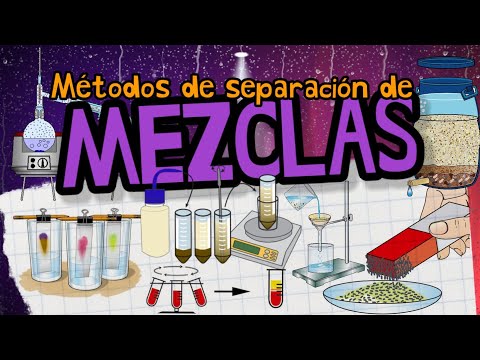
MÉTODOS DE SEPARACIÓN DE MEZCLAS⚡fácil y sencillo con ejemplos prácticos
Methods of Separating Mixtures
Introduction to Separation Methods
- The discussion begins with an overview of separation methods, also known as phase separation methods, which are physical procedures that allow the separation of components in a mixture while retaining their identity and chemical properties.
Overview of Separation Techniques
- A list of various separation methods is provided: evaporation, crystallization, distillation, chromatography, sedimentation, decantation, filtration, centrifugation, and magnetization. The speaker encourages active participation by repeating these methods aloud for better retention.
Evaporation
- Evaporation is explained as a method to separate homogeneous mixtures consisting of solid and liquid components. It involves heating the mixture until all liquid transitions to gas; for example, sea salt is obtained through this process where water evaporates under high vacuum conditions.
- During evaporation for sea salt production, water boils at 100°C (212°F), leading to visible salt crystals forming as the water vapor recycles back into the environment. This process highlights the hydrological cycle's role in nature.
Crystallization
- Crystallization is introduced as a method used primarily to separate solids from liquids in homogeneous mixtures by cooling after partial solvent evaporation. An example given is sugar dissolved in water; crystallization prevents caramel formation by allowing pure sugar crystals to form instead.
- The resulting sugar crystals exhibit well-defined patterns that can be visually confirmed by examining them closely. This emphasizes the importance of crystallization over simple evaporation when dealing with substances like sugar.
Distillation
- Distillation is described as a technique for separating homogeneous mixtures between liquids or even separating liquids from solids based on boiling points—water boils at 100°C while alcohol boils at 78°C. This method involves both evaporation and condensation processes to recover both liquid and solid components effectively.
- In distillation equipment setup, substances are heated until they reach their boiling point; then vapors condense back into liquid form in a separate container—this allows recovery without loss unlike simpler methods such as evaporation alone.
Chromatography
- Chromatography serves as a method for separating homogeneous mixtures with multiple dissolved components interacting across two phases: mobile (active) phase and stationary phase. An illustrative example involves using filter paper colored green (stationary) and alcohol (mobile) to demonstrate how colors separate based on movement speed through porous media over time.
- This technique proves valuable in fields like medicine and biology for identifying component interactions within complex mixtures due to its effectiveness in visualizing separations clearly over time during experiments involving color pigments or other compounds.
Sedimentation
- Sedimentation is discussed next as a natural method for separating heterogeneous mixtures involving solids suspended in liquids through gravitational force acting on different densities within the mixture—heavier particles settle at the bottom over time due to gravity's influence while lighter ones remain suspended above them until removed manually or via other means if necessary.
Separation Methods in Chemistry
Sedimentation and Decantation
- Sedimentation Process: When a mixture of water and sand is left undisturbed, larger sand particles settle at the bottom, leading to a clear separation of phases. This process is known as sedimentation.
- Decantation Overview: Decantation is used to separate heterogeneous substances with different densities. It can be performed in two ways:
- Solid-liquid decantation (solid elements in a liquid).
- Liquid-liquid decantation (two immiscible liquids like oil and water).
- Decantation Procedure: For effective decantation, the mixture must rest until the denser component settles. The densest part can then be extracted using a separating funnel.
Filtration
- Filtration Method: Filtration separates heterogeneous mixtures where an insoluble solid is present in a liquid. A porous filter paper allows only the liquid to pass through while retaining solid materials.
- Applications of Filtration: This method is simple and cost-effective, also applicable for separating solids from gases, such as filters in cars that prevent contamination.
Centrifugation
- Centrifugation Explained: Centrifugation separates solids from liquids or liquids from each other based on density differences by rapidly spinning them in a centrifuge.
- Practical Examples: Commonly seen in washing machines during drying cycles; also used in biology/medicine to separate components like fat from milk or blood cells from serum.
Magnetization
- Magnetization Technique: This method separates magnetic materials from non-magnetic ones within heterogeneous mixtures. It involves using magnets to attract magnetic components away from non-magnetic substances.