ICT Precision Trading Concepts - 1
Introduction
The video series will cover specific concepts on how to implement price action in trading and gain consistency. This volume focuses on weekly order blocks and order flow.
ICT Order Blocks
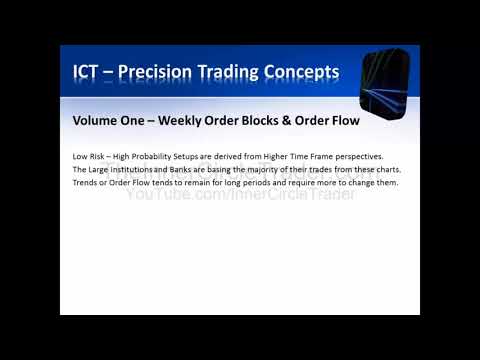
The ICT order blocks are found on all time frames, but the weekly charts are often overlooked. Utilizing the weekly order blocks and order flow can direct attention to low-risk, high-probability setups derived from higher time frame perspectives.
- Large drawdowns and busts are common among retail traders.
- A clear, concise plan of action removes uncertainty for new traders.
- Adopting a mindset that looks at charts with this concept in mind can lead to a whole new level of trading.
- Large institutions and banks base the majority of their trades on higher timeframe analysis.
Higher Timeframe Analysis
Large institutions and banks base the majority of their trades on higher timeframe analysis.
- Weekly charts provide liquidity for large orders.
- Professional-minded traders look for opportunities to buy at wholesale prices and sell at retail prices.
- Smart money leaves tell-tale signs and fingerprints in charts that they have participated in a specific move.
- The Inner Circle Trader Scout Sniper Field Guide Series identifies these signs.
Implementing Three Components to Your Trading
In this section, the speaker discusses how implementing three components in your trading analysis can lead to stunning results. The three components are understanding the market, price movement, and when to trade.
Key Points:
- Understanding the market is crucial for successful trading.
- Knowing when price should be moving is important.
- Human error will always plague trading regardless of how concise a trader's plan is.
Trends and Order Flow on Weekly Charts
In this section, the speaker talks about trends and order flow on weekly charts and how they tend to remain for a long period of time.
Key Points:
- Trusting directional bias based on weekly charts can benefit traders of all types.
- Majority of textbooks do not comment on the importance or utilization of weekly charts.
- It takes a long time for specific trades to set up on weekly charts but there is a specific understanding once you adopt it.
Importance of Weekly Charts
In this section, the speaker emphasizes the importance of weekly charts in trading and how they can provide insight into what smart money is doing.
Key Points:
- Weekly charts are not just useful for long-term position traders.
- Smart money's actions can be understood by analyzing weekly charts.
- Learning from consistently profitable traders can help improve one's own trading skills.
Blind Luck vs. Consistency in Trading
In this section, the speaker talks about his personal experience with blind luck in trading and emphasizes that consistency is key.
Key Points:
- Making money right away as a new trader may trick you into thinking you're smarter than you really are.
- Consistency in trading is achieved by learning from successful traders and implementing their strategies.
- Blind luck can only take a trader so far, but consistency leads to long-term success.
Understanding the Fundamentals of Trading
In this section, the speaker discusses how he approaches trading and why he believes in his methods.
The Speaker's Approach to Trading
- The speaker trusts that he is limited in his capacity to understand the fundamentals behind market moves.
- The speaker combines his personal approach to trading with central tenants in the marketplace that are inherently generic and repeat over and over again.
- The speaker warns against quitting a job to trade full-time without first having a clear and concise approach to trading.
Advantages of Having a Clear Approach
- Having a clear approach stacks the odds in your favor and lessens the likelihood of going bust.
- It is important to have money management training and not risk too much on trades, even if they seem promising.
Final Thoughts
- Consistently taking money out of the marketplace is key, and having a specific concept for what you're looking for when analyzing charts can help achieve this goal.
Understanding Market Direction and Support/Resistance Levels
In this section, the speaker explains that small moves in the market may not be significant for longer-term trading strategies. He also discusses how to determine support and resistance levels.
Importance of Directional Premise
- Small moves in the market may not be significant for longer-term trading strategies.
- Waiting for a setup to come to you is better than chasing minor moves in the marketplace.
Fundamentals vs Price Action
- Understanding fundamentals behind market moves is important but not necessary for successful trading.
- Trusting price action can provide all necessary information about the marketplace.
Using EMAs on Weekly Timeframes
- Applying 9 and 18 EMA on weekly charts can assist in higher odds order flow and order blocks.
- A bullish condition on a weekly timeframe is indicated when the 9 EMA is greater than the 18 EMA, opening up and pointing up. Conversely, a bearish condition is indicated when the 9 EMA is below the 18 EMA, opening up and pointing down.
Trading with a Professional Mindset
In this section, the speaker discusses how to trade with a professional mindset by focusing on the strongest and most likely tendency to move higher or lower based on the timeframe. By doing so, traders can remove emotion and fear from their trades.
Focusing on Direction and Buying/Selling
- Traders should focus on direction and whether they are predominantly buying or selling.
- Having this in their arsenal of tools will help them remove emotion and fear from their trades.
- Traders should not be scared if they find a daily order block to be a buyer when everything is moving higher.
- By trading with a professional mindset, traders can have weekly order flow, weekly order blocks, daily order blocks all in favor of their trades.
Using EMAs on Weekly Timeframe
- The speaker discusses the advantageous nature of having EMAs on a weekly timeframe.
- This helps traders stay focused on where the fundamentals are driving price and where momentum is continuously pushing behind the marketplace.
- By waiting for the market to come to them instead of chasing it, traders can maximize low-risk high-probability entry points.
Consistency and Precision
- Trading in line with this view will greatly increase the likelihood of consistency and precision.
- It takes time to learn these concepts, expect at least six months for growth period.
- Hindsight and back-testing are great but applying it is an altogether different animal when putting money or even demo account or pride on the line placing trades based on these concepts.
Dealing with Probabilities
- Traders must understand that they are dealing with probabilities rather than certainties when trading.
- There is no guarantee that traders will make money consistently; there's only a guarantee that if they're wrong, they will lose money.
- Traders must have an understanding of what they are doing and not grossly abuse leverage to avoid emotionalism, fear, and greed.
Understanding Unique Results
In this section, the speaker discusses how results in trading are unique to each individual and why it's important not to compare oneself to others.
Uniqueness of Results
- Everyone has completely unique results in trading.
- Comparing oneself to others is not helpful as we are all uniquely different.
- Improvement comes from consistently judging one's development against how they were the day before.
Judging Your Development
In this section, the speaker emphasizes the importance of judging one's development against themselves rather than comparing themselves to others.
Comparing Yourself to Others
- Don't judge your development against the mentor or teacher.
- Judge your development against how you were the day before.
- Consistently doing this will lead to improvement over time.
Analyzing a Weekly Chart
In this section, the speaker analyzes a weekly chart for EUR/USD and explains how to use moving averages as a tool for identifying market conditions.
Using Moving Averages
- The 9 and 18 period exponential moving averages can be used as tools for identifying market conditions.
- When the 9 is above the 18 on a weekly chart, it indicates a bullish market condition.
- A crossover between the two averages must occur before considering a change in market condition.
- Stacking of averages indicates that they are trending in the same direction and opening up, which qualifies as a bullish market condition on higher time frames.
Applying Information from Weekly Chart Analysis
In this section, the speaker demonstrates how information from analyzing a weekly chart can be applied when looking at order blocks.
Applying Weekly Chart Analysis
- When the averages are opening up, color the area to indicate a bullish market condition.
- Use this information when looking at order blocks to filter out uncertainty and identify potential trading opportunities.
The Benefit of Studying in Hindsight
In this section, the speaker emphasizes the importance of studying past market trends and how it can benefit traders in the future.
Studying Past Market Trends
- Studying past market trends can provide valuable insights for future trading decisions.
- It's important to not discount past market trends and to learn from them.
Orchestration of Tools for Trading Success
In this section, the speaker discusses how using a combination of tools together can lead to successful trading outcomes.
Using Tools Together
- It's not just about using individual tools, but rather how they are used together that leads to success.
- Combining different tools can help build a confluence of ideas that will hopefully materialize into profitable trades.
Analyzing Market Trends on a 4-Hour Chart
In this section, the speaker breaks down market trends on a 4-hour chart and explains what traders should be focusing on.
Focusing on Weekly Bullish Order Flow
- Traders should focus on weekly bullish order flow when analyzing market trends.
- Understanding order blocks is crucial when identifying institutional sponsorship in the marketplace.
Identifying Potential Trades with Order Blocks
In this section, the speaker explains how to identify potential trades by looking at areas where price action has shown potential to bounce.
Using Order Blocks to Identify Trades
- By understanding order blocks, traders can identify potential trades when price drops back down into an area of order block.
- Traders should focus on consistently profitable setups over a long period of time rather than cherry-picking the best trades.
Removing Indicators and Focusing on Price Action
In this section, the speaker explains why it's important to remove indicators and focus solely on price action when analyzing market trends.
Focusing on Price Action
- Traders should remove indicators and focus solely on price action when analyzing market trends.
- By having a clear understanding of weekly bullish order flow, traders can identify potential buys when price drops down into a one-hour order block.
Euro and British Pound Trading Strategy
In this section, the speaker discusses a trading strategy for the euro and British pound.
Key Points:
- The speaker recommends being a buyer if trading in the euro.
- There is an area of consolidation with support and resistance levels.
- The price rallies up and comes back down to an old high before rallying off again.
- The market is inside a bullish weekly order flow, so it's important to focus on big picture events.
- Smart money buys in down markets and sells in up markets. This can be applied to candlesticks to anticipate market moves higher.
- There are precise areas of bullish order blocks inside of larger weekly order flows that present opportunities for buying.
- Pay attention to dates at the bottom of the chart as these setups present themselves multiple times.
- When there is accumulation of positions inside an order block within a weekly bullish order flow, it indicates that the level will likely hold as a support level without being violated.
Understanding Support Levels
In this section, the speaker explains how support levels around an order block should be maintained and respected in a bullish market.
Identifying Solid Support Lines
- The support level identified around the order block is expected to be solid and maintain price above it.
- Order blocks on the bullish side of the marketplace are being respected greatly, resulting in huge moves with short amounts of time going higher.
Importance of Investigating Market Behavior
- Investigating what's being respected in the market on a daily basis is crucial for traders.
- Even if you're a day trader, going against the grain by shorting when there are bullish order blocks on multiple charts being respected is not worth it.
Developing Patience as a Trader
- Patience is honed by not doing anything and waiting for market participants to line up for the next move going higher with a bullish order block inside this weekly order flow that's bullish.
- Waiting for better deals on buying opportunities can lead to better profits than buying at inflated prices.
Pure Naked Trading Approach
In this section, the speaker emphasizes pure naked trading approach without any indicators or Fibonacci.
Price Action Alone
- The inherent nature of price behavior repeats over and over again, making it important to focus solely on price action alone.
- Professional traders avoid cherry-picking charts and instead focus on identifying what they're looking for while they're looking for it.
Identifying Support and Resistance Levels
- The speaker shows how to classify and qualify a support level or resistance level using pure naked trading approach.
- Price comes down rallies off sharply, making it important to identify the order block and add it to the high of the first bearish candle going right before the move began.
Understanding Higher Time Frame Order Flow
In this section, the speaker discusses how to use weekly order flow as a framework for determining where to buy or sell. By understanding higher time frame order flow and looking for order blocks in lower time frames, traders can limit their focus to one side of the marketplace and avoid being misled into thinking they need to be a bear.
Using Weekly Order Flow
- Traders should use weekly order flow as a framework for determining where to buy or sell.
- By limiting their focus to one side of the marketplace, traders can avoid being misled into thinking they need to be a bear.
Understanding Higher Time Frame Order Flow
- Understanding higher time frame order flow allows traders to look for order blocks in lower time frames that support buying.
- This approach helps traders make precise trades with confidence and perpetuates their equity curve to higher heights.
Precision in Trading
- The speaker emphasizes the importance of precision in trading and encourages viewers to go back through the Sniper series video if necessary.
- When looking at price charts, it's important to understand what they are communicating and why certain reactions occur at specific times of day.
Reading Price Charts Like Sheet Music
In this section, the speaker compares reading price charts with reading sheet music. He explains how he adopted his sniper persona because it makes perfect sense for him.
Reading Price Charts
- The speaker compares reading price charts with reading sheet music.
- Linda from Street-Smarts uses the marketplace as an analogy for reading musical notes.
- The speaker communicates using his adopted sniper persona because it makes perfect sense for him.
Importance of Focused Trading
In this section, the speaker emphasizes the importance of being focused and having a clear premise when trading.
Being Focused
- Traders should be completely focused on what they are doing, why they are doing it, and when they are doing it.
- A trader's analysis should be unmovable regardless of what anyone else says.
- When traders arrive at a level where they are completely confident and unshaken, losses will not affect them.
Timeframe for Trading
- The London close is a timeframe where traders expect things to happen.
- Traders should focus on specific trades at specific times of the day and days of the week (Tuesday, Wednesday, Thursday).
- It is not advisable to trade on Sundays due to low liquidity.
Qualifiers for Order Blocks
In this section, the speaker discusses qualifiers for order blocks and how to measure institutional buying.
Qualifiers for Order Blocks
- The speed at which price moves away from a level is a qualifier for order blocks.
- The time spent meandering around a level indicates minimal institutional buying.
Measuring Institutional Buying
- Institutional buying can be measured by looking at footprints in charts.
- Smart money leaves elephant footprints in charts.
Trusting Weekly Order Flow
In this section, the speaker emphasizes trusting weekly order flow and viewing every decline as a potential buying opportunity if it qualifies under time and price theory.
Trusting Weekly Order Flow
- Traders should trust that weekly order flow will stay intact.
- Every decline can be viewed as a potential buying opportunity if it qualifies under time and price theory.
Dovetailing of Order Blocks
- Daily, four-hour, or one-hour order blocks that are bullish can dovetail with weekly order flow.
- Understanding how these things start to dovetail is important for traders.
Incorporating the Spread
The speaker explains why it is important to incorporate the spread and how to develop an entry point for a particular setup.
Developing an Entry Point
- Always incorporate the spread when analyzing price structure.
- Look at the overall price structure from low to high to develop an entry point.
- Identify where a reaction is occurring, such as at the 135 big figure level.
Professional Trading vs Retail Trading
The speaker discusses how professional traders buy bargain pricing and how retail traders do not move the market.
Institutional Buying and Declining Markets
- Declines in bullish markets are not caused by retail sellers pushing the market lower. They are indicative of a lack of smart money buying.
- When prices drop in a bullish condition, it's not indicative of smart selling but rather a lack of institutional buying.
Paying Attention to Market Signals
- When you see declining markets in an overall bullish condition, this should be seen as a signal that institutional order blocks will soon appear.
Moving from Bearish Tone to Bullish Tone
The speaker explains how professionals expect markets to move higher even when they appear bearish.
Expecting Higher Prices
- Professionals expect markets to move higher even when they appear bearish, moving from a bearish tone to bullish tone.
- Look for institutional order blocks that indicate where prices will swing next.
Consolidation and Imbalance of Buys and Sells
- Dealers work both sides of a consolidation range, looking for an imbalance of buys and sells.
- The path of least resistance is where the most liquidity is, which is where prices will move to.
Hunting Bullish Order Blocks
In this section, the speaker discusses how to identify bullish order blocks and use them to make profitable trades.
Identifying Bullish Order Blocks
- A bullish order block is an area where price rallies up sharply and then comes back down into the previous bearish candle.
- These moves can be 50 pips or more and are opportunities to build a career on a one-shot, one-kill basis.
- Traders should not fear compounding their returns if they understand what they are doing. It takes 18 to 24 months of proper positioning and risk management to see significant numerical growth in an equity curve.
Consolidation and Stop Runs
In this section, the speaker discusses how to identify stop runs during consolidation periods.
Identifying Stop Runs During Consolidation
- When price rallies up sharply and starts consolidating, traders should look for where stops may be located.
- The next move will likely be aimed at running out participants or sucking them into a long period of correction.
- Traders should anchor protective stops at key levels such as lows during consolidation periods.
Bearish Candle as Bullish Order Block
In this section, the speaker discusses how a bearish candle can act as a bullish order block.
Using Bearish Candles as Bullish Order Blocks
- A bearish candle can act as a bullish order block if it has a big bold body with only a small wick.
- Price may dip down into the bearish candle before rallying off it again.
- Traders should focus on the bullish side of the market when there is weekly bullish order flow.
Identifying Bullish Order Blocks
In this section, the speaker discusses how to identify bullish order blocks and how they can be used to make profitable trades.
Bullish Order Blocks
- The speaker identifies a bullish order block that led to a 50-pip rally.
- Another bullish order block is identified that resulted in a 32-pip move.
- A nice bullish order block is found despite a sharp reversal and slam lower, resulting in 60+ pips.
- The previous high is running out as an area to take a trade with.
Trading Strategies
- The speaker advises not to get upset about missing out on certain moves and instead focus on finding small segments of the market place over and over again.
- Nobody catches every move, but traders only need a small segment of the marketplace that they can consistently go back to and harvest.
- The speaker emphasizes that aggressive moves higher are what traders should be hunting for, rather than short-term drops.
Examples of Bullish Order Blocks
- Several buying opportunities are presented through examples of bullish order blocks where price rallies off or drops back into them.
- Rapidly moving down towards an area where liquidity rests indicates there's a large pocket in that area because buyers did their buying there.
Understanding Order Blocks
In this section, the speaker explains how institutional investors' large interest in the market affects price movements and how retail traders can identify and use order blocks to make profitable trades.
Institutional Investors' Impact on Price Movements
- Institutional investors have a vast and large interest in the market.
- Their blocks are much larger than those of retail traders.
- As a result, when their orders are executed, price movements occur quickly.
Identifying Order Blocks
- Retail traders can identify order blocks by observing price movements on charts.
- Order blocks are areas where price has previously stalled or reversed.
- When these areas are revisited, they often act as support or resistance levels.
Using Order Blocks for Trading
- Retail traders can use order blocks to make profitable trades by placing buy or sell orders at these levels.
- When an order block is respected, it often leads to a rally or reversal in price movement.
Importance of Institutional Sponsorship
In this section, the speaker emphasizes the importance of institutional sponsorship behind price movements and explains why retail market traders cannot move the marketplace alone.
Institutional Sponsorship Behind Price Movements
- Institutional sponsorship is necessary for significant price movements in the market.
- Retail market traders do not move the marketplace alone.
Positioning with Institutional Investors
- Retail traders must position themselves on the heels and coattails of institutional investors to benefit from significant price movements.
- This requires having cash flow and understanding the brains behind the whole move.
Conclusion
The speaker concludes by summarizing key points discussed in previous sections and wishing listeners good luck with their trading endeavors.
Key Points Recap
- Understanding order blocks is crucial for identifying profitable trading opportunities.
- Institutional sponsorship is necessary for significant price movements in the market.
- Retail traders must position themselves with institutional investors to benefit from these movements.
Final Thoughts
- The speaker wishes listeners good luck and success in their trading endeavors.
Turn any video into a summary like this
YouTube links, meetings, lectures. With transcripts, search, and chat.