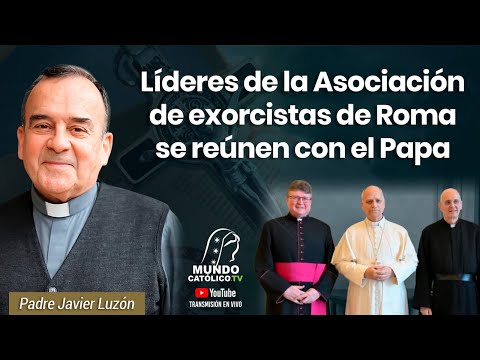
Líderes de la Asociación de exorcistas de Roma se reúnen con el Papa - P. Javier Luzón
Introduction and Invocation Opening Remarks
Greeting and Invocation
- The speaker expresses gratitude for the audience's presence and introduces Father Javier Luzón, who is present for the discussion.
- A prayer is recited, invoking the Holy Spirit to fill hearts with love and renew faith on Earth.
- The prayer concludes with a call for intercession from saints, including Santa María and San José.
Discussion of Papal Meeting Insights on Exorcism
Context of the Meeting
- The speaker mentions a recent meeting between the Pope and representatives from the International Association of Exorcists in Rome.
- This meeting was significant as it involved nearly 300 exorcist priests at their 15th International Congress, highlighting its importance in addressing spiritual warfare.
Key Messages from the Pope
- In a letter sent by Secretary of State Pietro Parolín, the Pope emphasized that the work of exorcist priests is crucial in combating evil today.
- The speaker notes that discussions during this meeting addressed issues often overlooked by church reforms since Vatican II, particularly regarding liberation and healing ministries.
Cultural References Importance of Addressing Spiritual Issues
Analogy through Film
- An analogy is drawn using a French film about cultural differences within a family to illustrate how certain topics are often avoided or omitted in discussions about faith.
- The film depicts a family's reaction to their daughter's choice of partner from different backgrounds, paralleling how difficult conversations about spirituality are often sidestepped.
Reflection on Evangelization
- The speaker emphasizes that just as personal truths cannot be omitted in relationships, neither can discussions about healing and liberation be ignored in evangelization efforts.
- There’s an urgent need to train more exorcists due to increasing societal issues related to occult practices as society becomes less Christianized.
The Role of Exorcism in Contemporary Spirituality
Eastern Spiritualities and Their Impact
- Discussion on Eastern spiritualities, particularly Hinduism and Buddhism, which are described as nihilistic and detrimental to humanity. The speaker suggests that these beliefs may be influenced by demonic forces.
Demand for Exorcists
- There is a significant increase in demand for exorcists globally, leading to many being overwhelmed. Exorcists have communicated this urgent situation to the Pope.
Pope Francis's Engagement with Exorcism
- Pope Francis is noted for his pastoral approach and has actively engaged in promoting the ministry of exorcism during his papacy. His background includes personal experiences with individuals needing help.
Institutional Support for Exorcism Ministry
- The Pope has encouraged bishops worldwide to establish exorcist positions within dioceses, emphasizing the need for proper training and formation of exorcists to effectively address spiritual issues.
Challenges in Training Exorcists
- A lack of preparation among clergy, especially within certain orders like the Augustinians, poses challenges. Many do not receive specialized training necessary for effective ministry in exorcism.
Global Context of Witchcraft and Demonic Influence
- In regions like Peru and Brazil, where witchcraft is prevalent, there is a notable neglect from bishops regarding the ministry of exorcism despite high levels of spiritual affliction reported.
Urgent Need for Preparedness
- The overwhelming demand for exorcisms highlights a critical gap in church readiness. Many dioceses still lack appointed exorcists despite an increasing number being named globally.
Importance of Proper Formation
- It’s essential that newly appointed exorcists receive comprehensive training beyond just attending annual meetings; they must learn from experienced practitioners to ensure effective practice.
Responsibility of Bishops and Associations
- Bishops hold primary responsibility for forming exorcists while also relying on support from associations dedicated to this ministry. Current efforts are insufficient as more structured training programs are needed.
This markdown file summarizes key discussions surrounding the role and challenges faced by the ministry of exorcism today, highlighting both institutional responses and individual experiences related to spiritual warfare.
Exorcism and the Role of Bishops
The Responsibility of Exorcists and Bishops
- An exorcist's failure to respond to individuals seeking help is a serious issue, highlighting the need for accountability from bishops who oversee these ministries.
- Bishops are ultimately responsible for the ministry of exorcism and must ensure that trained exorcists are available to assist those in need.
- Regular attention is crucial for individuals experiencing possession; they require weekly sessions to effectively combat demonic influences.
Treatment Frequency and Effectiveness
- Just as antibiotics require a specific dosage schedule, exorcisms must be conducted with regularity to weaken demonic forces effectively.
- Individuals with lesser forms of spiritual affliction should also receive treatment at least every two weeks, or weekly if symptoms intensify.
Training and Formation of Exorcists
- There is a pressing need for more trained exorcists across all dioceses, emphasizing the importance of proper formation under experienced mentors.
- Personal experiences shared by practicing exorcists reveal that hands-on training significantly enhances their confidence and effectiveness in dealing with cases.
Historical Context of Exorcism Ministry
- The church's restriction on who can perform exorcisms has led to confusion about the roles of priests involved in healing prayers versus designated exorcists.
- The decline in active participation in this ministry can be traced back to historical events where it became stigmatized due to associations with witch hunts during the Inquisition.
Modern Implications and Church Responsibilities
- Acknowledging the growing demand for spiritual assistance is essential; neglecting this responsibility could lead to severe pastoral failures.
- The church’s abandonment of certain practices over time has resulted in a lack of engagement with critical spiritual issues faced by believers today.
The Role of Exorcists in the Catholic Church
Authority and Power of Exorcists
- Only ordained ministers, including deacons, priests, and bishops, possess the authority to confront demons directly; laypeople can intercede through prayer but lack this power.
- There is a recognition among Pentecostal communities that Catholics hold unique powers in difficult cases involving demonic influence.
Demand for More Exorcists
- The need for more exorcists has been highlighted due to an increase in superstition and occult practices that require proper attention from trained individuals.
- Father Riperger's community exemplifies effective exorcism practices by combining prayer, fasting, and psychological analysis to address cases thoroughly.
Training and Formation of Exorcists
- A significant issue is the shortage of qualified exorcists; many current practitioners lack adequate training or support systems.
- Guidelines have been developed to assist exorcists with practical recommendations, emphasizing the necessity for ongoing education and mentorship.
Experience Sharing Among Exorcists
- Experienced exorcists often mentor novices, allowing them to learn through direct involvement over a short period while managing their caseload effectively.
- Continuous communication among global exorcist communities is crucial for sharing insights on handling specific cases and ensuring comprehensive care.
Challenges Faced by Current Exorcists
- There are complaints about some diocesan exorcists not responding adequately to requests for help or guidance from those seeking assistance.
- Criticism exists regarding the effectiveness of certain known figures within the field who may not be actively engaging with those in need.
Perspectives on Notable Figures
- Discussion includes Father Fortea's limited experience as an exorcist; he has written extensively but does not practice regularly as one would expect from a dedicated exorcist.
- Personal anecdotes reveal connections between speakers and notable figures like Father Fortea, highlighting differing views on theological interpretations related to demonology.
Discussion on Angels and Human Perception
The Nature of Angels
- The speaker warns against anthropomorphizing angels, emphasizing that their deterioration is not a gradual process like humans experience.
- Acknowledges differing opinions on intergenerational salvation, asserting that God's justice allows for the existence of demons due to human sins.
Father Gortial's Role
- Clarifies that Father Gortial is not an official exorcist but a demonologist who studies theology related to demons and has written extensively on the subject.
- Describes Father Gortial's work as a chaplain in a hospital near Alcalá, highlighting his experience and dedication despite disagreements on certain theological issues.
Exorcism Authority and Practice
Exorcism Assignments
- Explains that Father Gortial has performed exorcisms only when specifically authorized by a bishop for particular cases, rather than holding an official title as an exorcist.
- Notes that he has handled several cases over his career, especially during times when there were few others available to assist.
Meeting with the Pope
- Discusses the outcome of a meeting with the Pope regarding the need for more trained exorcists; it remains uncertain what actions will be taken next.
- Emphasizes the gravity of the situation concerning untrained exorcists and outlines proposals made to address this issue.
Historical Context of Exorcism in Church Councils
Vatican Council I Insights
- Provides historical context about Vatican Council I (1870), which was interrupted and never resumed, leaving many important discussions unresolved.
- Mentions Blessed Palao Iquer’s efforts to reinstate the ministry of exorcism during this council through his writings but notes no action was taken due to its abrupt end.
Impact on Future Councils
- Highlights how subsequent councils ignored topics like exorcism due to prevailing theological trends denying demonic existence influenced by Jewish Talmudic theology and Protestant thought.
- Points out that significant documents from Vatican II focused on other matters while neglecting essential themes such as sin, healing miracles, and casting out demons.
Theological Trends Affecting Exorcism Practices
Shift in Focus During Vatican II
- Critiques how discussions around exorcisms were dismissed during preparations for Vatican II due to contemporary theological influences rejecting traditional beliefs about demons.
Consequences for Evangelization Efforts
- Argues that excluding core practices like forgiveness of sins, healing miracles, and casting out demons from church teachings undermines genuine evangelization efforts.
New Evangelization and the Role of Sacraments
The Importance of Authentic Baptism
- The new evangelization emphasizes announcing and administering the forgiveness of sins, highlighting the need for genuine baptism initiation rather than superficial practices.
- There is a call for a more authentic approach to baptism, particularly for children of non-practicing parents, stressing that conversion must precede such sacraments.
Key Themes from Vatican II
- The first theme discussed is recovering Christian identity, which involves a call to holiness and specific responsibilities for bishops, priests, religious, and laity.
- Acknowledgment of living faith in a pluralistic environment is essential; this includes recognizing various Christian denominations and non-believers.
Pastoral Challenges Identified
- Three pastoral challenges are identified: education, the Church's role in contemporary society, and communication methods.
- To revitalize the Church, three key tools are proposed: improving biblical formation, renewing liturgy practices, and enhancing priestly training in seminaries.
Reforming Sacramental Rituals
- Discussion on reforms made to sacramental rituals post-Vatican II highlights that while many were updated in the 1970s, exorcism rituals lagged behind until 1998.
- The delay in reforming exorcism rituals reflects a broader reluctance within the Church to acknowledge spiritual warfare against evil forces.
Exorcisms by Clergy
- All priests and deacons have the authority to perform minor exorcisms during baptisms as part of their liturgical duties.
- Clergy can also exorcise sacramentals like water and oil; misconceptions exist about limitations on what can be exorcised.
Clarifying Misconceptions About Exorcism Practices
- Current rituals may not explicitly mention all objects that can be exorcised; however, traditional practices still apply under canonical law.
- Emphasis on understanding canon law suggests that if certain rites are omitted from newer texts, older formulas should still be utilized when necessary.
Discussion on Church Practices and Evangelization
Importance of Training in Church Norms
- The speaker expresses disappointment over the limited training provided to clergy regarding certain church norms, emphasizing that this lack of education is a shame.
- There is a call for the current Pope to take significant action, as many issues remain unresolved within his pontificate.
Recent Audience with the Pope
- The audience with the Pope was publicized widely, indicating its importance; however, it also highlights the need for further actions from the Vatican.
- A letter from Cardinal Parolín to an association of exorcists signifies a notable response from the Vatican regarding their discussions.
Resources for Understanding Current Challenges
- The speaker promotes "Las Seis Puertas," a book available online that discusses historical context and current challenges facing evangelization efforts.
- The book outlines how evangelization must adapt in terms of fervor, methods, expression, and addressing contemporary challenges.
Addressing Issues in Catechesis
- Concerns are raised about children receiving sacraments without proper Christian upbringing; parents' involvement is deemed crucial for authentic faith development.
- Recommendations are made for catechists to engage only in parishes where genuine Christian formation occurs before allowing children access to sacraments.
Practical Guidance and Support for Clergy
- Emphasis on adhering to canonical law when administering sacraments; baptizing children without parental support is viewed as contradictory.
- The speaker encourages priests to utilize resources like prayer guides available through "Las Seis Puertas" to enhance their ministry effectiveness.
Community Support and Resources
- Mention of extraordinary prayers included in "Las Seis Puertas" that can aid individuals seeking spiritual assistance or guidance.
- Encouragement for community members to reach out with questions about prayer practices, highlighting immediate support available through online resources.
Discussion on Liberation Prayers and Resources
Importance of Incorporating Liberation Prayers
- The speaker suggests including a book titled "Preces de liberación" in future writings, emphasizing its value as a resource for liberation prayers.
- The book contains traditional prayers that could be beneficial if reviewed and compiled into a manual for laypeople by the priest.
Role of Priests in Deliverance
- The speaker notes that while they can suggest prayers, their authority as a layperson may not carry weight; thus, having a priest endorse these prayers is crucial.
- Emphasizes the need for priests to have resources to guide both themselves and laypeople effectively in spiritual matters.
Practical Applications of Spiritual Practices
- Shares personal experience with using exorcised incense to combat an infestation, illustrating practical applications of spiritual advice from priests.
- Discusses the use of blessed oil at home as another method for protection and spiritual cleansing.
Collaboration Between Laity and Clergy
- Highlights the necessity for collaboration between clergy and laity in addressing spiritual needs within communities.
- Proposes distributing materials to all priests to enhance their understanding and ability to perform exorcisms or blessings effectively.
Training and Awareness Among Clergy
- Describes experiences at conferences where military chaplains expressed interest in learning about deliverance practices, indicating a gap in training among clergy.
- Shares an anecdote about how one experienced chaplain became aware of the potential impact of these practices after attending discussions on them.
Empowering Priests with Knowledge
- Relates an incident where a parish priest learned he had healing powers through prayer after witnessing miraculous recoveries during his ministry.
- Concludes with reflections on how many priests are unaware of their capabilities regarding healing and deliverance until they receive proper guidance.
Exorcism and the Role of Priests
The Power of Exorcism
- Don Carlos, a former vicar general turned exorcist, discusses the importance of understanding the power given to priests for healing and exorcism.
- When priests are educated about their abilities, they lose fear and can provide significant service to others.
Resources for Priests
- A priest expresses reluctance to perform an exorcism on items like salt or oil due to lack of belief in his ministry; however, it is emphasized that all priests have this capability.
- The speaker plans to send materials that could help priests understand how to use sacramentals effectively in their ministries.
Importance of Prayer in Various Professions
- The discussion highlights the need for protective prayers tailored for various professions such as police officers and doctors, emphasizing their daily challenges.
- Legal professionals are also mentioned as needing prayers that guide them towards justice and integrity in their work.
Awakening the Church's Ministry
- There is a call for revitalizing the church’s ministry of healing and liberation, which is deemed essential for supporting believers in maintaining their faith with dignity.
- The speaker stresses that many individuals act improperly due to ignorance about sacramentals, urging education on these spiritual tools.
Sacramentals and Their Usage
- Emphasis is placed on the Virgin Mary’s repeated messages regarding the use of sacramentals during her apparitions.
- Knowledge about oils used in rituals—how they work and what benefits they provide—is highlighted as crucial information that should be shared among clergy.
Final Thoughts on Supportive Resources
- The speaker expresses gratitude while reiterating the necessity for prayerful support towards church leaders like the Pope amidst challenges faced by them.
- Instructions are provided on how individuals can access resources online related to liberation prayers through specific websites.