Clase 06
Class 6 Overview and Key Concepts
Recap of Previous Class
- The class begins with a brief recap of the previous session, focusing on key concepts discussed.
- Emphasis is placed on the exercise involving vectors, specifically how to obtain an orthogonal vector to a segment.
Understanding Vector Cases
- Two important cases are highlighted:
- When the segment is diagonal, specific code was developed to calculate the vector.
- For horizontal segments, different instructions were necessary.
Instruction of Assignment and Selection
- The instructor notes that assignment instructions alone are insufficient; selection is often required based on conditions.
- A deeper exploration into selection instructions will be conducted in this class.
Clarifications on Function Definitions
Initial Function Interpretation
- An example function from the previous class is revisited, clarifying that all variables involved are real numbers.
- The instructor explains how variable declarations impact function interpretation.
Extending Domain and Handling Exceptions
- Discussion about extending the domain of functions to include all possible states, including zero.
- It’s noted that when zero occurs, it must be handled by redirecting to an abort state.
Concept of Stronger vs. Weaker Predicates
Predicate Strength Comparison
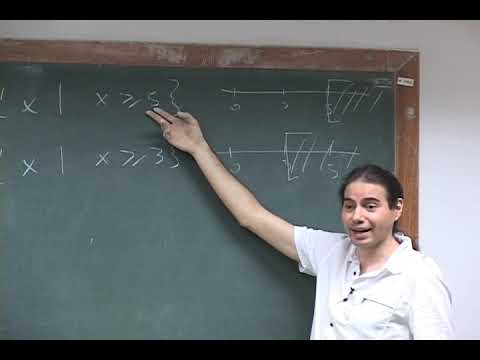
- An example illustrates stronger versus weaker predicates using numerical comparisons (e.g., x ≥ 5 vs. x ≥ 3).
Graphical Representation and Implications
- Graphical representation shows how one predicate restrictively defines a smaller set than another.
Logical Implications
- The discussion concludes with logical implications where stronger predicates imply weaker ones in terms of variable values.
Understanding Variable Comparisons and Set Theory
Comparison of Variables
- The speaker discusses the concept of comparing two variables, indicating that one variable is more restrictive (stronger) while the other is less so (weaker).
- A comparison is made between a single-variable expression and a two-variable expression, emphasizing the importance of understanding their respective domains.
Set Representation
- The discussion shifts to representing sets where certain conditions hold true, specifically focusing on ordered pairs.
- A graphical representation of the equation y = -x + 3 is introduced, illustrating how to visualize inequalities in terms of greater than or equal to.
Logical Comparisons
- The speaker explains how to compare expressions when one lacks a specific variable, leading to assumptions about the set being considered.
- It’s noted that if no variable appears in an expression, it can be assumed that any value for that variable is acceptable within defined constraints.
Exercises and Specifications
- The speaker transitions into discussing homework assignments related to specification exercises which define problems with preconditions and postconditions without requiring algorithms.
- Emphasis is placed on correctly defining constants and variables along with meaningful names for problems presented in assignments.
Demonstration Requirements
- An example problem requires students to demonstrate correctness through specified conditions; students are encouraged to use definitions they have learned throughout the course.
- Students are instructed on how to substitute values into equations as part of their demonstration process, ensuring they understand domain and range concepts.
Proving Conditions
- The first exercise involves substituting specific values into an equation and determining whether results fall within expected ranges based on defined functions.
- In subsequent parts of the exercise, students must prove similar conditions using fixed values without making assumptions about those values.
This structured approach provides clarity on key concepts discussed in the transcript while allowing easy navigation through timestamps for further exploration.
Understanding Generalization in Mathematical Proofs
The Concept of Generalization
- The speaker discusses the process of generalizing mathematical statements, emphasizing that once a proof is established for specific cases A and B, it can be generalized to "for all A and B."
- The importance of variable naming is highlighted; any variables can be used as long as they are consistently defined within the context of the proof.
- The definition of truth values in triples (precondition, code, post-condition) is explained through two stages: one without specification variables and one with them.
Importance of Definitions
- Understanding definitions is crucial for grasping future concepts. Revisiting foundational definitions aids comprehension and prepares students for more complex ideas.
- The speaker mentions a technique that simplifies understanding by first tackling problems in a straightforward manner before applying more advanced methods.
Algorithm Development for Triangle Calculation
Steps in Algorithm Creation
- Introduction to writing an algorithm specifically for calculating properties related to triangles, starting with a cold run validation.
- The first step involves calculating the height (H), using coordinates X1, Y1, X2, Y2 as part of the triangle's parameters.
Vector Calculations
- A second step includes calculating an orthogonal vector to the segment formed by the triangle's points.
- This orthogonal vector must then be adjusted or stretched to match the specified height H.
Final Steps in Algorithm Execution
- After determining the orthogonal vector's height and midpoint calculation between two points, this information is used to position elements accurately within the triangle structure.
- Instructions on how to compute these steps analytically are provided, including using vector addition for translation.
Running Through Example Cases
Cold Run Validation Process
- An example case is presented where calculations are performed step-by-step based on initial conditions set earlier in the discussion.
Detailed Calculation Breakdown
- Specific calculations involving coordinate differences and squaring results are demonstrated to illustrate how values evolve through each iteration.
Conclusion of Example Case
- Emphasis on analytical computation methods such as vector summation highlights practical applications within geometric contexts.
Mathematical Operations and Variable Changes
Initial Calculations
- The speaker begins by discussing a mathematical operation, specifically calculating 3 times 29, while deciding to avoid decimals for simplicity.
- The speaker notes that the only variables changing are x_3 and y_3, while all other values remain constant. They perform subtraction on two variables, resulting in 1 - 3 = -2 and y_1 - y_2 = 5.
Updating Variables
- The speaker reiterates that only x_3 and y_3 will change, writing down the unchanged values first. They calculate a new value for x_3.
- A division is performed between two previous states of variables with a negative sign, leading to a positive result of 2/5.
Further Adjustments
- The speaker mentions updating variable H based on previous calculations involving square roots of squared terms from earlier states.
- They confirm that the current state of certain variables remains unchanged as they proceed with their calculations.
Simplifying Expressions
- The speaker simplifies an expression to make it more manageable, equating it to 4/25. They explain how fractions can be manipulated under square roots.
- After simplification, they combine terms under one root, ultimately expressing it as 5 sqrt3.
Final Steps in Calculation
- The updated value for x_3, which was previously 1, is now multiplied by the simplified expression yielding an equivalent result.
- At this point in time (instant number seven), changes occur only in coordinates related to variables x_1, y_1. New averages are calculated for these coordinates.
Verifying Conditions for Equilateral Triangle
Summation of Coordinates
- As the program executes final steps, both x-coordinates are summed and divided by 2; similarly for y-coordinates. This results in new coordinate values necessary for forming an equilateral triangle.
Distance Calculation
- To ensure correctness in forming an equilateral triangle, distances between points are calculated using squared differences without extracting square roots initially.
Confirming Results
- The distance formula yields a result indicating successful verification: if both sides equal sqrt29, then conditions hold true.
Understanding Instruction Execution Order
Sequential Execution of Instructions
- The speaker discusses empirical observations regarding instruction execution order within programming syntax. Each instruction follows sequentially after semicolons.
Importance of Syntax
- Emphasizing syntax's significance, they clarify that semicolons indicate completion of one command before proceeding to another. This structure is crucial for proper program execution.
Understanding Binary Operators and Semantics in Programming
The Role of Semicolons in Programming Languages
- A binary operator is introduced, highlighting that the end of a program does not require a semicolon. Some programming languages use semicolons to terminate instructions.
- In GCL, the semicolon acts as a binary operator, indicating that the last instruction in a code block does not need one. This contrasts with variable declarations where it serves as a terminator.
- Python recognizes blocks through indentation rather than semicolons, allowing for more flexible coding styles compared to other languages that rely on this operator.
Instruction Sequencing and Code Structure
- Each instruction should be placed on separate lines for clarity; preconditions and postconditions are also formatted similarly in Python.
- Other programming languages may allow omitting line breaks, enabling entire programs to be written on one line, although this can reduce readability.
- Writing code without line breaks can save space but may lead to less human-readable formats.
Composing Functions and State Transitions
- The discussion transitions into function composition, emphasizing how sequential execution resembles composing functions where order matters (first one function then another).
- States are denoted using symbols (e.g., x with an arrow), illustrating how executing instructions leads from one state to another.
Understanding Function Composition
- The concept of function composition is reiterated: executing one function followed by another represents a transition between states.
- Mathematical notation for composition is discussed, clarifying which function executes first based on their placement (right or left).
Semantic Interpretation and Time Representation
- When assigning semantics to instructions, temporal aspects are often disregarded; only initial and final points are considered without detailing intermediate steps.
- The loss of information about intermediate steps when defining functions as ordered pairs is highlighted; this simplification removes any notion of time from the model.
Understanding Ordered Pairs and Control Structures in Programming
Definition of Ordered Pairs
- The concept of ordered pairs is introduced, emphasizing their role in defining relationships within programming structures.
- An ordered pair consists of two elements where the first element relates to a point in one set and the second element relates to a point in another set.
- It is suggested that for those less interested in formal definitions, they can consider ordered pairs as simply connections between starting and ending points without intermediate information.
Introduction to Skip Instruction
- The "skip" instruction is presented as a fundamental part of programming languages, functioning similarly to an identity function.
- When executed, the skip instruction does not alter the current state; it returns the same state immediately after execution.
Selection Instruction Overview
- A discussion on selection instructions highlights their importance in directing program flow based on conditions.
- The necessity for different code segments depending on specific conditions is emphasized, showcasing how certain code may only be applicable under particular circumstances.
Syntax of Conditional Statements
- The general syntax for conditional statements (if statements) is outlined: an expression must evaluate to a boolean value (true or false).
- Before executing any subsequent instructions, the program checks this boolean expression to determine which path of code will be executed next.
Understanding GCL Structure
- In GCL (Generalized Command Language), nested expressions are discussed, with emphasis on visual clarity when structuring code blocks.
- It’s noted that within GCL syntax, the last instruction inside an if statement does not require a semicolon, marking it as the end of that block.
Execution Flow in GCL
Understanding Conditional Execution
- The program executes a specific block of code if a condition is true, ignoring other parts. This leads to a jump in execution flow.
- If none of the conditions (guardians) are true, the program does not continue but aborts entirely, which is unique to GCL compared to other languages.
Differences with Other Languages
- In typical programming labs, if all conditions are false, the program simply skips to the next line without aborting.
- A single false condition in GCL results in an abortion of execution, contrasting with other languages where it would just skip.
Implementing Logic in GCL
- To replicate behavior from Python or similar languages in GCL, one must include logical expressions that complement existing conditions and use 'skip' for non-abort scenarios.
- The 'skip' command serves as a way to manage conditional guards without terminating the program.
Non-determinism in Programming
Evaluating Multiple Conditions
- When multiple guardians evaluate to true simultaneously, either can execute due to non-deterministic behavior inherent in GCL.
- This non-determinism allows for more complex programming structures that cannot be easily replicated in standard lab environments.
Example: Finding Maximum Value
Setting Up Variables
- The example begins by defining two constants (A and B), aiming to calculate their maximum value using a variable named 'max'.
Precondition and Postcondition
- No restrictions on values mean preconditions can be set as true; postconditions require that 'max' holds the highest value between A and B.
Logical Specifications
- Two cases arise based on comparisons: when A is greater than or equal to B and vice versa. Each case determines how 'max' will be assigned.
Implementation Strategy
- Using conditional selection statements allows for assigning values based on evaluations of A and B's relationship.
Logical Equivalence Demonstration
Proving Equivalence
- An exercise involves demonstrating logical equivalence between different conditional statements used within programming constructs.
Understanding Conditional Logic in Programming
Evaluating Conditions and Assignments
- The discussion begins with the concept of evaluating conditions, emphasizing that if one condition is true, another will be false, leading to the cancellation of certain statements.
- It highlights the importance of using assignment instructions rather than just conditional checks to ensure variables hold specific values at the end of a block.
- The speaker explains that omitting semicolons in certain programming languages indicates the end of a block, which is crucial for clarity when writing code on a single line.
Handling Ambiguities in Code
- The necessity of termination tokens is discussed as a means to resolve ambiguities in code structure, especially when written without indentation.
- The speaker stresses that understanding how to write clear conditional statements helps prevent confusion about which instructions belong together.
Understanding GSL (Guarded Selection Language)
- An explanation follows regarding GSL's unique approach to conditional logic where every 'else' must have an associated condition.
- The need for logical expressions that define negations within nested conditions is emphasized for proper execution flow.
Practical Application: Evaluating Values
- A practical example illustrates how programs evaluate numerical comparisons, such as determining if 3 is less than or equal to 4.
- Different scenarios are explored where variable values change outcomes based on their evaluations, demonstrating real-time decision-making in programming logic.
Finding Maximum Values Among Integers
- A new problem statement introduces finding the maximum value among three distinct integers (A, B, C), with results stored in variable D.
- The speaker outlines constraints necessary for solving this problem effectively while ensuring all numbers are different.
Utilizing Functions for Simplification
- A method for calculating maximum values using auxiliary functions is proposed as a way to simplify assertions and improve code readability.
- Emphasis is placed on constructing predicates through function calls instead of lengthy logical expressions.
This structured overview captures key insights from the transcript while providing timestamps for easy reference.
Understanding Permutations and Logical Conditions in Programming
Exploring Permutations
- The discussion begins with the concept of permutations, specifically how many discrete permutations exist for a set. The answer is one, as there are six possible arrangements (3 factorial).
- The speaker reflects on their previous knowledge from a discrete mathematics course to confirm that they have identified all six distinct permutations.
Logical Comparisons and Conditions
- A focus on finding the maximum value among three variables (A, B, C) is introduced. The speaker considers simplifying comparisons by grouping cases.
- They propose rewriting permutations in an order that makes it easier to work with logical conditions, suggesting a single conditional statement could suffice for comparisons.
Disjoint Conditions
- The speaker discusses the nature of logical predicates and asserts that certain conditions cannot be true simultaneously (disjoint conditions).
- They clarify that since A, B, and C are distinct values, discussing "greater than or equal" does not apply; only "greater than" should be used.
Program Flow Control
- An exploration of states where two guards can be true at once leads to the conclusion that at least one guard will always evaluate to true when values are distinct.
- The importance of semicolons in programming syntax is highlighted; they must be placed correctly depending on whether additional instructions follow within control structures.
Assertions in Programming
- The speaker introduces assertions as tools for debugging programs. These can serve as preconditions or postconditions within code.
- Assertions help identify specific situations during program execution; if an assertion fails, it indicates where errors may lie.
Practical Application of Assertions
- There’s a discussion about why assertions aren't emphasized earlier in labs—it's due to upcoming techniques that will allow students to calculate valid assertions effectively.
- Students are encouraged to use assertions strategically throughout their code rather than just at the beginning or end. This approach aids in maintaining program correctness through calculated checks.
This structured overview captures key insights from the transcript while providing timestamps for easy reference back to specific parts of the discussion.
Contract-Based Programming Approach
Understanding the Contract in Programming
- The speaker emphasizes the importance of establishing a contract with clients before programming, specifying preconditions and postconditions to ensure mutual agreement on program requirements.
- This contract serves as a foundation for programming, where the developed software must adhere to the agreed-upon specifications, highlighting a structured approach to coding.
Iteration Instruction Explained
- An upcoming exercise will focus on iteration instructions, likening it to previous exercises involving loops that execute while certain conditions are true.
- The execution flow is described: if a condition is true, the program continues executing instructions; if false, it jumps out of the loop.
Assertions and Execution Flow
- Assertions placed before conditional statements are crucial for verifying conditions at each cycle's end before re-evaluating expressions.
- The placement of assertions directly above iteration commands affects how often they are checked during execution.
Semantic Composition in Functions
- The concept of semantic composition is introduced, where functions can be composed multiple times (n times), creating complex relationships through repeated application.
Problem Structuring Example
- A problem is presented: determining if a given letter is a vowel or consonant. The structure involves defining variables and expected boolean outcomes based on character input.
- The solution requires checking membership within defined sets (vowels vs. consonants), illustrating compactness in writing postconditions without excessive detail.
Final Thoughts on Boolean Logic
- A concise method for expressing conditions ensures clarity in logic; if an input letter belongs to vowels, it returns true; otherwise false for consonants.