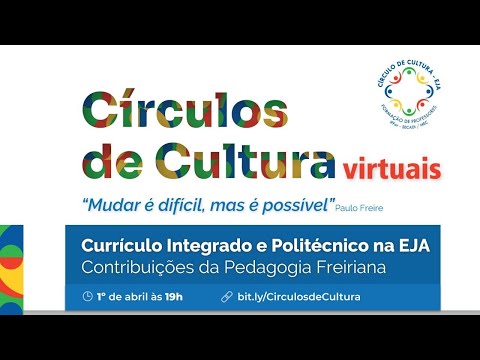
Currículo integrado e politécnico na eja: contribuições da pedagogia freiriana
Cultural Circle on Integrated and Polytechnic Curriculum
Introduction to the Cultural Circle
- The session begins with greetings from Maria Terezinha Air, marking the start of the third cultural circle in 2026, focusing on integrated and polytechnic curriculum in EJA (Education of Young Adults).
- The discussion will explore the connection between life knowledge, work, science, culture, and a critical understanding of the world of work.
Importance of Contextualized Curriculum
- Fernanda emphasizes education as a practice of freedom and collective knowledge construction. A significant point is made about creating a curriculum that reflects the real-life experiences of EJA students.
- The necessity for an educational process that is dialogical and emancipatory is highlighted, aiming to overcome fragmented knowledge.
Special Guests Introduction
- Maria expresses excitement about welcoming special guests from INFAR's Samborja campus: Tânia Mara, Tierry, and Alexander.
Greetings from MEC Representative
- Ana Lúcia Sanchez from MEC shares her enthusiasm for strengthening popular education through collective efforts. She references Paulo Freire’s philosophy regarding education as a shared experience rather than a commodity.
- Ana discusses recent events in Recife celebrating course completions developed through partnerships emphasizing popular education.
Tools for Education Improvement
- Ana introduces "Cadieja," an intersectoral tool designed to help identify non-literate individuals for educational opportunities within EJA programs.
- She encourages collaboration among educators to create meaningful curricula that recognize students' backgrounds and values.
Closing Remarks by Mariângela
- Mariângela acknowledges colleagues involved in Pacto initiatives and mentions new courses launched on the Mais Professores platform aimed at enhancing teacher training.
Introduction to the Educational Integration
Overview of Course Offerings
- The platform "Mais Professores" is currently open for course registrations, emphasizing continuous enrollment. For technical issues, participants are encouraged to contact profeja@mec.gov.br for immediate assistance.
- There are nine courses available that focus on integrating education with EJA (Educação de Jovens e Adultos) and EPT (Educação Profissional e Tecnológica), highlighting their importance in educational strategies.
Importance of Educational Integration
- The integration of EJA with EPT is a key strategy outlined in the Pacto and reinforced by Resolution 03 from the National Education Council, which aims for effective implementation in educational settings.
- A call to action is made for educational networks to collaborate with federal institutes to enhance curricular integration, showcasing successful experiences that demonstrate its effectiveness from early literacy stages onward.
Curricular Integration Experiences
Notable Courses and Initiatives
- Mentioned courses include one focused on curricular integration developed by the Federal Institute of Rio Grande do Norte and another addressing solidary economy perspectives within EJA curriculum integration led by Professor Sol from the Federal Institute of Paraíba. These initiatives are highlighted as exemplary models for others to follow.
Dialogue Session Introduction
Participants' Background
- Professor Tânia Mara Chaves introduces herself as a physics educator at IFAR São Borja, coordinating research on integrated curricula and teacher training, setting the stage for an engaging dialogue about educational practices.
- Tierry Ortiz Anchieta is introduced as a doctoral student in education at UFSC, contributing his expertise in pedagogical methodologies relevant to basic and technological education at IFAR Farropilha. This establishes a collaborative environment for sharing insights among educators.
Pedagogical Framework Discussion
Focus on Human-Centered Education
- The discussion will revolve around their pedagogical letter aimed at enhancing EJA through integral human formation and understanding integrated curricula alongside polytechnic approaches as essential components of this educational philosophy.
- Emphasis is placed on defining the purpose of EJA: fostering personal and professional development without separating these aspects, thus promoting holistic growth among learners engaged in adult education programs.
Understanding the Purpose of Education for Young Adults
The Role of Education in Professional and Personal Development
- The focus is on understanding who the individual is and what educational goals are set for their development, particularly in relation to entering the workforce.
- Beyond workforce integration, education should enable individuals to acquire knowledge, comprehend the world, express opinions, and create meaning during their schooling process.
- The aim is to foster both personal and professional growth within the framework of Youth and Adult Education (EJA), drawing from Freire's perspective.
- A critical approach to EJA emphasizes not only vocational training but also personal formation, highlighting two key categories: dialogue and integral human formation.
Dialogue as a Central Concept
- Dialogue is essential in Freire's educational philosophy; it represents a humble encounter between individuals seeking to communicate effectively. This humility is crucial for genuine dialogue rather than monologue.
- Effective dialogue contributes significantly to curriculum development within EJA and serves as a primary methodology guiding teaching and learning processes.
Integral Human Formation
- Integral human formation aims at providing access to knowledge that values both historical context and prior experiences of learners, fostering a comprehensive understanding of their place in the world.
- This approach encourages students not only to improve themselves but also to transform their surrounding environments, emphasizing educators' responsibilities in this transformative process.
Understanding Paulo Freire's Perspective on Integral Human Formation
The Importance of Dialogue in Education
- The discussion begins with the significance of dialogue as a foundational category in Freire's educational philosophy, emphasizing its role in integral human formation.
- Two perspectives are introduced that align with the concept of integral human promotion, which are essential for understanding Freire’s pedagogical approach.
- Communication and language are highlighted as critical elements of education, serving as tools for democracy and freedom, particularly within the context of Youth and Adult Education (EJA).
Building Integral Human Formation through Dialogue
- The necessity to explore how dialogic communication can facilitate the construction of integral human formation is emphasized.
- A key quote from Freire states that education is liberating when it empowers individuals to critically read their world and become agents of transformation.
- The importance of equality in dialogue is stressed; all subjects learn from each other through mutual engagement and respect.
Contextualizing Learning Experiences
- It is crucial to consider students' backgrounds and experiences within the classroom setting to foster effective learning environments.
- Language, communication, and dialogue are framed as instruments against oppression, advocating for social transformation through education.
Curriculum as a Tool for Liberation or Oppression
- There is a critique of traditional curricula that often perpetuate oppressive structures rather than promote freedom within EJA contexts.
- The need for curricula that encourage dialogue and personal expression among students is underscored to avoid oppressive educational practices.
Fostering Critical Thinking Through Educational Practices
- Emphasizing student voice in educational settings contributes significantly to developing critical thinking skills and emancipatory learning experiences.
- Educational practices must be non-authoritarian, promoting democratic engagement rather than being centered solely on educators’ authority.
- Investigative practices are proposed as fundamental methods for fostering genuine teacher-student interactions conducive to democratic learning environments.
Understanding Politecnia and Integrated Curriculum
The Role of Dialogue in Education
- Emphasizes the importance of understanding who the subjects are and how they interact through dialogue, highlighting the need for an investigative research perspective as a fundamental methodology.
- Argues against treating educational content merely as a checklist; instead, it should integrate theoretical knowledge with students' lived experiences.
Integration of Theory and Practice
- Discusses the idea of integrating curriculum with politecnia by allowing dialogue between theory and practice, enhancing students' learning through their experiences.
- Introduces Saviane's perspective that there is no pure manual or intellectual work; both are intertwined in human reality, reinforcing the connection between practical skills and intellectual engagement.
Intellectual vs. Manual Work
- Highlights that both intellectual and manual work occur simultaneously, which is essential for preparing individuals for the workforce.
- Stresses that education should not separate doing from thinking; students must reflect on their actions within their work context to develop critical thinking skills.
Comprehensive Educational Approach
- Advocates for a holistic approach where students are prepared for work while also engaging in reflective practices about their roles in society.
- Suggests that integrated curricula should connect various categories such as work, education, culture, science, and technology to provide a well-rounded formation.
Contextualizing Knowledge
- Warns against teaching isolated content (e.g., physics); instead, it should be contextualized within broader societal frameworks to enhance relevance.
- Reiterates that politecnia promotes an expansive human formation rather than focusing solely on specific content areas.
Transformative Learning Experiences
- Encourages educators to facilitate dialogues between students’ experiences and scientific knowledge to enrich learning outcomes.
- Notes that politecnia aims to transcend traditional training focused only on job performance by fostering critical awareness among learners.
Curriculum Development Insights
- Discusses how politecnia emerged from the need for more comprehensive training beyond basic literacy or functional skills.
- Emphasizes the importance of situating knowledge within real-world contexts so learners can critically engage with their realities.
This structured summary captures key insights from the transcript regarding politecnia and integrated curriculum while providing timestamps for easy reference.
Understanding Limit Situations in Education
The Importance of Recognizing Limit Situations
- Discusses the need to identify limit situations faced by diverse students, including those seeking to complete high school for certification and those excluded from regular education.
- Emphasizes understanding these limit situations to align educational expectations with students' needs, despite the constraints of a prescribed curriculum.
Curriculum Organization for Critical Education
- Advocates for a curriculum that promotes critical engagement with knowledge, contextualizing learning beyond basic job skills to transform students' realities.
- Introduces the concept of an integrated curriculum and integrative pedagogical practices as essential for effective educational implementation.
Key Principles for Educational Formation
- Highlights three fundamental principles: preparing students for the workforce, understanding their identities, and fostering scientific and technological comprehension.
- Stresses the importance of autonomy in student choices as they gain awareness of their surroundings.
Holistic Human Development
- Discusses the need for comprehensive education that encompasses personal, professional, and intellectual dimensions to foster critical reflection among students.
- Argues that integrative pedagogical practices require ethical-political solutions rather than just didactic ones.
Collaborative Efforts in Education
- Points out that achieving an integrated curriculum necessitates collective efforts from all educators and stakeholders within the educational environment.
- Encourages dialogue among all participants in adult education to ensure cohesive educational practices aligned with shared goals.
Ethical and Political Considerations in Curriculum Design
- Urges consideration of ethical-political frameworks guiding educational practices, emphasizing interconnectedness between teaching methods and broader societal values.
- Reinforces that developing a critical curriculum requires more than just instructional strategies; it demands a foundational political perspective on education.
The Role of Dialogue in Critical Education
- Concludes that creating a critical education framework relies heavily on dialogue to align student expectations with curricular goals.
- Asserts that curricula should not be rigid prescriptions but dynamic tools crafted by people for people aimed at fostering critical thinking among EJA (Educação de Jovens e Adultos - Youth and Adult Education).
This structured summary captures key insights from the transcript while providing timestamps linked directly to specific discussions.
Education as a Political Act
The Nature of Education
- Education is described not only as an act of knowledge but also as a political act, emphasizing that there is no neutral pedagogy.
- The curriculum and schools are inherently political and ideological, which shapes the integrated curriculum and the concept of politechnia.
Curriculum Development
- A key point raised is that an integrated curriculum cannot exist without horizontal dialogue among participants.
- Emphasis on participatory research where students must be involved in constructing the curriculum to ensure it resonates with their experiences.
Transformative Curriculum
- The integrated curriculum should focus on transformative practices that consider work, culture, science, and technology.
- It’s crucial to view students holistically rather than in isolation; educators should recognize the totality of their students' identities.
Ethical Practices in Education
- Educational practices must be ethical and political; neutrality does not exist when making educational decisions.
- Decisions made about teaching methods reflect positions for or against certain educational ideologies.
Challenges in Adult Education
Systematic Reflections
- Acknowledgment of the need for systematic reflections on theoretical-political consonance with Freirean perspectives within adult education (EJA).
Demands for Curriculum Organization
- Discussion highlights demands for a basic national curriculum from MEC that can be adapted by states due to perceived inadequacies in current curricula.
Balancing Autonomy and Regulation
- There exists a tension between curricular regulation and school autonomy; addressing this requires careful consideration of pedagogical complexities.
Engaging Students Effectively
- Challenges include mobilizing student participation; solutions cannot be one-size-fits-all but must consider individual learning trajectories.
Curriculum Diversity in Education
Importance of Diverse Curriculum Organization
- The discussion emphasizes the need for varied curricular organization to meet the diverse needs of students, including youth, adults, and seniors. A rigid standardization would contradict this goal.
- Questions are raised about the nature of the curriculum: whose service it is and how open it is to dialogue with students' realities. The school should not merely transmit pre-packaged content but foster critical engagement.
Contextualized and Plural Curriculum
- Advocates for a national curriculum that is contextualized and pluralistic, reflecting the concrete life conditions, work environments, and territories of students in Adult Education (EJA).
- Emphasizes ongoing reflection and dialogue among educators to reinvent curricula based on real-world knowledge and experiences.
Introduction of Professor Alexander da Silva Machado
- Transitioning to Professor Alexander da Silva Machado's segment; he is introduced as an experienced history teacher at IFAR's São Borja campus, currently pursuing a doctorate in education.
Personal Background and Teaching Experience
- Professor Alex expresses his pleasure in joining the discussion alongside fellow educators. He has been teaching EJA since 2010.
- Shares personal details: identifies as pardo (mixed race), has 45 years old, wears glasses, and has been involved in EJA for nearly 16 years across various courses.
Challenges in Educating Diverse Populations
- Acknowledges the challenge of presenting information amidst a wealth of knowledge shared by other speakers. Highlights the importance of recognizing potential within educational practices.
- Stresses understanding one's context when discussing educational practices; he speaks from São Borja, which faces significant educational challenges due to historical neglect.
Socioeconomic Context of São Borja
- Describes São Borja's geographical location near Argentina and its historical significance regarding public education development through federal policies.
- Notes that São Borja has a low Human Development Index (HDI), indicating economic disparity and social inequality that necessitate focused educational efforts.
Cultural Heritage and Education in Rio Grande do Sul
Historical Context and Cultural Significance
- The region of Rio Grande do Sul has a rich cultural heritage influenced by indigenous peoples, particularly the Guarani and Caigü. This heritage has often been overlooked in historical narratives.
- Two significant Brazilian presidents, João Goulart and Getúlio Vargas, hailed from this area. Their contributions were pivotal to the development of labor rights and education in Brazil.
- The 1934 Constitution marked a turning point by making education mandatory, aiming to prepare individuals for the workforce.
Local Traditions and Educational Institutions
- The region is known for its vibrant Fandango dance culture, which plays an important role in local celebrations.
- The IFAROPILHA (Federal Institute of Education), located in São Borja, is expanding its campuses from 12 to potentially 15, enhancing educational access in the western part of Rio Grande do Sul.
Educational Framework at IFAROPILHA
- IFAROPILHA focuses on three technological axes: Information & Communication, Tourism & Hospitality, and Management & Business. It offers integrated technical courses including Administration, Events, Informatics, and Gastronomy.
- As a history professor specializing in food history across various educational levels (EJA - Youth and Adult Education), there are challenges related to student self-esteem that need addressing.
Engaging Students Through History
- A key objective is to validate students' prior knowledge while fostering their self-esteem through interactive learning methods such as dialogues and writing assignments.
- The curriculum emphasizes understanding the origins of Western cuisine while integrating influences from indigenous and Afro-Brazilian cultures.
Practical Applications of Learning
- Since 2017, innovative projects have been implemented to engage students actively with historical contexts through practical experiences like cooking traditional dishes reflective of different historical periods.
- Students learn about food choices shaped by economic conditions and political decisions over centuries—highlighting how contemporary eating habits are rooted in long-standing traditions.
This structured overview captures essential insights from the transcript regarding cultural heritage's impact on education within Rio Grande do Sul.
Culinary Education and Historical Context
Integrating Intellectual and Manual Work
- The speaker emphasizes the importance of understanding historical processes in culinary education, highlighting a rich heritage from ancestors.
- A key objective is to connect intellectual research with practical cooking skills, encouraging students to explore historical recipes and materials.
Diverse Culinary Themes
- Students are given options to explore various ancient cultures (Greece, Rome, Egypt, Hebrews) or focus on Afro-Brazilian themes while avoiding common dishes like feijoada.
- The curriculum adapts each year based on student interests, including vegetarian and vegan options to accommodate diverse dietary preferences.
Collaborative Learning Experience
- The approach values existing knowledge among students and aims to merge practical work with theoretical understanding through dialogue.
- Students present their chosen dishes, discussing ingredients' origins and preparation techniques. This fosters a connection between personal identity and culinary choices.
Community Involvement in Culinary Projects
- Family members are invited to participate in cooking events, enhancing community engagement in the learning process.
- Students collaborate by pooling resources for ingredients, creating a shared experience that promotes discussion around the thematic content of their meals.
Interdisciplinary Approach
- Various subjects intertwine within the culinary projects; for instance, basic computer skills are used for menu creation while chemistry aids in understanding food processes.
- Practical skills such as cutting and cooking techniques are taught alongside theoretical lessons about food history and culture.
Historical Representation Through Food
- Students recreate historical dining experiences (e.g., Roman tables), allowing them to engage with history actively rather than passively learning about it.
- The speaker reflects on their educational philosophy influenced by Freirean principles of dialogue and collective construction of knowledge.
Discussion on Pedagogy and Student Empowerment
The Role of Prior Knowledge in Learning
- The speaker reflects on the importance of students' prior knowledge, noting that it is fundamental to their learning process. They emphasize how rewarding it is to see students realize the value of what they already know.
- Students encounter new concepts and skills, such as using beautiful tableware, which they initially do not recognize but later understand as part of their educational growth.
Integration of Popular and Scientific Knowledge
- There is a discussion about the integration of popular knowledge with scientific knowledge within the context of a gastronomy course. This blending helps students recontextualize their everyday experiences with academic learning.
- The speaker highlights that education is not neutral; it has specific objectives and implications for who benefits from it. This awareness shapes classroom dynamics and pedagogical approaches.
Contextualization in Education
- The importance of contextualizing education to reflect local realities is emphasized. The speaker notes how this approach fosters a deeper connection between students' cultural backgrounds and the curriculum being taught.
- A participatory planning process involving discussions about which dishes to prepare illustrates how collective input enriches the learning experience, promoting a horizontal dialogue among educators and learners.
Empowerment Through Education
- The articulation between traditional recipes (popular knowledge) and modern techniques (scientific knowledge) empowers students by enhancing their culinary skills while respecting their cultural heritage.
- Personal anecdotes are shared regarding adult education (EJA), highlighting moments where students feel empowered by acquiring new skills, such as setting a table or preparing sophisticated meals like salmon.
Political Dimensions of Education
- The conversation touches on food policies within educational contexts, asserting that choices made in education are inherently political acts aimed at providing better opportunities for marginalized groups.
- Acknowledgment is given to the transformative potential of education for young adults, emphasizing that teaching practices should be rooted in social justice principles rather than neutrality.
Closing Reflections on Educational Practices
- As the session concludes, there’s an expression of gratitude towards participants for sharing diverse perspectives. It reinforces the idea that these dialogues contribute significantly to collective understanding and commitment to adult education (EJA).
- Participants leave with renewed motivation to engage deeply with their teaching practices while remaining sensitive to student realities, aiming for a more just educational landscape.
- Emphasis is placed on continuing efforts toward creating an inclusive curriculum that resonates with students’ lives and aspirations while fostering hope for systemic change in EJA contexts.
Strengthening Service Training in Adult Education
Importance of Service Training
- The speaker emphasizes the need to strengthen service training as an integral part of the educational framework for youth and adults in Brazil.
- There is a call to ensure that this training is included within the official workload, highlighting its significance in enhancing educational quality.
- The goal is to continuously improve the education provided to young people and adults, indicating a commitment to lifelong learning.
- A warm farewell is expressed, showcasing appreciation for participants' engagement and contributions during the session.
- Participants are reminded that materials will be shared via chat on Eventre, along with a tutorial from Thiago, ensuring access to additional resources.