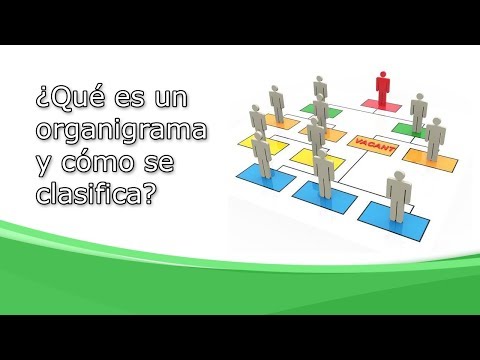
¿Qué es un organigrama y cómo se clasifica?
Introduction and Importance of Organization Charts
In this section, the importance of organization charts in companies is discussed.
Importance of Organization Charts
- Organization charts are graphic representations of the organic structure of a company or organization.
- They provide a schematic representation of departmental structures, hierarchical levels, lines of authority, and advisory relationships.
- Organizational charts serve as informative papers that present all elements of authority and hierarchy within an organization.
- They are important and useful for companies in various sectors such as production, commerce, administration, and politics.
- Designers and creators of organizational charts should be aware of different types and characteristics.
Classification of Organizational Charts
This section focuses on the classification of organizational charts based on their nature, purpose, scope, content, and presentation.
Classification by Nature
- Micro-administrative charts represent a single organization globally or specific areas within it.
- Macro-administrative charts involve more than one organization.
- Meso-administrative charts represent one or more organizations in the same sector or branch.
Classification by Purpose
- Informative charts are designed for non-specialized people to understand. They present parts or units at a general level.
- Analytical charts analyze specific aspects of organizational behavior or information related to budgets, staff distribution, expenses, etc.
- Formal charts represent the planned operating model with written approval from higher authorities.
- Informal charts represent planned models without written approval.
Classification by Scope
- General charts contain representative information up to a certain hierarchical level based on magnitude and characteristics.
- Specific charts show the structure of a particular area within an organization.
Classification by Content
- Integral charts graphically represent all administrative units and their hierarchical relationships.
- Functional charts include assigned functions along with unit interrelationships, useful for staff training and general presentation.
- Job, position, and unit charts show position needs and the number of existing or necessary positions.
Classification by Presentation
- Vertical charts depict hierarchies from top to bottom, following a pyramid structure.
- Horizontal charts present hierarchies from left to right in columns with horizontal lines connecting units.
- Mixed charts combine vertical and horizontal arrangements for expanded graphing possibilities.
Conclusion
This section concludes the discussion on organizational charts and their classification based on nature, purpose, scope, content, and presentation.
- Organizational charts play a crucial role in providing a visual representation of an organization's structure.
- They help in understanding the hierarchy, lines of authority, and relationships within an organization.
- The classification of organizational charts is based on various factors such as nature, purpose, scope, content, and presentation style.
New Section
The transcript discusses different types of organizational charts and their characteristics.
Types of Organizational Charts
- Tabular: Scalar only, no lines connecting authority controls.
- Block: Variant of vertical charts, integrate more units in smaller spaces. Allows units in last hierarchical levels to appear.
- Circular: Maximum authority located in center, concentric circles formed around it with authorities appearing in decreasing levels. Last circle indicates lowest level of hierarchy.
- Organization chart validity is not fixed or invariable, as it is only valid for a certain moment.