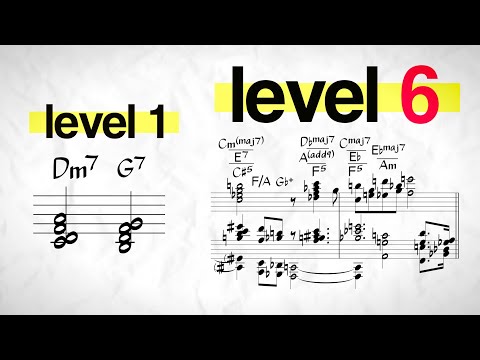
The 7 Levels of Jazz Harmony
Introduction to Jazz Harmony Levels
In this video, the speaker introduces the concept of jazz harmony levels and explains how they progress from basic to more complex. The focus is on reharmonizing a D minor chord progression to showcase different levels of jazz harmony.
Level 1: Bell Pepper
- Level one introduces a typical jazz chord progression using four-note seventh chords instead of basic triads.
- Two-five progressions are highlighted as essential components of jazz harmony, providing tension and release and creating forward momentum.
- The movement of roots in this progression follows a cycle of fifths pattern, which is common in jazz harmony.
Level 2: Poblano Pepper
- Tritone substitution is introduced as a way to add color to the harmonies by replacing dominant seventh chords with other dominant seventh chords three whole steps away.
- These substituted chords create tension that resolves down by half step to chords from the key, enhancing the sense of tension and release.
Level 3: Jalapeno Pepper
- This level explores chord extensions, where additional notes beyond the basic triads are added to create richer harmonies.
- Artists like Duke Ellington and Thad Jones utilized extensions extensively in their compositions, resulting in dense layers of harmony.
Level 4: Piri-Piri Pepper
- Pedal point technique is introduced, where a repeated note in the bass grounds the progression while allowing for non-functional chords on top.
- Modal jazz from the 1960s, particularly McCoy Tyner's piano playing with John Coltrane, exemplifies this level of harmony.
Level 5: Habanero Pepper
- Non-functional harmony is explored at this level, where chords exist independently without pointing to any particular key or chord.
- This level allows for more freedom and experimentation in creating harmonies.
Conclusion
The video provides an overview of the seven levels of jazz harmony, starting from basic seventh chords and progressing to more complex techniques such as tritone substitution, chord extensions, pedal points, and non-functional harmony. Each level adds depth and richness to jazz compositions.
New Section
This section discusses the progression of harmonic choices in jazz music, from formalized harmony to relying on experienced ears for aesthetic decisions. It also mentions the influence of level five harmony on fusion artists like Herbie Hancock and Chick Corea.
Evolution of Harmonic Choices
- In the late 1960s, the jazz avant-garde moved away from formalized harmony.
- Musicians started relying on their experienced ears for aesthetic decisions.
- Level five albums, such as "Mild Smiles" by Miles Davis, influenced later fusion artists.
- Herbie Hancock and Chick Corea were particularly influenced by level five harmony.
New Section
This section explores level six jazz harmony, characterized by liberated dissonance and complex harmonizations. It emphasizes that this type of harmony should be used sparingly.
Level Six Jazz Harmony
- Level six is characterized by liberated dissonance and poly quartz mirror twelve-tone harmonizations.
- Examples include chords used by Arnold Schoenberg and Igor Stravinsky.
- B-flat minor major seven over F major seven over C sharp five is an example of level six harmony with conflicting chords stacked on top of each other.
- Ludmila Ulehla advises using this type of musical phrase sparingly.
New Section
This section highlights examples of level six jazz harmony in compositions by Bob Breton Jers and Dave Liebman. It emphasizes that level six harmony should be used rarely and in small doses.
Examples of Level Six Harmony
- Bob Breton Jers' arrangements for Stan Kenton's album "A City of Glass" showcase level six jazz harmony.
- Dave Liebman's compositions are known for their spicy use of level six harmony.
- Level six jazz harmony should be used extremely rarely and in very small doses.
New Section
This section introduces level seven jazz harmony, which involves tuning chords to the melody using just intonation ratios. It mentions artists like Jakob Collier and Steve Lehman who have experimented with this type of harmony.
Level Seven Jazz Harmony
- Level seven jazz harmony involves tuning chords to the melody using just intonation ratios.
- Chords are detuned or adjusted to maintain equal temperament with the melody.
- Different just intonation ratios can be used for the same interval, resulting in subtle variations.
- Artists like Jakob Collier and Steve Lehman have explored level seven jazz harmony in their compositions.
New Section
This section explains the concept of tuning chords to the melody using just intonation ratios. It discusses specific examples and how different ratios affect the overall sound.
Tuning Chords with Just Intonation Ratios
- Just intonation involves tuning chords based on harmonic functions of the melody notes.
- Different just intonation ratios can be used for intervals like minor sevenths.
- The detuning of chords compensates for differences from equal temperament.
- Examples include a 9 to 5 ratio for a minor seventh, resulting in an 18-cent detuning.
- Using different ratios for the same interval can lead to quarter-tone differences between root notes.
New Section
This section compares level seven jazz harmony with twelve-tone equal tempered harmony. It explores how just intonated chords create a unique and piercing sound.
Comparison: Just Intonated Chords vs. Equal Tempered Chords
- Just intonated chords have a distinct quality compared to twelve-tone equal tempered chords.
- The lo-fi vibe and cassette tape-like feel are associated with just intonated chords.
- The subtle differences in tuning can create a piercing effect.
- A comparison between twelve-tone equal tempered and just intonated versions of chords is demonstrated.
New Section
This section concludes the discussion on level seven jazz harmony and mentions its use by artists like Gila Beads.
Conclusion: Level Seven Jazz Harmony
- Level seven jazz harmony exists outside the realm of twelve-tone equal temperament.
- Artists like Gila Beads have explored this type of harmony using just intonation ratios.
- Level seven jazz harmony offers unique tonal possibilities beyond traditional equal tempered systems.