Real Options
Understanding Real Options
Introduction to Financial Options
- The class will focus on real options, building upon the previous discussions about financial options.
- A financial option is introduced as a key concept for understanding real options.
Defining Financial Assets and Real Options
- Financial assets are defined, setting the stage for discussing real options.
- Real options differ from traditional financial options; they involve tangible assets rather than just financial instruments.
Characteristics of Real Options
- Real options allow managers to influence project cash flows through various actions during the project's lifecycle.
- Smart managers actively seek out and create real options within their projects.
Payoff Structures: Financial vs. Real Options
- In financial options, payoffs are clearly defined by contracts (e.g., strike prices).
- Conversely, real option payoffs can vary significantly based on project circumstances.
Investment Timing Example
Scenario Setup
- An example illustrates an investment timing option involving a new telecom product that requires a $100 million investment.
Risk Assessment in Investment Decisions
- Two potential scenarios arise: high demand leading to positive cash flow or low demand resulting in sunk costs without returns.
Strategic Decision-Making with Patents
- The option to patent the device allows for one year of market research before committing significant funds.
Market Research and Demand Validation
- During this year, companies can assess market demand through prototypes and test marketing strategies.
Exercising the Option
Conditions for Investment Decisions
- If market demand appears favorable after research, the company may proceed with the $100 million investment.
Cost-Benefit Analysis of Locking in Options
- Spending $2 million to secure a patent provides valuable time to evaluate market conditions without immediate large-scale investment risks.
Analogies with Financial Options
- This scenario parallels call options in finance where exercising depends on favorable conditions (high demand).
Conclusion on Option Pricing
Understanding Real Options in Business
The Power of Option Theory
- The class focuses on applying option theory to real-world scenarios, emphasizing its relevance beyond finance majors.
- Even non-finance students can find practical examples of options in various fields, such as marketing.
Marketing and Options
- Marketing majors are encouraged to consider the phased approach when launching a new product rather than making large upfront investments.
- Initial steps include research, prototyping, and pilot studies, which serve as options that minimize risk while exploring market demand.
Understanding Real Options
- Conducting research analysis is akin to giving oneself options; it involves spending a small amount to gauge potential demand for a product.
- The term "real option" refers to physical projects where decisions are internal to an organization rather than tradable financial instruments.
Types of Real Options
Investment Timing and Expansion Options
- An investment timing option allows businesses flexibility in decision-making regarding project initiation based on market conditions.
- Example: Two businessmen set up manufacturing plants; one is rigid (A), while the other (B) purchases extra land for future expansion if demand increases.
Cost-Benefit Analysis
- Person B's additional property represents an expansion option. The cost of this option is the extra price paid for the land.
- Decision-making should be based on thorough analysis rather than blind choices; understanding costs relative to benefits is crucial.
Flexibility in Product Manufacturing
Case Study: BMW's Plant Design
- BMW built a flexible manufacturing plant capable of producing SUVs amid uncertain demand trends 15 years ago.
- This flexibility involved additional costs but allowed BMW to capitalize on rising SUV popularity without significant delays.
Strategic Planning with Options
- Smart managers incorporate options into their projects by designing work processes that allow for adaptability and value creation.
Geographic Market Expansion Strategies
Research Before Investment
- When entering new markets (e.g., Central Asia), companies should conduct preliminary research instead of immediately investing heavily in infrastructure.
Understanding Procurement Management
The Role of a Procurement Manager
- A procurement manager is responsible for purchasing goods and services for an organization, essentially acting as the buyer.
- In the context of Engrow, the biggest procurement concern is gas, which is essential for operations.
Contracting in an Integrated Market
- Gas prices are volatile; locking in a long-term contract at a fixed price (e.g., $100 per unit) can be risky if market prices fluctuate.
- If gas prices drop to $90 after signing a contract at $100, the procurement manager may regret their decision due to being locked into a higher price.
Strategic Contract Options
- To mitigate risks, smart managers include options in contracts that allow them to cancel with notice (e.g., six months).
- Offering slightly higher pricing (e.g., $100.50 instead of $100) can make it more palatable for suppliers while securing valuable cancellation options.
Value of Cancellation and Suspension Options
- Including clauses like cancellation or temporary suspension can provide immense value if market conditions change favorably over time.
- Understanding these options allows managers to negotiate better terms and potentially charge counter-parties for such flexibility.
Quantifying Business Decisions
Importance of Financial Assessment
- All business decisions should ultimately focus on financial outcomes; marketing buzzwords must translate into increased cash flow.
- Evaluating options requires understanding their financial implications—decisions must make economic sense.
Approaches to Valuing Real Options
- Various methods exist for assessing real options: discounted cash flow analysis, qualitative assessments, decision-free analysis, and Black-Scholes analysis.
Simplified Project Example
- A basic project example illustrates initial investment costs ($70 million), cost of capital (10%), risk-free rate (6%), and projected cash flows over three years.
Understanding NPV and Risk in Project Evaluation
Simplistic Assumptions in NPV Calculation
- The discussion begins with the acknowledgment that while assumptions can be complex, a simplistic approach is often used to understand concepts better. This includes considering different project timelines, such as three years versus five years.
Expected NPV Calculation
- The expected Net Present Value (NPV) of the project is calculated to be 4.6 million, emphasizing the importance of quick calculations in financial assessments.
- A specific cash flow probability of 0.3 for a cash flow of 45 is mentioned, indicating how probabilities affect expected cash flows.
Present Value and Expected Cash Flows
- The expected cash flow for each year is simplified to 30, leading to a present value calculation of expected cash flows at 74.61 million. This forms the basis for determining the overall expected NPV.
- The distinction between expected NPV and regular NPV is clarified: expected NPV incorporates probabilities of various outcomes, making it a weighted figure based on potential scenarios.
Understanding Project Risk
- The project is labeled risky due to uncertain demand; if demand falls short, it could lead to significant losses reflected in negative NPVs (e.g., a 30% chance of losing 32 million). This highlights how risk assessment plays into financial decision-making.
- An analogy comparing job security with project risk illustrates that even with positive expectations (70% chance of job retention or promotion), there remains substantial risk (30% chance of being fired). This helps contextualize risk perception in business decisions.
Options for Mitigating Risk
- A strategic option discussed involves delaying project initiation by one year to gather more information about market demand before committing resources—this reflects prudent decision-making under uncertainty.
- It’s noted that waiting does not change upfront costs or subsequent cash flows but allows for better-informed choices regarding project viability based on market research findings after one year.
Value of Real Options Under Uncertainty
- The concept that real options become more valuable when underlying projects are risky is introduced; this parallels traditional financial options where volatility increases value over time. Thus, having an option to wait enhances decision-making flexibility amid uncertainty about demand and profitability.
Decision Tree Analysis in Project Investment
Introduction to Decision Tree Analysis
- The session begins with a request for participants to hold their questions for the next 10 to 15 minutes, indicating an upcoming Q&A session.
Investment Options and Timing
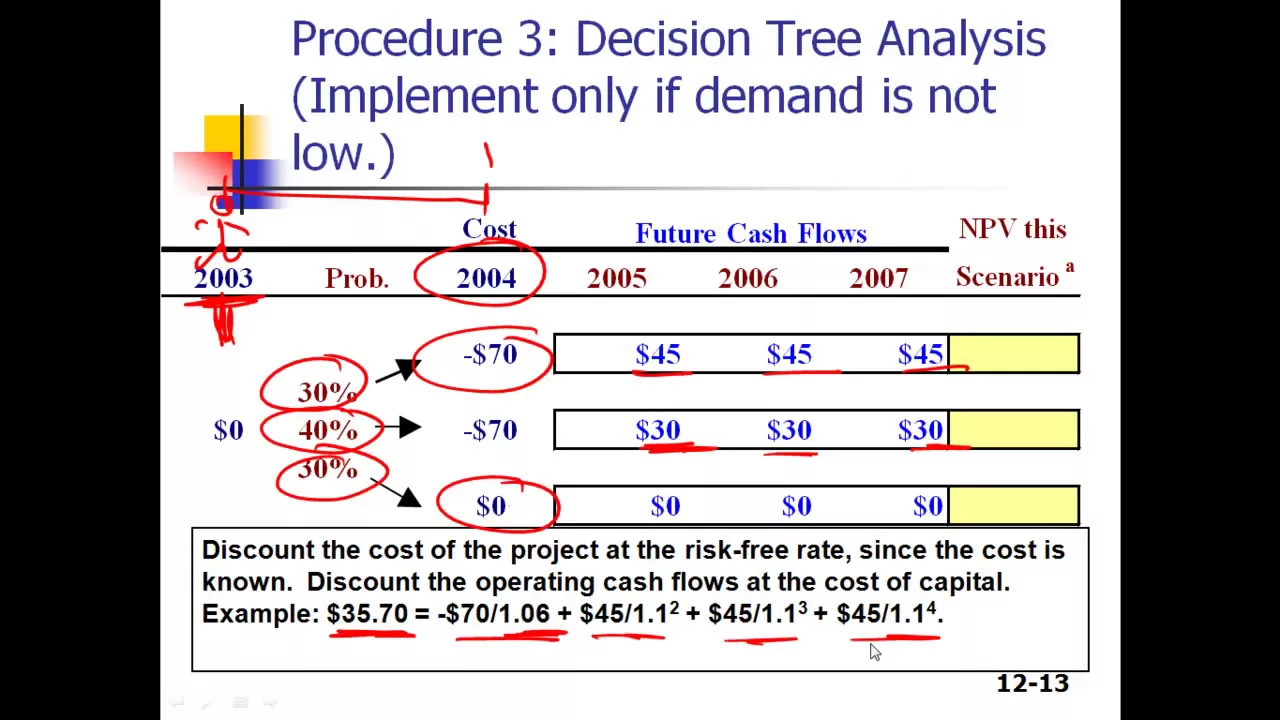
- The analysis focuses on a project starting in 2003, where the option exists to delay investment by one year.
- Instead of investing $70 million at time 0 (2003), there is an option to invest this amount at the end of year 1 (2004).
Understanding Demand Probabilities
- At time 0, three possible demand scenarios are presented with associated probabilities.
- There is a 30% chance of high demand, which would yield cash flows of $45 million each year.
- A 40% chance exists for medium demand resulting in cash flows of $30 million each year, while there is also a 30% chance for low demand.
Evaluating Low Demand Scenario
- If low demand is confirmed at time 0, it would be unwise to invest $70 million in building the plant.
- This scenario results in an NPV (Net Present Value) of zero since no investment would occur under low demand conditions.
Calculating NPV and Discount Rates
- The NPV for high demand is calculated as approximately $35.7 based on expected cash flows discounted appropriately.
- Cash flows are discounted using different rates: risk-free rate for certain investments and higher rates reflecting uncertainty for variable cash flows.
Risk Assessment and Discounting Strategies
- Investments that are certain should use the risk-free rate; uncertain future cash flows should be discounted at a higher risk-adjusted rate (10%).
- This approach ensures conservative estimates by lowering present values through higher discount rates.
Expected NPV Calculation with Waiting Option
- To find expected NPV when waiting one year, calculations involve considering various scenarios weighted by their probabilities.
- The expected NPV from waiting is calculated as approximately $11.4, indicating increased value compared to immediate investment.
Valuing Exclusivity Rights
- If exclusivity rights must be purchased from the government, understanding maximum willingness to pay becomes crucial based on previous calculations.
- If exclusivity costs exceed potential benefits (e.g., if it costs $7 million), it would not be worth purchasing; however, if priced lower (e.g., $2 million), it could be beneficial.
Understanding Project Risk and the Option to Wait
The Impact of Waiting on Project Risk
- The option to wait can significantly alter the risk profile of a project, potentially making it less risky by eliminating scenarios with low demand.
- If low demand is identified, the decision not to invest $70 million can mitigate financial losses.
Cash Flows and Discount Rates
- Cash flows become less risky when waiting is an option, as it allows avoidance of low cash flow scenarios. However, implementation costs may still carry risks.
- A discussion arises about whether different discount rates should be applied based on project risk; lower discount rates are suggested for less risky projects.
- The exact lower discount rate remains uncertain due to limitations in finance theory.
Black-Scholes Model Introduction
- Transitioning into the Black-Scholes model, it's noted that the cost of research was not initially factored into previous calculations.
Assumptions in Financial Modeling
- Several assumptions were made during modeling: waiting for a year while spending the same amount, consistent cash flows, and no additional costs for analysis.
- These assumptions highlight potential weaknesses in the model but serve as a foundation for understanding real options.
Enhancing Financial Models
- The conversation shifts towards enhancing models by relaxing one assumption at a time—such as incorporating research costs or varying cash flows—to improve accuracy without overcomplicating analysis.
Inputs to Black-Scholes Model
Key Inputs Explained
- Essential inputs for the Black-Scholes model include exercise price (X), underlying stock price (P), standard deviation (σ), and time to maturity (T).
Understanding Each Input
- X represents the strike price; in this context, it refers to an investment of $70 million needed to initiate the project.
- P denotes the present value of future cash flows from the project rather than total NPV calculations at year zero.
Variability and Time Considerations
- σ indicates variability in cash flow projections. T reflects time until option expiration; here it's set at one year despite a three-year project duration.
Understanding Present Value and NPV
Definition of Present Value (PV) and Net Present Value (NPV)
- The price of a stock or project is defined as the present value of future cash flows, which reflects its worth.
- The value of a project is determined by calculating the present value of expected future cash flows.
Estimating Present Value
- To estimate the present value (P), one must consider the current price of the stock, equating it to the present value of expected future cash flows.
- The current price remains unaffected by exercise prices on options, emphasizing that P for real options also derives from PV calculations.
Probability and Cash Flow Scenarios
- A scenario indicates a 30% chance associated with certain future cash flows, highlighting uncertainty in projections.
- The present value at a specific point in time (2004) is noted as 111.9, illustrating how historical data informs current valuations.
Calculating Expected Values and Discount Rates
Time Considerations in Valuation
- When using a discount rate of 10%, it's crucial to apply probability-weighted numbers to derive today's price based on various scenarios.
- Clarification on whether values are calculated at time zero or one is essential for accurate financial analysis.
Discounting Future Cash Flows
- The process involves dividing by 1.1 to discount expected values back one period, yielding an estimated price today.
- This discounted figure (67.82 at time zero) serves as input for further financial models like Black-Scholes.
Variance Calculation in Financial Options
Understanding Variance
- Sigma squared represents variance; for financial options, it pertains to stock return variance while for real options it relates to project return variance.
Approaches to Estimate Variance
- Judgment-based estimation suggests that if company variance is around 10%, project variance might be slightly higher due to inherent risks.
- A direct approach will be utilized for those lacking experience, focusing on calculating variances and expected values systematically.
Final Steps in Valuation Analysis
Calculating Returns and Variance
- With established inputs including today's price (67.8), analysts can calculate potential returns based on projected prices after one year.
Methodology Recap
- Identifying possible returns from given prices allows calculation of probabilities leading to overall variance assessment.
Understanding Risk Rate and Black-Scholes Model
Exploring the Calculation of Risk Rate
- The discussion begins with identifying key variables in risk assessment, specifically focusing on "P" and "sigma squared."
- The speaker emphasizes the importance of understanding these variables to proceed with calculations.
- A suggestion is made to utilize the Black-Scholes model for further analysis, indicating its relevance in financial contexts.
- The speaker reassures listeners that they will not be required to perform manual calculations, implying a reliance on computational tools.