L9: How to Strike Out the Pattern & Cut Our Traditional Jacket | Online Coat Making Course
Introduction
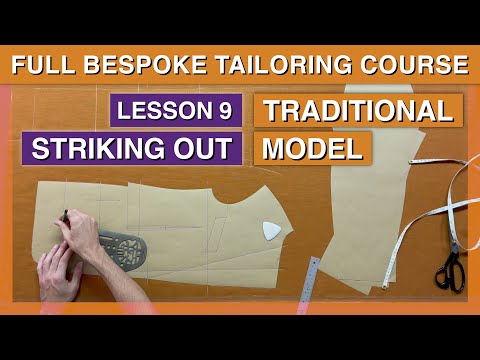
In this lesson, Reza introduces the ninth lesson of the "How to Make a Bespoke Jacket" series. He explains that they will be striking out the traditional model of their foundation bundle using the principles covered in the previous lesson.
Striking Out Traditional Model
Reza explains how to strike out the pattern on fabric using the principles covered in the previous lesson.
- Position Selvage towards us with fold away from us.
- Position back panel so that center back is facing fold.
- Position front panel next to it with front edge facing Selvage.
- Take top sleeve and position it so that hind arm is facing fold with top of top sleeve facing right side of fabric.
- Take under sleeve and position it so that hind arm again is facing fold but top of under sleeve is facing left side of fabric.
- Put side body panel so that side seam is facing Selvage.
Cutting Out The Real Deal
Reza demonstrates how to cut out a jacket after laying out your fabric.
- Run fabric through steam to expose it to heat and moisture.
- Lay fabric in front of you with roll facing other side of table and run steam through both sides.
- Ensure Selvages match for both layers and grain runs straight and perpendicular to Selvage before laying patterns on fabric.
- Lift top layer and mark where edge of layer underneath it is if they overlap, so panels are not different lengths.
Back Panel
This section covers the steps to create the back panel of a suit jacket.
Matching Chest Line and Marking Inlay
- Ensure that the back panel's shoulder line is 3/4 inches or 2 centimeters away from the neck.
- Match the chest line of your back panel with the weft of your fabric.
- Trace all around the pattern with chalk.
- Mark solid lines for chest line, top of side seam, back pitch, center vent, and hip line.
Marking Inlay on Long Lines
- Measure 3/8 inch or 1 centimeter at the top and bottom of the side seam.
- Align your pattern at both ends and follow through all the way down.
Marking Center Vent Area
- Mark one inch above the center vent mark which is two and a half centimeters like so.
- Draw a straight line going towards the fold like that.
Shoulder Inlay
- Take your ruler measure three quarters away from the shoulder point and connect that to the edge of your inlay on the side seam like so.
Front Panel
This section covers creating front panels for a suit jacket.
Lapel Edge Placement
- Measure 2.5 inches from bottom and three-quarters from there where Selvage separates fabric.
- The edge of your lapel has to be placed there.
Matching Chest Line and Chalking Pattern
- Match chest line with weft of fabric by rotating if necessary.
- Trace all around pattern with chalk.
Detail Markings
Mark details starting with:
- Chest line
- Front pitch
- Brake line
- Top/bottom first button
- Center front
- Hip line
- Base/top patch pocket
Marking Inlay and Outbreast Welds
- Add 3/4 inch or 2 centimeters to the shoulder line.
- Add three-quarters outwards from the shoulder half an inch which is about 1.2 centimeters out from the pitch point.
- Connect freehand the shoulder inlay to the front side inlay.
Marking Details
This section covers marking details for a suit jacket.
Middle of Pattern Detail Markings
- Use a soft graphite pencil or chalk pencil and pick through corners making a rotating movement to mark points.
- Mark four corners of outbreast weld, top point of dart, middle point of dart where intake line is, top corner of patch pocket, base of dart, top/bottom pitch line (sleeve pitch line), and five points for curve of patch pocket.
Solidifying Lines
- Start with chest line move over to hip line connect one of your last dots with base of patch pocket base of dart all way to corner where step is.
- Take longer ruler to mark brake line and feel free to extend brake line higher towards shoulder.
- Add inlay by connecting shoulder inlay to front side inlay.
Cutting the Front Panel
In this section, the instructor explains how to cut out the front panel of a jacket.
Marking and Cutting
- Mark a clear line for the front.
- Align your pattern and curve in when you reach the curve.
- Add 1.25 inches (3.2 cm) for the top of the lapel.
- Cut along the outer lines of your panel, cutting the shoulder inlay first.
- Double-check every line that you're cutting and never look at just the point of your scissors or shears.
Cutting the Back Panel
In this section, the instructor explains how to cut out the back panel of a jacket.
Marking and Cutting
- Cut along the outer line of your side body inlay and shoulder inlay around the neck.
- Cut both layers all way to first line marked above vent on both sides.
- Lift up top layer and continue cutting on chest line only.
- Open up fabric where center back seam will be sewn to create shield for vent.
- Make subtle curved line from one inch over long edge to bottom edge, then cut away excess fabric.
Checking Fabric Alignment
In this section, the instructor explains how to check if fabric is aligned properly before continuing with sewing.
Checking Fabric Alignment
- Double-check if salvage is matching on all layers and if grain is still straight and perpendicular to salvage.
- Correct any misalignments before proceeding with sewing.
[CUTOFF_LIMIT]