Two-way frequency tables and Venn diagrams | Data and modeling | 8th grade | Khan Academy
Introduction and Candy Description
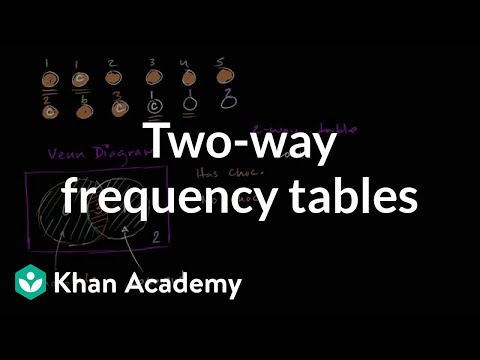
In this section, the speaker introduces 12 pieces of candy, explaining that the brown ones have chocolate on the outside and those with a "C" have coconut on the inside.
- The candy consists of 12 pieces, with brown ones having chocolate and those with a "C" having coconut.
- Example: Top left candy is made of chocolate but doesn't have coconut.
Different Combinations of Chocolate and Coconut
The speaker discusses different combinations of chocolates and coconuts in the candies.
- Some candies have both chocolate and coconut, while others only have one or none.
- Example: One candy has both chocolate and coconut, while another has only chocolate.
- Another candy has neither chocolate nor coconut.
Representing Information Using Venn Diagram
The speaker explains how to represent the information using a Venn diagram.
- A Venn diagram can be used to represent the different sets of chocolates and coconuts.
- A rectangle represents the universe (all chocolates), with numbers adding up to 12.
- Circles are drawn to represent sets such as chocolates and coconuts.
Drawing Chocolate Set in Venn Diagram
The speaker draws a circle to represent the set of chocolates in the Venn diagram.
- A circle is drawn within the rectangle to represent the set of chocolates.
- It does not need to be drawn to scale.
Drawing Coconut Set in Venn Diagram
The speaker draws another circle to represent the set of coconuts in the Venn diagram.
- Another circle is drawn within the rectangle to represent the set of coconuts.
- The size of the circles does not accurately reflect the actual sizes of the sets.
Filling in Sections of Venn Diagram
The speaker fills in the different sections of the Venn diagram based on the number of candies with specific characteristics.
- Six candies have chocolate but no coconut, represented by a shaded green section.
- Three candies have both chocolate and coconut, represented by an overlap between the chocolate and coconut circles.
- One candy has coconut but no chocolate, represented by a white section.
- Two candies have neither chocolate nor coconut.
Completing Venn Diagram
The speaker completes filling in the remaining sections of the Venn diagram.
- Two candies have neither chocolate nor coconut, completing all sections.
- The total number of chocolates is 9 (6 with no coconut + 3 with both).
- The total number of coconuts is 4 (1 with no chocolate + 3 with both).
Representing Information Using Two-Way Table
The speaker introduces another way to represent information using a two-way table.
- A two-way table can be used to show combinations of chocolates and coconuts.
- "Has Chocolate" and "No Chocolate" are written on one axis, while "Coconut" and "No Coconut" are written on another axis.
Filling in Two-Way Table
The speaker fills in the cells of the two-way table based on the number of candies with specific characteristics.
- Three candies have both chocolate and coconut, placed in that cell of the table.
- Six candies have chocolate but no coconut, placed in that cell of the table.
- One candy has coconut but no chocolate, placed in that cell of the table.
- Two candies have neither chocolate nor coconut, placed in that cell of the table.
Adding Totals to Two-Way Table
The speaker adds total numbers to the two-way table.
- The total number with coconut and chocolate is 3.
- The total number with only chocolate is 6.
- The total number with only coconut is 1.
- The total number with neither chocolate nor coconut is 2.
New Section Understanding Chocolate and Coconut
In this section, the speaker discusses the quantities of chocolate and coconut in a certain scenario.
Quantities of Chocolate and Coconut
- The total amount of coconut is determined by adding six to two. This can be calculated horizontally as three plus six equals nine, and one plus two equals three.
- The total amount of chocolate is obtained by adding six to three, resulting in nine.
- The quantity of no chocolate is represented by the number three.
Timestamps are not available for this section.