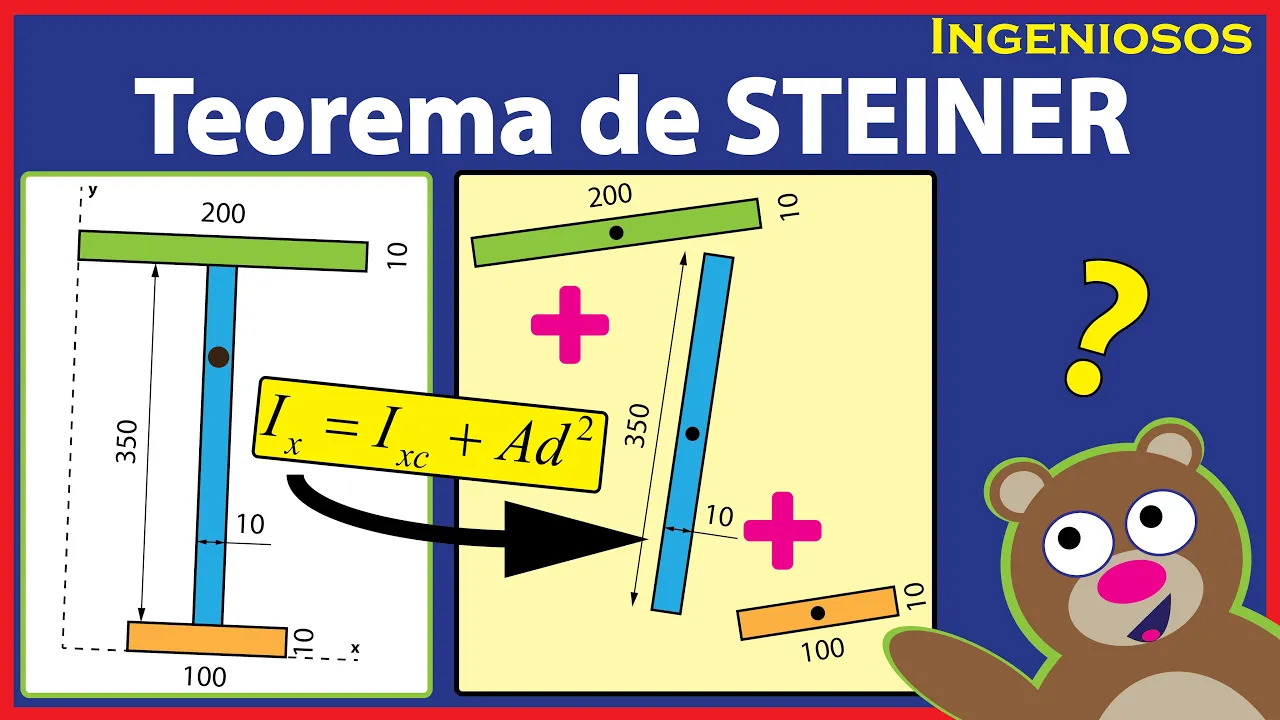
TEOREMA de STEINER 😊👌INERCIA de una figura compuesta
New Section
In this section, the video introduces the concept of using the Steiner's Theorem to calculate moments of inertia for composite sections.
Applying Steiner's Theorem
- Steiner's Theorem states that the moment of inertia of a section about an axis is equal to the moment of inertia about a parallel axis through the center of gravity plus the product of area and squared distance between the axes.
- Moments of inertia about any axis can be found by adding known moments of inertia about centroidal axes and adjusting with additional terms involving areas and distances squared.
- This theorem is particularly useful for determining inertias of complex or composite sections composed of simpler sections, leveraging known values from tables.
Steps to Calculate Moments of Inertia
- Begin by establishing reference axes and dividing the section into simpler parts, typically rectangles, with known formulas for their moments of inertia.
- Determine the position of the centroid for each part relative to reference axes, then calculate individual moments of inertia around these centroids.
- Position coordinates are calculated by multiplying each part's area by its centroid coordinate relative to reference axes and dividing by total area. Similar process applies for y-coordinate calculation.
Industrial Application: Dinteles con Cartelas
This segment discusses an industrial application involving dinteles con cartelas in industrial warehouses to enhance bending resistance at pillar junctions.
Industrial Application Insights
Inertia Calculation for Structural Profiles
In this section, the speaker discusses the process of calculating inertia for structural profiles by focusing on specific details and utilizing formulas to determine the total inertia.
Calculating Inertia for Structural Profiles
- Structural profiles can be placed at the ridge junction. The section's cross-section consists of a profile "p" and two rectangles forming the cartouche, each with equal dimensions.
- By leveraging symmetry, determining the center position is straightforward as it lies in the middle of the central wing. The section is divided into three parts: two rectangles for the cartouche and the profile "p."
- Obtain the inertia of profile "p" around its x-axis using data from standard structural profiles. Apply Steiner's theorem by summing up obtained inertia and area multiplied by the distance between axes squared.