Capitulo III Filtración video 17
Principles of Filtration Techniques
This section discusses the principles governing separation processes in various filtration techniques.
Common Filtration Techniques
- Filtration is used in biochemistry to separate substances based on size differences.
- Filters evolved from fine cloth to porous paper for controlling particle sizes.
Classification of Filtration Techniques
- Filtration techniques are classified by material size; conventional filtration for particles >10 microns, microfiltration for 0.1-10 microns.
- Ultrafiltration separates molecules with molecular weights between 10^3 and 10^6.
Advanced Filtration Methods
- Osmosis inversa aims to separate particles <0.01 m3.
- Techniques can be classified by driving force (e.g., pressure, gravity, vacuum), flow rate, and retention mechanism.
Types of Filter Media
This section delves into the characteristics and applications of different filter media used in filtration processes.
Surface vs. Depth Filters
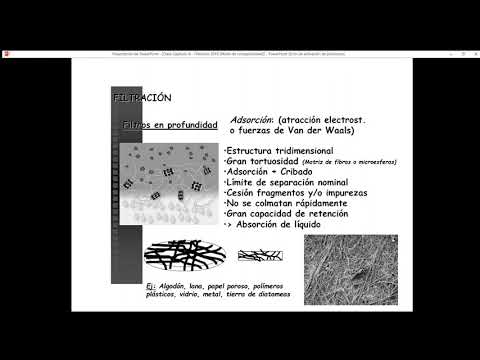
- Depth filters have a 3D structure for screening and absorption but may release impurities back into the solution.
- Surface or membrane filters use rigid polymer sheets for mechanical screening but may clog quickly.
Ideal Filter Characteristics
- Desired filter traits include high particle retention, chemical/mechanical durability, easy cake detachment, high filtrate volume, non-contaminating components.
Materials Used in Different Filters
This section explores materials utilized in various types of filters and their specific applications.
Filter Materials
- Depth filters use loose materials like cotton or glass wool for large molecule separation; porous materials like diatomaceous earth can also be employed.
Chemical Filtration Processes
The section discusses various filtration processes, including the use of membranes with different pore sizes for filtering based on molecular weight and the application of techniques like dialysis and reverse osmosis.
Membrane Filtration
- Membranes can be used for filtration based on factors like chemical compatibility, thermal resistance, and pore size.
- The relationship between membrane diameter and filtrate volume is shown in a table.
- Different types of filtration setups are illustrated, such as conventional filtration with filter paper on a glass funnel and Büchner funnel setup with vacuum assistance.
Ultrafiltration Techniques
- Ultrafiltration involves using centrifugal force to accelerate filtration through small membrane pores.
- Ultrafiltration devices utilize vials with a top reservoir containing a specific pore size filter to separate molecules based on size.
- By exploiting centrifugal acceleration, molecules are separated by size, determined by the molecular weight cutoff (14), which influences molecule passage through pores.
Dialysis and Reverse Osmosis
This part delves into dialysis as a method for separating colloidal particles by size using membranes with tiny pores. It also explores reverse osmosis as a technique to purify water by forcing it through a semipermeable membrane under pressure.
Dialysis Process
- Dialysis separates colloidal particles based on size through small-pore membranes allowing small molecules like salts and water to pass while blocking macromolecules.
- Low molecular weight molecules move from higher concentration solutions to lower concentration solutions through the membrane.
Reverse Osmosis Technique
- Reverse osmosis forces water through a semipermeable membrane under pressure, permitting only water molecules to pass.