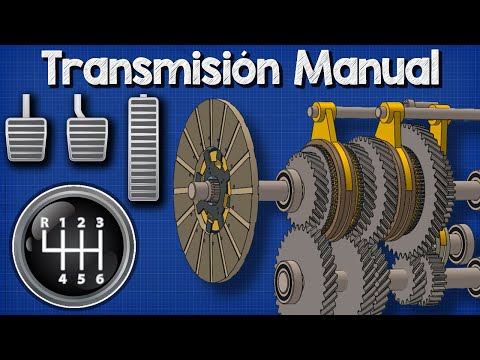
Transmisión Manual
How Does a Manual Transmission Work?
Introduction to Manual Transmission
- The manual transmission is essential for all combustion engine vehicles, from family cars to high-performance sports cars. It plays a crucial role in vehicle operation and efficiency.
Components of a Vehicle's Drivetrain
- Vehicles with rear-wheel drive consist of several key components: the engine, clutch, transmission, driveshaft, differential, axles, and wheels. Front-wheel drive and all-wheel drive vehicles have slight variations but still require a transmission.
Functionality of the Transmission
- The engine burns fuel to move pistons and crankshaft, generating rotation. The clutch connects or disconnects this rotational energy from the engine to the transmission. The transmission uses various gears to transfer power from the engine to the wheels while allowing speed and torque adjustments.
Manual vs Automatic Transmissions
- A manual transmission requires drivers to know when and which gear to shift into while using a clutch pedal for engagement/disengagement of the motor's power. In contrast, automatic transmissions handle these processes automatically for convenience.
Gear Shifting Analogy with Bicycles
- Similar to cycling where starting on a high gear is difficult; vehicles also start in lower gears for better acceleration before shifting up as speed increases or down when climbing hills. Lower gears provide high torque at low speeds; higher gears offer high speed but low torque.
Understanding Torque
Definition of Torque
- Torque measures the force that causes an object (like a nut) to rotate around an axis; it can be illustrated by comparing different wrench lengths applied with equal force—longer wrenches yield greater torque due to increased leverage.
Gear Ratios Explained
- When connecting two gears:
- If both are equal in diameter (1:1 ratio), they rotate together.
- If one gear is half the diameter of another (2:1 ratio), it rotates faster than its counterpart.
- Conversely, if it's double in size (1:2 ratio), it rotates slower requiring more rotations from the driving gear for one complete turn of the driven gear. This principle applies similarly in reverse direction scenarios using intermediate gears known as gear trains.
Components Inside a Transmission
Internal Structure Overview
- The main housing protects internal components like input/output shafts and counter shafts that rotate together with fixed gears attached on them.
Gear Design Features
- Gears feature helical cuts that allow gradual engagement across multiple teeth rather than abrupt contact—this reduces noise during operation compared to straight-cut gears.
Clutch Mechanism
How Does a Synchronizer Work in a Manual Transmission?
Overview of the Input and Output Shafts
- The input shaft rotates each time the clutch engages with the engine, causing both the input shaft and countershaft to turn. This is crucial for power transfer within the transmission.
- A series of gears of varying sizes on the output shaft are constantly meshed with gears on the countershaft, allowing for coordinated movement between these components.
Functionality of Gear Engagement
- Each output gear is mounted on a needle bearing, enabling it to rotate independently from the output shaft itself. This design allows for smoother operation during gear changes.
- The output shaft features several notched sections where a synchronizer hub fits snugly, ensuring that it can rotate with the shaft when engaged properly.
Role of Synchronization Components
- A synchronization sleeve fits over the hub; its grooved surfaces interlock with those of both components, facilitating movement as needed during gear shifts. The sleeve moves back and forth in conjunction with shifting actions.
- Additional straight-cut teeth align within this sleeve when a gear is selected, allowing for proper engagement between the sleeve and gear once synchronized correctly. This ensures smooth transitions without grinding or clashing sounds during shifts.
Addressing Speed Differences
- When engaging gears, discrepancies in rotational speeds between the output shaft and sleeve can cause teeth to clash; thus, a synchronizer blocking ring is employed to prevent premature engagement until speeds match up adequately.
- The inner edge of this blocking ring is angled to fit against conical shapes on gears, which aids in smooth sliding into position without resistance or damage during shifts. Additionally, small pins held by radial springs assist in maintaining alignment throughout this process.
Mechanism of Gear Shifting
- As shifting occurs, friction generated helps synchronize speeds between components before full engagement takes place; this prevents wear and tear while ensuring effective power transfer through correct gearing ratios as needed for driving conditions.
- Once synchronized successfully via frictional contact at specific points (like cone edges), engagement occurs smoothly—allowing drivers to shift seamlessly through various gears without significant delay or mechanical failure risks involved in manual transmissions.
Process for Engaging Reverse Gear
- To engage reverse effectively after stopping completely: an intermediate gear aligns with both output and counter shafts using straight-cut designs that allow free rotation until necessary adjustments are made post-stopping action by drivers themselves—ensuring safety measures remain intact throughout operations performed manually by users behind wheels!
Steps for Shifting Through Gears
- First Gear: Disengage clutch; move shifter to engage first gear while utilizing synchronization methods described earlier.
How Gear Trains Work
Understanding Gear Mechanisms
- To reverse the direction of a vehicle, the clutch is disengaged, stopping all gears. The intermediate gear's teeth are then adjusted before re-engaging the clutch to change the output shaft's direction.
- The engine propels the car forward, and shifting gears allows for increased speed. A mention of "The Great Courses Plus" offers free trials for learning resources related to engineering and other subjects.
- "The Great Courses Plus" provides on-demand learning with over 13,000 expert-led videos across various fields including science and history. Personal recommendations highlight engineering lectures as particularly engaging.
- New content is added monthly, allowing users to watch unlimited videos on multiple devices. Viewers can start a free trial by clicking a link in the video description.
Calculating RPM and Torque in Simple Gear Trains
- Explanation of how to calculate RPM (Revolutions Per Minute) and torque using Excel sheets provided in the video description:
- Output RPM = Input RPM / Gear Ratio
- Output Torque = Input Torque × Gear Ratio
- Example given: If gear A has 8 teeth and gear B has 10 teeth, the ratio is 10/8 = 1.25. If gear A spins at 150 RPM, then gear B will spin at 120 RPM (150/1.25).
- For torque calculations: if gear A has a torque of 20 Nm, then gear B will have an output torque of 25 Nm (1.25 × 20). Larger gears rotate slower but provide more torque.
Compound Gears Analysis
- Introducing another gear C with 20 teeth results in a new ratio of 2 (20/10). The output RPM remains at 120 since they share an axis; however, it also maintains a torque equal to that of gear B (25 Nm).
- When adding another smaller gear D with eight teeth into this system, its ratio becomes less than one (8/20 = 0.4), resulting in higher RPM but lower torque compared to larger gears.
Practical Applications of Gears
- Visualization aids understanding how gears manipulate speed, torque, and direction within complex systems like compound trains where multiple gears interact.
- In this example setup with four interconnected gears A through D:
- Gear A drives B at reduced speed due to size differences while increasing torque.
- Each subsequent connection affects both speed and force transmitted through the system.
- As each additional gear alters performance characteristics—like rotation direction or speed—it’s crucial to consider these factors when designing mechanical systems requiring specific outputs.
Conclusion on Gear Functionality
- The discussion emphasizes understanding how different configurations affect performance metrics such as speed and torque—critical for applications like automotive design or machinery operation.