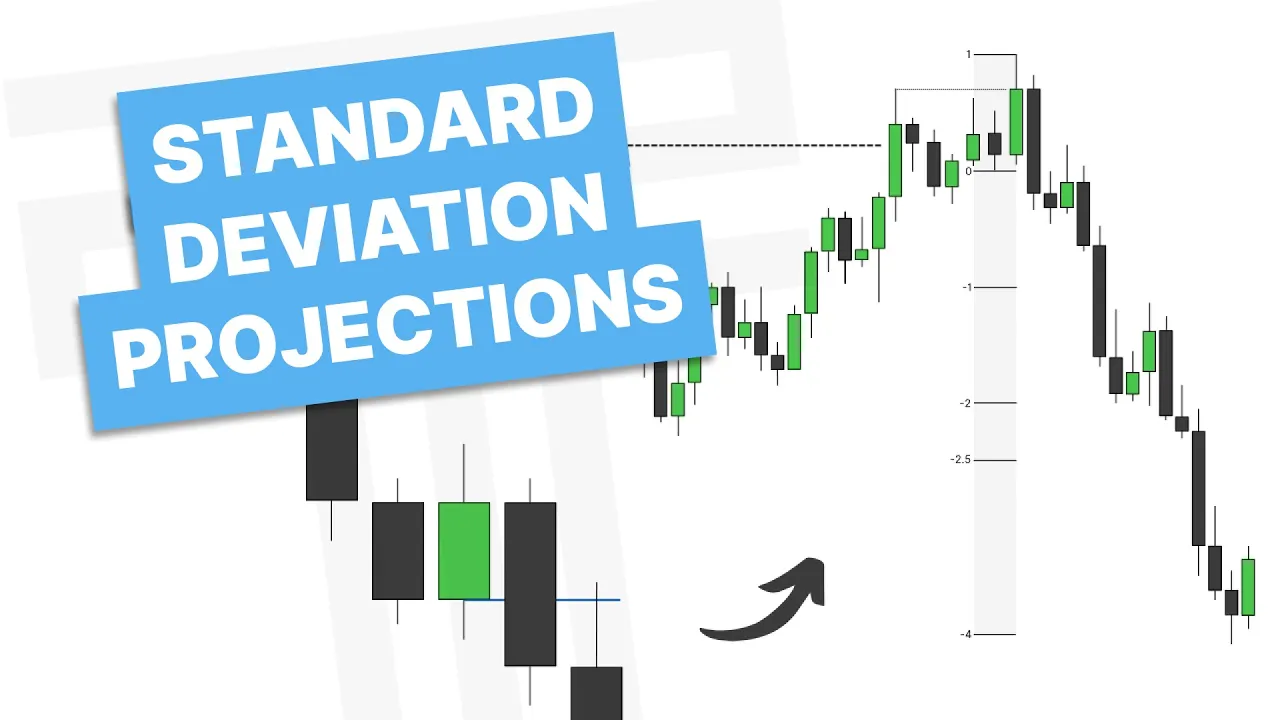
Standard Deviation Projections - ICT Concepts
Introduction
The video introduces the concept of standard deviation projections and how they can be used to find target areas for retracements or reversals. It also mentions the importance of confluence with existing strategies.
Standard Deviation Projections
- Fibonacci retracement tool settings: 1, 0, -1, -2, -2.5, and -4.
- Anchor the Fibonacci tool to the manipulation leg (swing that swept liquidity before changing delivery state or shifting structure).
- Examples of projecting out the manipulation leg using Fibonacci retracement tool.
- Price action examples of smart money reversals and projection outcomes.
Areas of Interest in Projections
This section focuses on specific areas (-2 to -2.5 and -4 standard deviations) as points of interest when price reaches them. It also discusses pairing these standard deviations with PD arrays (fair value gaps, liquidity resting between them).
Areas of Interest
- When price reaches -2 to -2.5 standard deviations, look for retracement or reversal.
- If price displaces and closes through this area, expect max expansion at 4 standard deviations.
- Pairing standard deviations with PD arrays for additional confirmation.
- Marking out areas of interest on charts and looking for PD array confluences.
Conclusion
The video concludes by emphasizing the importance of identifying manipulation legs and projecting them out using Fibonacci retracement tools. It highlights the significance of confluences between different projections and PD arrays.
Final Thoughts
- Projecting manipulation legs using Fibonacci retracement tools provides valuable insights into potential price movements.
- Look for confluences between different projections and PD arrays for stronger confirmation.
Analyzing the Chart
The speaker analyzes the chart and identifies key levels and patterns.
Identifying Key Levels
- The speaker marks out the -2 to -2.5 level on the chart.
- They also mark out the -4 level.
- A fair value gap is identified as an important level.
Projecting Manipulation Legs
- The speaker projects manipulation legs to determine potential targets.
- They use PD arrays to add confluence to their targets.
- Multiple projections are used to enhance accuracy.
Market Maker Sell Model
The speaker discusses a market maker sell model using projection techniques.
Setting Objectives
- The speaker identifies the -2 to -2.5 standard deviations as one objective.
- They also target the fourth standard deviation for selling opportunities.
Reviewing Price Movement
The speaker reviews how price moved according to their projections.
Sweeping Lows and Projection Opportunities
- Price sweeps the projected lows but still aligns with the fourth standard deviation.
- Another manipulation leg is identified for further projection opportunities.
Top-down Analysis Example
The speaker demonstrates a top-down analysis example using multiple time frames.
Daily Chart Analysis
- Price reaches a daily fair value gap and makes a reversal.
- Anticipating a sell week, Thursday is expected to continue lower.
Hourly Chart Analysis
- The manipulation leg from the daily fair value gap is projected on the hourly chart.
- Targets are set at 2 to 2.5 standard deviations below Thursday's range.
15-Minute Chart Analysis
- London session shows aggressive downward movement.
- Equal highs are identified as potential resistance levels.
5-Minute Chart Analysis
- New York session is expected to move lower into the 2 to 2.5 standard deviation area.
Further Analysis on Lower Time Frames
The speaker continues analyzing lower time frames for potential trading opportunities.
2-Minute Chart Analysis
- An order block is marked, indicating a potential formation.
Timestamps and content have been summarized and organized for study purposes.
New Section
In this section, the speaker discusses the PD arrays and projections, specifically focusing on the London low as a potential target for trading.
PD Arrays and Projections
- The speaker examines if there are any PD arrays aligning with the projections.
- A London low is identified as a potential target, as it rests just above -2 standard deviations.
- The speaker suggests zooming in to find an entry point for trading.
New Section
In this section, the speaker discusses a possible entry strategy based on retesting an order block and targeting the London lows.
Entry Strategy
- The first entry strategy involves looking for a retest of a specific order block.
- The stop loss would be placed at the high of that retest.
- The target would be set at the London lows.
New Section
This section reviews a trade scenario where there was a classic sell-off followed by retracement towards London lows.
Trade Scenario Review
- A classic sell-off is anticipated, leading to potential expansion into Thursday.
- On the hourly chart, manipulation is found and projected out to determine an overall target.
- The yellow box represents the target area, which is reached successfully.
- There is subsequent encroachment into that target area.
New Section
Here, the speaker explains how they analyzed lower time frames and used daily profiles to find an entry point targeting London lows.
Analyzing Lower Time Frames
- After reaching the overall target mentioned earlier, the speaker drops down to lower time frames.
- They examine the daily profile to identify an entry opportunity targeting London lows.
New Section
In this final section, the speaker concludes the video and mentions plans for future content.
Conclusion and Future Plans
- The speaker hopes that viewers found the video helpful.
- They ask for feedback on combining previous videos with this one, focusing on accumulation manipulation and distribution combined with standard deviations.
- The video ends with a farewell message and a promise to return with new content in the future.
Timestamps are provided in seconds to link to specific parts of the video.