APES Notes 7.2 - Photochemical Smog
Introduction to Photochemical Smog
In this section, we will learn about the causes and effects of photochemical smog, as well as methods to reduce it.
Precursors of Photochemical Smog
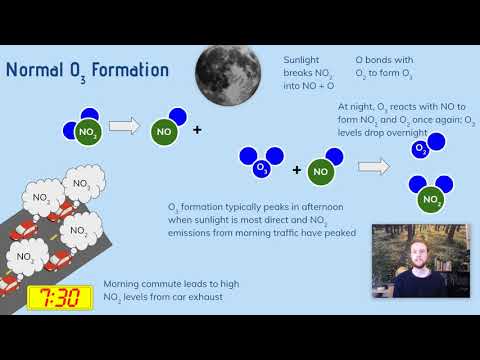
- Nitrogen dioxide (NO2) is broken down by sunlight into nitric oxide (NO) and free oxygen. The free oxygen combines with atmospheric O2 to form ozone (O3), which is a secondary pollutant.
- Volatile organic compounds (VOCs) are easily vaporized hydrocarbon compounds. They include substances like acetone and gasoline.
- VOCs can be emitted from petrochemical or plastic production processes, as well as natural sources like coniferous trees.
Environmental Conditions for Smog Formation
- Sunlight is required to break down nitrogen dioxide and drive ozone production.
- Warmth accelerates the reactions that create photochemical smog, including the evaporation of volatile organic compounds.
Normal Ozone Formation
- Early morning traffic produces nitrogen oxides (NOx), leading to an increase in NO2 concentrations in the atmosphere.
- When sunlight interacts with NO2, it breaks down into nitric oxide (NO) and a free oxygen atom.
- The free oxygen atom binds with atmospheric O2 to form ozone (O3).
- Normally, at night when there is no sunlight or traffic emissions, ozone recombines with nitric oxide to produce nitrogen dioxide again.
Effects of Ozone in the Troposphere
In this section, we will explore the effects of ozone in the troposphere.
Effects on Humans
- Ozone in the troposphere is a respiratory irritant for humans.
- It can also damage plant stomata, limiting their ability to take in carbon dioxide and potentially affecting plant growth.
Factors Affecting Smog Formation
In this section, we will discuss the factors that influence the formation of smog.
Sunlight and Traffic Emissions
- Sunlight is necessary for the breakdown of nitrogen dioxide and the subsequent production of ozone.
- Traffic emissions contribute to the increase in nitrogen oxides (NOx) concentrations, which are precursors for smog formation.
Nighttime Conditions
- During nighttime, when there is no sunlight or traffic emissions, ozone recombines with nitric oxide to form nitrogen dioxide again.
- Under these conditions, smog is not prevalent as there are no significant accumulations of ozone in the atmosphere.
The transcript does not provide further information beyond this point.
New Section
This section discusses the formation of photochemical smog and the role of nitrogen dioxide, ozone, and volatile organic compounds in this process.
Formation of Ozone and Nitrogen Dioxide
- Nitrogen dioxide is produced during the morning commute when traffic increases.
- Nitrogen dioxide breaks down into nitric oxide and oxygen.
- Oxygen combines with O2 to form ozone.
Introduction of Volatile Organic Compounds
- Volatile organic compounds come from gasoline, detergents, cleaning solutions, and petrochemical processes.
- When these compounds enter the atmosphere, they alter the reaction between nitric oxide and ozone.
- They bind with nitric oxide to form photochemical oxidants.
Build-up of Ozone
- The presence of volatile organic compounds prevents nitric oxide from recombining with ozone.
- As a result, ozone builds up in the atmosphere.
- The combination of ozone and photochemical oxidants leads to the formation of photochemical smog.
Factors Increasing Smog Formation
- Increased traffic contributes to higher levels of nitrogen dioxide emissions.
- Urban areas with gas stations and industries involving petrochemicals have higher volatile organic compound emissions.
- Warmer temperatures and more sunlight accelerate smog formation by increasing evaporation and ozone production.
Impact of Smog
- Smog limits photosynthesis in plants, inhibiting their growth.
- It irritates respiratory tracts in animals, including humans, exacerbating conditions like asthma, COPD, bronchitis, emphysema.
New Section
This section explores how urban areas are more prone to experiencing smog due to various factors. It also discusses the economic costs associated with smog.
Factors Contributing to Smog in Urban Areas
- Higher density of cars in urban areas leads to increased nitrogen dioxide levels.
- Urban heat island effect causes warmer temperatures, which accelerate smog formation.
- Increased evaporation of volatile organic compounds due to higher temperatures.
- Power plants burning coal or natural gas in urban areas release nitrogen dioxides.
Impact on Urban Areas
- Urban areas are more likely to experience smog compared to suburban or rural areas due to these factors.
Economic Costs
- Smog results in lost economic productivity.
New Section
This section highlights the specific health effects of smog on humans and its impact on plant growth.
Health Effects on Humans
- Smog worsens asthma, COPD, bronchitis, emphysema, and irritates the eyes.
- Ozone is particularly damaging to human health.
Impact on Plant Growth
- Smog limits photosynthesis and damages stomata, inhibiting plant growth.
Impact of Smog on Agricultural Yields
The impact of smog on agricultural yields is discussed, highlighting how smog can affect areas outside of urban areas and decrease agricultural productivity.
Smog's Impact on Agricultural Yields
- Smog can disperse through wind and impact nearby areas, even outside of urban or suburban regions.
- Agricultural yields can be decreased due to the effects of smog.
- Factors such as nitrogen dioxide and ozone formation contribute to the negative impact of smog on agriculture.
Ways to Reduce Smog
Strategies for reducing smog are discussed, focusing on reducing vehicle emissions and gasoline consumption.
Strategies for Reducing Smog
- One way to reduce smog is by decreasing the total number of vehicles on the road and minimizing their travel distance.
- Vehicle emissions are a major source of nitrogen oxides (NOx) in the atmosphere, which contribute to smog formation.
- Lowering gasoline consumption helps decrease nitrogen dioxide levels and volatile organic compounds (VOCs) that contribute to smog.
- Using renewable energy sources like solar, wind, and hydroelectricity for electricity production reduces NOx emissions.
- Switching from coal to natural gas as a fossil fuel alternative significantly reduces nitrogen oxide production.
FRQ 7.2 Practice Question
A practice question related to analyzing the relationship between nitrogen dioxide concentration and ozone concentration is introduced.
Analyzing Nitrogen Dioxide and Ozone Concentration Relationship
- Students are presented with a graph showing the concentration of various compounds at different times of day.
- The task is to explain the relationship between nitrogen dioxide concentration and ozone concentration based on the provided graph.