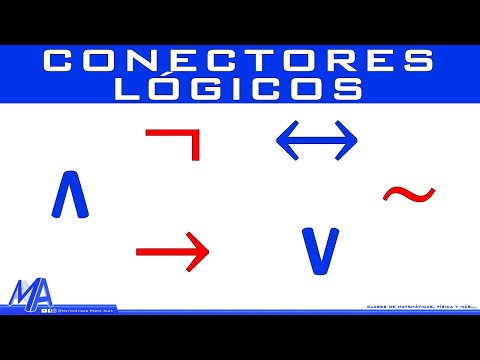
Conectores lógicos
Understanding Logical Connectors
Introduction to Logical Connectors
- The video aims to explain what logical connectors (also known as logical operators) are and how to use them, building on concepts from a previous video about propositions.
- The speaker will utilize various propositions as examples to illustrate the different types of logical connectors.
Propositions and Their Symbols
- Propositions are represented by letters for simplicity; for instance, "p" represents "I will go to the cinema," and "q" represents "I will play football."
- The focus is on converting phrases into symbols, which helps in understanding logical operations.
Negation: The First Logical Connector
- Negation is introduced as a key logical connector, symbolized by specific characters. The most common symbol used in this course is highlighted.
- To symbolize negation in propositional logic, if "p" stands for "I will go to the cinema," then "not p" indicates that one will not go to the cinema.
Examples of Negation
- Various examples demonstrate how negation works with different propositions. For example, “not q” would mean “I will not play football.”
- It’s emphasized that negation can be expressed in multiple ways; for instance, saying “it is false that I am giving you flowers” can also be written as “not r.”
Rules of Negation
- Not all statements negate simply with the word 'no'; some require alternative phrasing like “it is false that...”
- An important rule mentioned is that double negations cancel each other out. For example, saying “it is false that it is not raining” simplifies directly to stating “it is raining.”
Practical Application of Double Negations
- When using double negations in logic expressions, they can often be eliminated for clarity. This principle applies universally across various statements.
- A practical example illustrates this concept: if we say “it’s false that 2 isn’t even,” it effectively confirms that 2 indeed is even.
Conclusion on Negation Usage
- The speaker concludes by reiterating the significance of recognizing double negatives and their simplification within propositional logic.
Understanding Logical Connectives
Negation and Conjunction
- The concept of negation can be interpreted as "not" or "is false," with both interpretations being valid.
- Negation is typically applied to a single proposition, although it can extend to multiple propositions when parentheses are used.
- Conjunction, represented by "y" (and), connects two propositions; for example, "I will go to the cinema" and "I will play football."
- In Spanish, conjunction is often expressed as “iré al cine y a jugar,” demonstrating how two propositions are combined using 'y.'
- Symbols for logical operations: the symbol for conjunction resembles an intersection while disjunction resembles a union.
Symbolization of Propositions
- To symbolize the conjunction of two propositions like "I will go to the cinema" and "I will play football," one uses letters such as p and q.
- An example provided is “te regaló flores y dulces” which symbolizes that someone gave flowers and sweets using conjunction.
- Disjunction is introduced with examples like “iré al cine o a jugar,” indicating options between two actions connected by 'o' (or).
Conditional Statements
- The conditional connective is represented by an arrow (→), indicating that if one proposition occurs, then another follows.
- Examples include statements like “if I behave well, then I will take you out,” illustrating how conditions link actions logically.
- Another example given is “it’s raining, therefore there are clouds in the sky,” showcasing practical applications of conditional logic.
Biconditional Logic
- The biconditional connective indicates mutual implication between two statements, symbolized by a double-headed arrow (↔).
Logical Connectives and Propositions
Understanding Logical Connectives
- The speaker introduces the concept of logical connectives, emphasizing their conditional nature. Examples include "I will go to the movies if and only if it is raining" and "I will play football if and only if I go to the movies."
- The explanation concludes with a prompt for an exercise involving compound propositions connected by logical connectives, encouraging practice in understanding these concepts.
Exercise on Propositions
- Participants are instructed to articulate how certain propositions read in words, focusing on negations and conjunctions. This includes examples like "I will not go to the movies" combined with other actions.
- The speaker provides specific propositions for analysis, such as "I will go to the movies" and "I will play football," illustrating how they can be logically connected or negated.
Logical Soundness
- The discussion highlights that logical statements become clearer when articulated properly. For instance, stating "If there are no clouds in the sky, then it is not raining" demonstrates improved logical clarity.