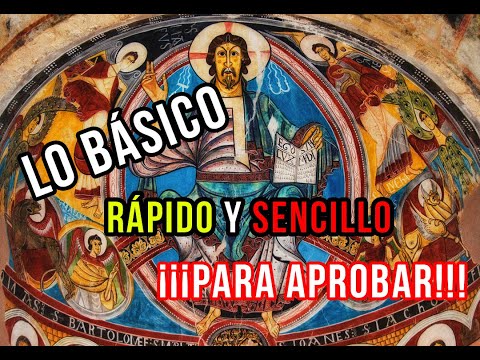
REPASA EL ROMÁNICO en 7 MINUTOS !! - Lo básico para APROBAR
Introduction to Romanesque Art
In this section, the speaker introduces the topic of Romanesque art and its general characteristics.
Characteristics of Romanesque Art
- Romanesque art emerged in Italy and France during the 11th and 12th centuries.
- It became an international style and spread across Europe after the fall of the Western Roman Empire.
- The influence of the Christian Church is evident in Romanesque art, as it was used to convey biblical messages to illiterate populations.
- The art was closely tied to rural environments and pilgrimage routes, reflecting the feudal and agrarian nature of medieval Europe.
Architecture in Romanesque Art
This section focuses on the architecture of Romanesque art, particularly cathedrals, churches, and monasteries.
Architectural Features
- Key architectural elements found in Romanesque buildings include:
- Use of round arches
- Barrel vaults
- Thick columns and pillars
- Wide walls with small windows resulting in limited natural light inside
- The most representative building in Romanesque art is the church, which typically follows a Latin cross plan.
- The church includes a long nave or naves forming the longer arm of the cross, a shorter arm called transept where Christ's head would be located hypothetically, an apse housing the altar, and an ambulatory for pilgrim transit.
Painting and Sculpture in Romanesque Art
This section explores painting and sculpture within Romanesque art.
Painting
- Both painting and sculpture in Romanesque art share similarities.
- They are influenced by Christian themes from the Bible.
- Common subjects include biblical passages and sacred figures such as Christ on the cross, Christ in majesty, and the Virgin Mary with child.
- The paintings are adapted to fit the available spaces within buildings.
- Many of the original colors have faded over time, but it is known that polychromy was used, with vibrant and flat colors without much detail or shading.
- Figures are depicted rigidly and schematically, lacking emotion or intricate details.
Sculpture
- Sculptures in Romanesque art were primarily seen in reliefs found on column shafts, capitals, tympanums, and other parts of buildings.
- Common motifs include plants, animals, and religious scenes.
- Tympanums at church entrances often depict Christ's acceptance surrounded by biblical characters narrating stories related to the Gospels.
- Free-standing sculptures like crucifixes and Madonna with Child were also prevalent.
Types of Painting in Romanesque Art
This section discusses different types of painting techniques used in Romanesque art.
Mural Painting
- Mural painting refers to paintings done directly on walls using fresco technique.
- Notable representations include Christ in Majesty (Christ Pantocrator) and the Virgin Mary.
Miniature Paintings
- Miniature paintings can be found in books such as Bibles and religious codices.
Altarpiece Paintings
- Altarpieces made of wood often feature pictorial representations behind altars.
Conclusion
Romanesque art emerged as a significant artistic style during medieval times. It was characterized by its association with Christian themes, rural influences, architectural features like round arches and thick walls, as well as distinctive painting and sculpture techniques. Understanding these characteristics helps us appreciate the rich cultural heritage left behind by this period.