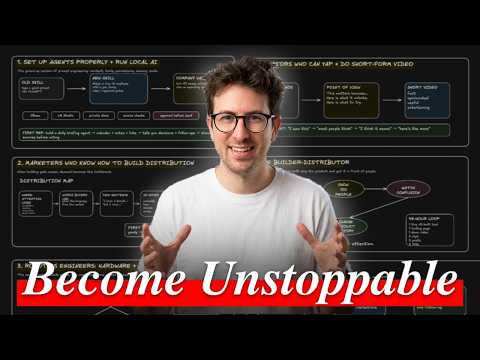
"Learn AI” Is Bad Advice. Learn This Instead
What Are the Six Most Valuable Skills in an AI-Driven Future?
Introduction to Valuable Skills
- The speaker discusses a future where AI can perform many tasks traditionally done by humans, prompting the question of which skills will remain valuable.
- They identify six core skills that do not require advanced degrees or connections and can be started immediately.
- Each skill becomes more valuable as AI technology advances, rather than less. By the end of the episode, viewers will learn about these skills and how to get started with them.
Skill 1: Managing Local AI Agents
- The first skill is setting up and managing local AI agents, evolving from basic prompt engineering to creating functional AI employees with specific goals and permissions.
- Companies will face challenges integrating multiple AI tools into cohesive workflows; those who can manage this complexity will be indispensable.
- Understanding local models is crucial for privacy, cost management, and operational control over workflows involving sensitive data.
Getting Started
- A practical exercise involves building a daily briefing agent that aggregates information from various sources to help prioritize tasks effectively. This teaches context retrieval and evaluation metrics for success.
Skill 2: Mastering Distribution in Marketing
- The second skill focuses on marketers who excel at distribution—understanding where attention lies and how to build trust before asking for purchases. This goes beyond mere posting on social media platforms.
- Successful marketers must blend research, storytelling, media operation, and community building to create compelling narratives around products or services.
Practical Steps
- To develop distribution skills, create a distribution map identifying key attention sources within a chosen niche and articulate common pain points expressed by potential customers. Then generate engaging hooks based on these insights to attract interest before product development begins.
Skill 3: Robotics Engineering
- Robotics engineers who can integrate hardware with AI are increasingly valuable as industries shift focus from software-centric solutions to hardware innovations that incorporate intelligent systems.
- Advances in open-source robotics projects have made it easier for individuals without formal training in robotics to engage in this field creatively and practically using affordable components available online.
Learning Pathway
- Start by assembling a low-cost robotic arm paired with a camera; teach it simple tasks while documenting failures encountered during the process—this builds resilience and understanding of real-world applications of robotics technology.
Skill 4: Curation Expertise
- Curators who can distill vast amounts of information into meaningful content are essential in today's information-saturated environment; they provide clarity through storytelling rather than just sharing links or articles indiscriminately.
Developing Curation Skills
- Engage in a week-long curation sprint focused on a specific niche; produce short videos summarizing insights while maintaining an authentic voice that resonates with audiences seeking genuine connection amidst overwhelming content options online.
Skill 5: Building Distributors
- The fifth skill emphasizes individuals capable of both product creation and effective marketing—a hybrid role becoming increasingly important as traditional boundaries between building and selling blur due to technological advancements like AI.
Actionable Steps
- Conduct a "48-hour loop" exercise where you identify a small problem you understand well; prototype an initial solution using available tools while simultaneously crafting promotional materials before launch.
Skill 6: IRL Community Builders
- Finally, there’s value in fostering real-life communities as people seek authentic connections amid digital interactions; skilled community builders know how to create environments conducive to networking and collaboration.
Starting Point
- Host intimate gatherings centered around thought-provoking questions relevant to your interests or industry; follow up with recaps highlighting key takeaways from discussions—this transforms casual meetups into lasting networks.
In summary, these six skills represent critical competencies needed for thriving in an increasingly automated world where human creativity remains irreplaceable despite technological advancements.
Essential Skills for the Future Workforce
Key Skill Sets Identified
- The speaker outlines six essential skill sets needed for future success:
- Agent Management: Individuals who can effectively set up and manage AI agents.
- Marketing Expertise: Marketers skilled in building distribution channels.
- Robotic Engineering: Engineers capable of integrating AI into hardware and managing manufacturing processes.
- Content Creation: Curators adept at producing engaging short-form video content.
Additional Skill Sets
- Continuing from the previous list, two more critical skills are highlighted:
- Builder Distributor: A versatile individual who can both create products and ensure they reach consumers.
- Community Builder: Someone focused on fostering real-life connections and networks.
Importance of Combining Skills
- The speaker emphasizes that the future favors those who can integrate multiple capabilities. Key questions include:
- Can you make agents useful?
- Can you attract attention?
- Are you able to build physical products?
- Do you understand what is important in your field?
Strategic Skill Development
- The speaker encourages listeners to focus on developing a combination of these skills:
- Choose one skill to master; becoming proficient in two provides leverage.
- Mastering three or more makes an individual highly desirable in any team or organization.
Navigating Future Job Markets
- The discussion reflects uncertainty about future job markets but stresses that possessing diverse skills will serve as a protective measure against economic changes.
- The speaker believes that having a robust skill set acts as a "defense" or "shield" in unpredictable times.
Conclusion and Call to Action
- The episode aims to clarify what individuals should focus on regarding their career paths.
- Listeners are encouraged to share this information with others who may benefit from understanding these essential skills.
Closing Remarks
- The speaker expresses gratitude towards the audience, wishing them creativity and success as they navigate their personal development journeys.