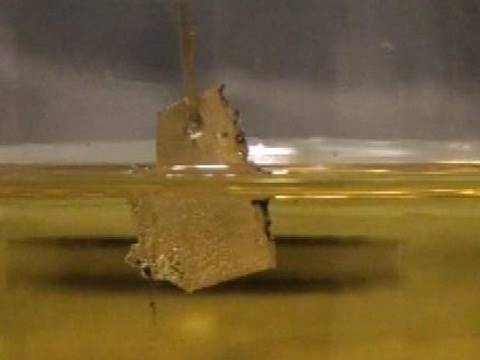
Aqua Regia dissolves Gold - Periodic Table of Videos
Aqua Regia: The Royal Water
Introduction to Aqua Regia
- Aqua Regia, known as "Royal Water," is a mixture of hydrochloric acid and nitric acid, capable of dissolving gold.
- Gold's unique properties—its resistance to tarnishing and dissolution—make it a fascinating material throughout history.
Chemical Composition
- Hydrochloric acid (HCl) consists of hydrogen chloride, which dissociates in water into chloride ions (Cl-) and hydrogen ions (H+), the latter being responsible for its acidic nature.
- Neither hydrochloric nor nitric acid alone can dissolve gold; however, their combination allows for a reaction that facilitates gold dissolution.
Mechanism of Gold Dissolution
- Nitric acid initiates the process by attacking gold atoms, leading to an equilibrium where some atoms enter solution while others remain on the surface.
- Chloride ions from hydrochloric acid convert dissolved gold into a soluble compound with four chlorine atoms surrounding it, allowing complete dissolution.
Properties and Uses
- The resulting solution from Aqua Regia can appear brownish or greenish depending on the concentration of dissolved gold; it requires careful handling due to toxic fumes produced during reactions.
- Aqua Regia serves as a last-resort cleaning agent for laboratory glassware when other methods fail.
Historical Anecdote
- A notable incident involved German Nobel Prize winners who sent their gold medals for safekeeping during WWII; they were accidentally dissolved in Aqua Regia at Niels Bohr's institute in Denmark.