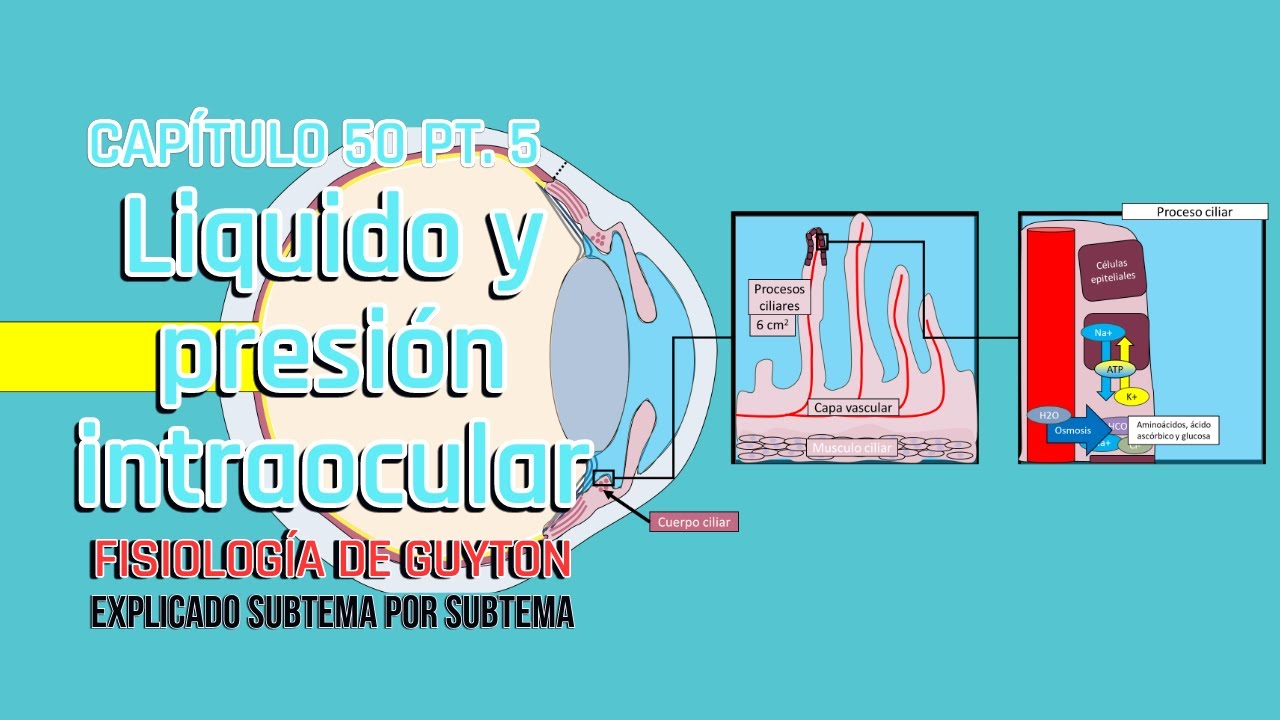
CAP 50 5/5: Liquido y presión intraocular l Fisiología de Guyton
New Section
In this section, the speaker introduces the topic of intraocular fluid and its significance in maintaining eye shape.
Formation of Intraocular Fluid
- The intraocular fluid consists of two main components: vitreous humor and aqueous humor.
- The vitreous humor is gelatinous due to high hyaluronic acid content, providing rigidity. In contrast, the aqueous humor is more liquid and undergoes continuous formation and reabsorption.
- Emphasis is placed on the aqueous humor as it significantly influences intraocular pressure regulation.
New Section
This part delves into how aqueous humor is formed within the ciliary bodies.
Formation of Aqueous Humor
- Aqueous humor synthesis occurs in the ciliary processes, which are richly vascularized structures connected to lens suspensory ligaments.
- The ciliary processes' cellular structures synthesize aqueous humor. These processes cover a significant area where fluid production takes place.
New Section
Here, the process of aqueous humor formation through concentration gradients is explained.
Mechanism of Aqueous Humor Formation
- Aqueous humor primarily forms due to concentration gradients between cells, facilitated by sodium movement via ATP pumps.
- Osmosis plays a crucial role as water moves from lower solute concentration (blood vessels) to higher solute concentration (ciliary processes).
New Section
This segment elaborates on osmosis's role in generating aqueous humor and regulating intraocular pressure.
Osmosis and Pressure Regulation
- High solute concentrations in ciliary processes induce osmosis, drawing water from blood vessels into interstitial spaces.
- Various solutes aid in osmosis, leading to water movement that fills both anterior and posterior chambers with aqueous humor.
New Section
Focus shifts towards the circulation and disposal of aqueous humor within the eye.
Circulation and Disposal of Aqueous Humor
- Aqueous humor production rate ranges from 2 to 3 microliters per minute, emphasizing its constant recycling process.
New Section
This section discusses the mechanism of pressure regulation in the eye and how it relates to intraocular pressure.
Mechanism of Pressure Regulation
- The resistance in the eye regulates intraocular pressure, primarily controlled by the resistance of fluid outflow through trabeculae.
- Trabeculae contain small openings (2-3 micrometers) that allow aqueous humor to exit, maintaining a balance where production equals drainage at 2.5 microliters per minute.
- Intraocular pressure ranges from 12 to 20 mmHg but can increase if outflow velocity decreases due to trabecular obstruction.
- Obstruction of trabecular spaces, possibly by cells like erythrocytes or leukocytes, can lead to increased intraocular pressure.
Glaucoma Development
- If reticuloendothelial cells fail to clear obstructions in trabeculae, intraocular pressure rises, potentially causing glaucoma characterized by elevated intraocular pressure up to 60-70 mmHg.
- Increased intraocular pressure can compress the optic nerve head's laminar region, affecting axonal flow and leading to cell death due to compromised blood supply from compressed arteries and veins.
Next New Section
This section delves into the consequences of increased intraocular pressure on vision and potential treatments for glaucoma.
Impact on Vision
- Elevated intraocular pressure may result in cell death due to compromised blood supply, risking vision loss as retinal function relies on adequate blood flow.
- Glaucoma can manifest acutely or chronically; chronic cases often occur in older individuals due to fibrotic occlusion of trabeculae which can be managed with surgery or medicated eye drops.