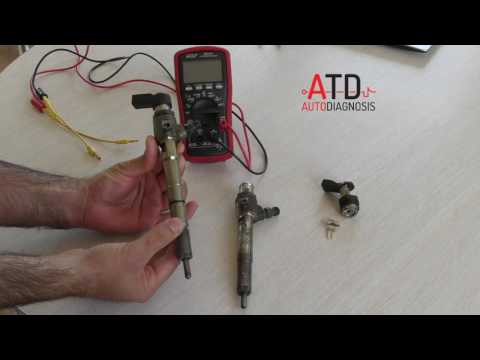
Inyector piezoeléctrico common rail. Funcionamiento detallado.
How Does a Common Rail Piezoelectric Injector Work?
Overview of Common Rail Injectors
- Common rail injectors, both piezoelectric and solenoid types, maintain the same high pressure (around 300-320 bar) at both the bottom and top sides when closed.
- The needle rises due to a pressure difference; higher pressure at the bottom compared to the top pushes the needle upwards, allowing fuel to exit through the nozzle.
Actuation Mechanism
- The injector is actuated by creating a leak from the control chamber to return, resulting in lower pressure on top and higher pressure below, causing needle movement.
- In piezoelectric injectors, an Electronic Control Unit (ECU) sends pulses of 50-60V that increase until reaching 125V due to the piezoelectric effect.
Injection Process
- The voltage amplitude moves a poppet valve downwards, enabling fuel derivation towards return. When ECU stops voltage supply, the piezoelectric remains charged like a condenser.
- To close the injector, a short-circuit is created by ECU between terminals for discharge without inverting polarity.
Oscilloscope Analysis
- An oscilloscope shows voltage (blue line) and current (red line); during idling speed with two pre-injections and one main injection.
- Maximum voltage occurs at zero current; this peak indicates that piezoelectric is charged at 125V before closing via ECU-induced discharge.
Regeneration and Safety Features
- During regeneration phases, post-injections may occur while some pre-injections are canceled to reduce fuel consumption.
- Newer generation injectors have built-in resistance preventing open state if unplugged; it ensures safe closure by discharging any residual charge.
Injector Components Examination
- A common rail injector example from a 1.6 TDI model often fails due to nozzle sticking; internal components include piezoelectrics responsible for control valve operation.
- Resistance measurement of about 200kohms can be taken from piezoelectric terminals; this resistance aids in safe discharge upon disconnection.
Detailed Structure of Piezoelectrics
- The structure includes stacked plates acting as condensers; resistance allows for proper functioning during disconnection scenarios.
- Damage assessment reveals critical components such as contactors for each plate within piezoelectrics which contribute to overall functionality.