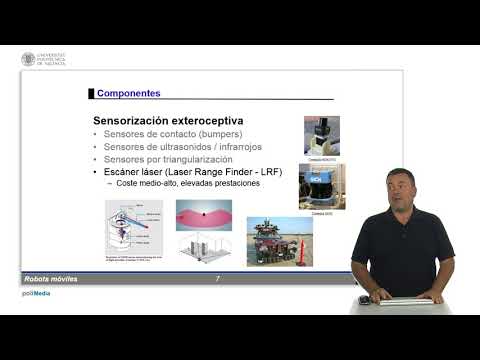
Rmóvil - Componentes - Sensores Exteroceptivos | | UPV
Understanding Mobile Robot Sensory Systems
Introduction to Sensory Systems
- The video focuses on the importance of sensory systems in mobile robots, particularly objective sensors that provide external information about the robot's environment.
- Key objectives include distinguishing between proprioceptive and exteroceptive sensors, identifying various types of exteroceptive sensors applicable in mobile robotics, and evaluating their uses.
Types of Sensors
Proprioceptive vs. Exteroceptive Sensors
- Proprioceptive sensors provide internal information about the robot's state, while exteroceptive sensors give insights into the external environment.
Contact Sensors
- Basic contact sensors (also known as bumpers) are low-cost devices used primarily for collision detection; they trigger when an obstacle makes contact with the sensor.
- These sensors are effective at low speeds and can help navigate by reversing or altering the vehicle's trajectory upon detecting a collision.
Ultrasonic and Infrared Sensors
- Ultrasonic and infrared sensors offer analog distance measurements rather than just binary contact signals, allowing for better obstacle detection.
- They operate based on time-of-flight principles: emitting sound or light waves that bounce off obstacles to calculate distance.
Advanced Sensor Technologies
Triangulation Sensors
- Triangulation methods involve projecting optical markers onto surfaces to determine a vehicle's position within a controlled environment using fixed detectors.
GPS Technology
- Global Positioning System (GPS) is widely used for navigation in vehicles by determining location based on satellite signals.
Laser Scanning Systems
- Laser scanning systems provide high precision by emitting laser beams to map surroundings accurately; they are more advanced compared to traditional ultrasonic or infrared methods.
Vision Systems in Robotics
The Role of Sensors in Robotics
Introduction to Sensor Technology
- The use of multiple cameras allows for the acquisition of three-dimensional depth information, enhancing robotic capabilities.
- Basic robots can navigate mazes using simple distance sensors to detect obstacles and make movement decisions.
Practical Applications in Robotics
- A robot is shown navigating a simulated room, employing sensory data to strategize movements for effective cleaning.
- Another example features a basic robot programmed by a student, utilizing sensors and a gripper to locate, grasp, and transport objects.
Types of Sensors in Mobile Robotics
- Two main categories of sensors are identified:
- Proprioceptive Sensors: Monitor the robot's internal state.
- Exteroceptive Sensors: Gather information about the external environment.
Collision Detection and Avoidance
- Collision detection is primarily achieved through low-speed sensors; however, infrared and ultrasonic sensors are recommended for better accuracy due to their reflective properties.
Advanced Sensor Technologies