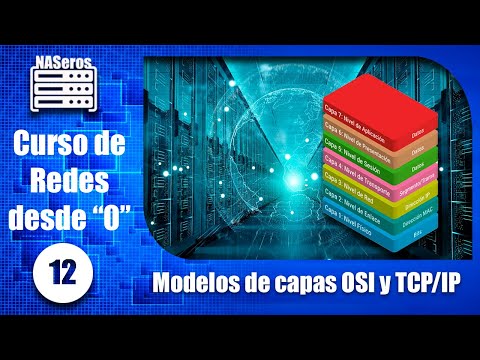
Modelo de capas OSI y TCP/IP. Curso de redes desde 0 | Cap 12 |
Introduction and Course Resumption
In this section, the speaker introduces himself, discusses the hiatus in producing videos due to various reasons, and expresses intentions to resume the network course with vigor in 2021.
Speaker Introduction and Course Resumption
- The speaker is @macjosan on Twitter and runs the NASeros blog's YouTube channel.
- Due to circumstances like the pandemic, there was a pause in video production for the network course.
- Plans are outlined to revive the course strongly in 2021 with a structured schedule for video releases.
Understanding OSI Model
This part delves into explaining the significance of the OSI model in networking, emphasizing comprehension over memorization of its layers.
Significance of OSI Model
- Importance of grasping the concept and purpose of the OSI model rather than focusing solely on memorizing layer specifics.
- Comparison drawn between an ideal educational setting sequence versus adapting content delivery based on audience needs.
Complexity of Network Communications
The discussion centers around how network communication complexity led to the development of layered models like OSI for streamlined operations.
Complexity Leading to Layered Models
- Emergence of layered models like OSI due to intricate nature of network communications.
- Evolution from chaotic early computing days where proprietary systems hindered interoperability.
Simplifying Communication Processes
Simplification through layered models like OSI is highlighted by breaking down complex communication tasks into manageable segments for efficient data transmission.
Simplification Through Layered Models
- Analogy drawn between network communication processes and commercial package delivery systems for better understanding.
Understanding the OSI Model
In this section, the speaker explains the process of parcel delivery as an analogy to introduce the concept of layers in networking, leading to a discussion on the OSI model.
Parcel Delivery Analogy
- The speaker uses a parcel delivery scenario to illustrate how different layers handle specific tasks without concerning themselves with other layers' responsibilities.
- Each layer in the delivery process focuses on its designated task, showcasing a similar approach to how networking layers operate in isolation.
Introduction to OSI Model
- Introduces the OSI model consisting of seven layers and highlights that each layer has distinct functions and responsibilities.
- Explains that while not directly implementing the OSI model, understanding its structure aids in comprehending network communication processes.
Layers of the OSI Model
This part delves into the first two layers of the OSI model, emphasizing their roles and significance in establishing standardized hardware protocols.
Layer 1: Physical Layer
- The physical layer defines hardware standards such as RJ45 connector sizes and fiber optic cable specifications for consistent communication across devices.
- It dictates parameters like wavelength, frequency, and power levels for various mediums like fiber optics and Wi-Fi to ensure seamless connectivity.
Layer 2: Data Link Layer
- The data link layer ensures error-free data transmission by verifying data integrity akin to inspecting a delivered package for damage before forwarding it.
Understanding Network Layers
In this section, the speaker explains the functions and roles of different network layers in data transmission.
Layer 1: Data Verification and Repair
- The first layer ensures data integrity during transmission through methods to verify and repair corrupt data.
- Analogized as checking if a package is intact at various transit points, emphasizing the importance of data verification.
Layer 2: Network Topology Awareness
- Layer 2 (switches) sends and verifies data between locations, understanding network topology intricacies.
- Layer 3 (routers) comprehends overall network structure, directing traffic efficiently based on this awareness.
Layer 3: Traffic Routing
- Routers guide traffic flow within a network based on its topology, akin to a traffic controller with a map.
- Introduction of the transport layer marks initial communication establishment between sender and receiver endpoints.
Layer 4 to Layer 7: Communication Establishment and Application
- Initial communication setup occurs at layer 4 before progressing to higher layers for application-specific interactions.
- Layers 5 (session) and 6 (presentation) focus on communication agreement and data presentation respectively.
TCP/IP Model vs. OSI Model
Contrasting the TCP/IP model with the OSI model in terms of practicality and functionality.
OSI Model Limitations
- OSI model's theoretical nature hindered practical implementation due to poorly developed protocols from its origins in another private company's model.
Emergence of TCP/IP Model
- TCP/IP model evolved from chaotic early internet days, offering simplicity, rapid implementation, reliability, leading to widespread adoption as an industry standard.
Understanding TCP/IP Model Components
Understanding Networking Models
In this section, the speaker explains how layers 1 and 2 merge into a single layer called "host," encompassing hardware and essential functions in networking models.
Layer Consolidation
- Layers 1 and 2 merge to form the "host" layer, crucial for hardware functionality.
- The host layer encapsulates layers 1 and 2, ensuring hardware existence and operation.
- Hardware often manages layer 2 functions, leading to their consolidation under the host layer.
TCP/IP Model vs. OSI Model
Contrasting the TCP/IP model with the OSI model, focusing on layer organization and terminology differences.
Layer Transition
- TCP/IP model retains layers like transport while combining layers 5 and 6 into layer 7 (application).
- Terminology consistency is maintained across both models despite structural variations.
- Users commonly adopt a hybrid approach utilizing aspects of both models for practical applications.
Networking Layers Utilization
Exploring practical application scenarios by dissecting networking layers' functionalities in real-world contexts.
Practical Application
- Emphasizes utilization of physical (layer 1), data link (layer 2), network (layer 3), transport (layer 4), and application (layer 7) layers.
- Simplifies complex networking concepts through structured teaching methods.
- Highlights the importance of understanding switches at layer 2 and routers at layer 3 for effective communication network comprehension.
Upcoming Topics: Protocols Exploration
Previewing upcoming discussions on protocols within different networking layers for comprehensive understanding.
Protocol Insights
- Future sessions will delve into protocol definitions, operations, and specific protocols within each networking layer.
- Encourages viewers to grasp foundational concepts before delving deeper into protocol intricacies.
Turn any video into a summary like this
YouTube links, meetings, lectures — with transcripts, search, and chat.