Statistics Lecture 5.3: A Study of Binomial Probability Distributions
Understanding the Binomial Probability Distribution
Introduction to Binomial Probability Distribution
- The binomial probability distribution involves scenarios with two possible outcomes, termed success and failure. It is derived from the concept of flipping a coin.
- The term "binomial" signifies that there are only two outcomes in this probability distribution framework.
Characteristics of Binomial Distributions
- Even if an event has multiple potential outcomes (e.g., rolling a die), it can be framed as a binomial distribution by defining one outcome as a success and all others as failures.
- To utilize the binomial distribution, we categorize our results strictly into successes or failures.
Rules for Binomial Probability Distribution
Fixed Number of Trials
- A key requirement is having a fixed number of trials; the process cannot continue indefinitely. For example, when flipping a coin, you must determine how many times you will flip it.
Independence of Trials
- Each trial must be independent; the outcome of one trial should not influence another. This ensures that probabilities remain consistent across trials.
- If outcomes were dependent, calculating cumulative probabilities would become complex and inaccurate due to overlapping influences between trials.
Two Outcomes per Trial
- Each trial must yield only two possible outcomes: success or failure. This binary nature is fundamental to defining a binomial distribution.
Consistent Probability Across Trials
- The probability of achieving success must remain constant throughout all trials. For instance, if flipping coins, the chance of landing heads should not change mid-experiment.
Notation in Binomial Probability Distribution
Understanding Probability in Trials
Key Concepts of Probability in Trials
- The number of trials, denoted as n, is established to be 1,000 for the example being discussed. This indicates how many times the trial will be repeated.
- The instructor emphasizes rewriting examples clearly and keeping track of key concepts as they progress through multiple examples.
- The lowercase letter p represents the probability of a successful outcome in each individual trial. It remains constant throughout all trials.
- The opposite of p is represented by q, which stands for the probability of failure in a single trial.
- In this context, x refers to the number of successes desired from the trials, while capital P(x) denotes the probability of achieving exactly that number of successes.
Clarifying Terminology and Relationships
- It's crucial to differentiate between terms:
- x is simply a count (number of successes).
- Lowercase p is the probability associated with each success.
- Capital P(x) signifies the overall probability related to achieving that specific count.
- Students often confuse these terms; understanding their distinct roles helps clarify calculations involving probabilities and outcomes.
- While x counts up successful outcomes, p reflects individual success probabilities. Both are essential but serve different purposes within statistical analysis.
- Emphasizing that x is not a probability but rather a numerical target for counting successes clarifies its role in calculations.
Success Definition and Calculation
- A critical point made is that defining "success" correctly impacts calculations; here, success means getting one head when flipping coins—not achieving multiple heads at once.
- In this example, students are reminded that they are looking for one head per trial across multiple flips—specifically aiming for 51 heads total over those trials.
- The instructor reiterates that identifying success as obtaining just one head simplifies understanding how many times this event needs to occur during trials.
Final Notes on Probabilities
Understanding Binomial Probabilities in Trials
Introduction to Binomial Terms
- The discussion begins with the identification of key variables in binomial probability: n (number of trials), p (probability of success), and q (probability of failure).
- A formula for calculating binomial probabilities is anticipated, emphasizing the importance of understanding these terms.
Defining Success and Failure
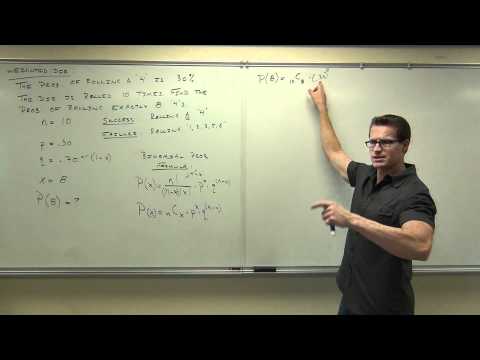
- The number of trials, denoted as n, is established as 10 for a die rolled multiple times.
- Students are encouraged to identify what constitutes a success and a failure in their problems, which is crucial for accurate calculations.
Probability Calculations
- An example problem is presented: finding the probability of rolling exactly eight fours when rolling a die ten times.
- Clarification on what defines success: it’s not about achieving eight successes but rather rolling one four per trial.
Understanding Outcomes
- A successful outcome is defined as rolling a four; all other outcomes (1, 2, 3, 5, or 6) are considered failures.
- Emphasis on identifying successes and failures independently during tests or homework assignments.
Probability Values
- The probability of success (p) must be determined before proceeding with calculations.
- It’s highlighted that the given percentage for success needs conversion into decimal form for proper use in formulas.
Complementary Probabilities
- If p represents the probability of success at 30%, then q (the probability of failure) can be calculated as 1 - p = 70%.
- This relationship between p and q illustrates that they are complementary events within binomial distributions.
Finalizing Success Criteria
- X represents the total number of successes sought—in this case, eight fours from ten rolls.
- The focus shifts to determining how to calculate the exact probability based on identified successes rather than specific outcomes like "four."
Understanding Binomial Probability
Introduction to Binomial Probability
- The discussion begins with the concept of calculating probabilities based on the number of successes in a series of trials, emphasizing the need to understand both success and failure probabilities.
The Binomial Probability Formula
- A formula is introduced for finding probabilities in binomial situations, indicating that it will be explained further.
- The speaker presents the formula for calculating the probability of a specific number of successes, hinting at its familiarity from previous sections.
Combination Formula
- The formula discussed resembles either a permutation or combination; specifically, it is identified as the combination formula (nCx).
- This section focuses on determining how many combinations can yield eight successes out of ten trials.
Calculating Successes and Failures
- To find an exact probability, both successful outcomes and failures must be considered. For example, if there are eight successes, two failures are needed.
- The relationship between total trials (n), successes (x), and failures is clarified: n - x gives the number of failures.
Application of the Formula
- Various scenarios are explored regarding rolling dice to illustrate different combinations leading to eight successes and two failures.
- Emphasis is placed on multiplying probabilities for each success and failure according to their respective counts.
Simplifying Calculations
- A more concise method for calculation using ncx * P^x * q^(n-x) is suggested for ease when using calculators.
Probability of Successes in Trials
Understanding the Probability Formula
- The probability of success is represented as P , which is a decimal value. In this case, it is raised to the power of the number of successes desired, denoted as y to the e th power, indicating multiple successes.
- To find the probability of achieving eight successes out of ten trials, we multiply the probability of success by itself eight times (i.e., 30^8 ). This reflects our goal for eight successful outcomes.
- The formula incorporates both successes and failures: 10C8 times 30^8 times 70^2 . Here, 10C8 represents all possible ways to achieve eight successes from ten trials. The probabilities for success and failure are multiplied together according to the multiplication rule.
Calculation Steps
- Calculating 10C8 yields 45, meaning there are 45 different combinations to roll exactly eight fours in ten rolls. This highlights that specific values (like four) do not influence the equation; rather, it's about counting successes versus failures.
- When calculating probabilities using decimals, care must be taken not to round prematurely; accurate results are crucial until final calculations are made. For instance, multiplying decimals can yield very small numbers that need precise representation (e.g., converting from scientific notation).
Interpreting Results
- After performing calculations for rolling a die ten times with a focus on achieving exactly eight fours results in a low probability (approximately 0.14%), indicating that such an event is quite rare and unusual when compared against a threshold of less than 5%. This suggests that events with probabilities below this threshold are considered unusual occurrences in statistical terms.
Exploring "At Most" Scenarios
- The discussion shifts towards understanding what "at most" means in terms of rolling dice: if you have at most $8, you could have any amount from $0 up to $8 but not more than $8 itself. This concept will be applied when calculating probabilities related to rolling at most eight fours across multiple trials.
Understanding Probability: At Most, At Least, More Than, and Less Than
Key Concepts of Probability Definitions
- The concept of "at most" is introduced, indicating that a maximum value (like eight) can be included in the count. If stated as "less than eight," then eight is excluded.
- Clarification on "at least" versus "more than": "At least eight" includes eight itself, while "more than eight" does not include it.
- The definition of "at most eight" encompasses all values from zero to eight (0 through 8), emphasizing the importance of understanding these terms for solving probability problems.
Successes in Rolling Dice
- Discussion on rolling dice and counting successes: Zero successes (no fours rolled) still satisfies the condition of at most eight successes.
- Any number of successes from zero to eight (including one or two fours rolled) meets the criteria for at most eight.
Addition Rule in Probability
- To calculate probabilities for disjoint sets (e.g., rolling different numbers of fours), you add the probabilities together since they cannot occur simultaneously.
- Example scenario: When rolling a die ten times, it's impossible to achieve both exactly three and four fours at once; thus, these outcomes are disjoint.
Calculating Probabilities
- The total probability for getting at most 8 fours involves summing individual probabilities from zero up to eight successful rolls.
- Emphasis on understanding what constitutes a success: It’s about counting how many times a specific outcome occurs within multiple trials rather than just rolling numbers like one or four.
Practical Application and Simplification
- Highlighting that calculating probabilities involves determining how many specific outcomes occur out of total attempts—this distinction is crucial for accurate calculations.
Understanding Binomial Probabilities in Statistical Analysis
Introduction to Binomial Probabilities
- The discussion begins with a reference to a specific page (749) in a book that contains a table of binomial probabilities, which is essential for understanding statistical outcomes.
- Acknowledgment that the table provides pre-calculated probabilities up to three decimal places for various scenarios, simplifying the process of finding these values.
Key Components of the Probability Table
- Explanation of the letters used in the table:
- n represents the number of trials.
- x indicates the number of successes desired.
- p denotes the probability of success on each trial.
- Clarification that the probabilities listed are for achieving specific numbers of successes rather than cumulative probabilities.
Application Example: Rolling Dice
- The example involves rolling dice where n equals 10 and looking for exactly eight successes with a success probability of 30%.
- The speaker emphasizes locating this scenario within the table to find corresponding probabilities.
Calculating Cumulative Probabilities
- Discussion on calculating cumulative probabilities, specifically "at most" eight successes, which requires summing individual probabilities from zero up to eight successes.
- The speaker lists out individual success probabilities from zero through three and explains how they can be added together using an addition rule.
Using Calculators for Binomial Distribution
- Instructions on utilizing calculators to compute binomial distributions effectively. Emphasis on understanding terms like "at most" and "at least."
- Guidance provided on entering data into scientific calculators, focusing on navigating distribution functions relevant to binomial calculations.
Conclusion and Next Steps
- Encouragement for participants to write down calculated values before proceeding with calculator instructions.
Understanding Probability Distributions and Calculators
Point Probability and Cumulative Distribution
- The concept of point probability is introduced, which relates to the probability density function (PDF).
- To find cumulative probabilities (up to a certain number), one must input the correct values into the calculator. For example, for "at most eight," you would enter seven.
Using the Calculator for Binomial Probabilities
- To calculate the probability of exactly eight successes in trials, input the number of trials first, followed by the probability of success, and then specify how many successes are desired.
- For cumulative probabilities (up to and including a specific number), use binomial CDF on your calculator. This function sums all probabilities up to that number.
Practical Applications in Games
- The discussion shifts to practical applications involving drawing hearts from a deck. Winning conditions are established based on drawing five or more hearts.
- Scenarios are explored where drawing fewer than four hearts results in losing the game.
Exploring Different Game Conditions
- A new game scenario is introduced where winning requires drawing exactly four hearts. The complexity of achieving this with various combinations is discussed.
- The challenge of obtaining exactly four successes amidst other draws is highlighted as being difficult due to strict requirements.
More Complex Winning Conditions
- Another game condition is presented: winning requires at most three hearts drawn. Various scenarios for winning under this condition are examined.
Probability of Drawing Hearts in a Card Game
Overview of the Game and Objectives
- The session involves playing five games to determine probabilities related to drawing hearts from a deck. The goal is to find the probability of getting at least five hearts, exactly four hearts, and at most three hearts.
Understanding Probabilities
- Different scenarios yield different probabilities; thus, the chances of winning vary for each game played. This highlights the importance of understanding how probabilities work in different contexts.
Tools for Calculation
- Participants are encouraged to use tables and calculators during the session. The instructor emphasizes that these tools will be essential for calculating probabilities accurately throughout the lesson.
Preparing for Calculations
- Students should have their tables and graphing calculators ready as they will be used frequently during calculations. The instructor mentions providing an appropriate table for tests but advises against memorizing extensive information due to its complexity.
Key Concepts in Probability Tables
- The instructor explains key components of probability tables:
- n: Total number of trials.
- X: Number of successes (in this case, drawing hearts).
- Probability: Each success's likelihood must be calculated on a trial basis.
This foundational knowledge is crucial for understanding how to apply these concepts effectively in calculations.
Estimating Probabilities with Tables
- There are limitations when using probability tables; students may need to estimate values between given percentages (e.g., between 20% and 30%). This estimation process can lead to inaccuracies but is necessary when precise data isn't available on the table being used.
Calculating Specific Probabilities
- To find the probability of drawing at least five hearts, students focus on specific columns within their tables corresponding to their calculated probabilities (e.g., column four). They learn that they need to sum up individual probabilities for getting five, six, or seven hearts together for accurate results.
Example Calculation Insights
- An example calculation shows that if you add up the probabilities for exactly five, six, or seven hearts drawn from a game scenario, it results in a total probability less than 0.05—indicating it's unusual to win under those conditions based on this setup. This reinforces understanding about what constitutes "normal" versus "unusual" outcomes in probabilistic terms.
Comparing Game Outcomes
Probability Analysis of Card Draws
Understanding the Concept of "At Most Three Hearts"
- The discussion begins with evaluating the probability of drawing at most three hearts from a deck. The values considered are 0, 1, 2, and 3 hearts.
- The speaker emphasizes that these probabilities yield a high chance of winning in the game being analyzed. They mention specific numbers: 210, 367, and others to illustrate this point.
Exploring Probabilities Greater than Two Hearts
- A transition is made to consider the probability of drawing more than two hearts, clarifying that this includes only three or more hearts (not two). This distinction is crucial for accurate calculations.
- The speaker explains how "more than two" equates to "at least three," guiding listeners on how to interpret these terms correctly in probability contexts.
Calculating Less Than Six Hearts
- When discussing less than six hearts, it’s clarified that this means five or fewer hearts are included in the calculation. This reinforces understanding of inclusive versus exclusive counting in probabilities.
- The total probability for less than six should approach 100%, indicating a near certainty when considering all possible outcomes within this range. However, slight discrepancies may occur due to rounding errors in calculations.
Importance of Accurate Probability Representation
- If calculations yield a total close to one but not exactly one, it's advised not to round up indiscriminately; instead, acknowledge potential inaccuracies by noting it as approximately one (e.g., n999). This highlights careful statistical reporting practices.
Utilizing Calculator Functions for Binomial Distribution
- The speaker transitions into demonstrating how to use calculators for binomial distribution problems, emphasizing which functions (PDF vs CDF) apply based on whether you're looking for exact counts or cumulative totals. For example: “exactly four” uses PDF while “at most” uses CDF functions.
Understanding Probability Calculations in Binomial Distributions
Introduction to Binomial Distribution
- The speaker requests assistance with lighting, indicating a casual classroom environment before diving into the topic.
Working with Cumulative Distribution Function (CDF)
- The discussion begins on calculating probabilities using a calculator, focusing on "at most three hearts" and clarifying whether to include the number three in calculations.
- Emphasis is placed on understanding trial parameters: confirming that trials and probability of success remain unchanged while determining how to interpret "at most three."
- The calculation for "at most three" yields a result of 0.9666, which rounds to 0.967 as suggested by the table.
Exploring Less Than and More Than Scenarios
- Transitioning to "less than six hearts," the speaker clarifies that only five or fewer should be considered, reinforcing the need for careful interpretation of calculator inputs.
- A reminder is given that calculators may not intuitively understand phrasing; thus, one must input values smartly (e.g., using five instead of six).
Complementary Probabilities
- The speaker introduces complementary probabilities as an effective strategy for finding results like "more than two hearts," suggesting it’s easier to calculate its complement ("at most two").
- Clarification is provided on how complements work: if you want more than two hearts, you can find at most two as its opposite.
Final Calculations and Conclusions
- The relationship between complementary events is emphasized—probabilities must add up to one. This leads into practical calculations involving subtracting from one.
- For calculating "at least five hearts," it's noted that this includes five itself; thus, the complement would be at most four.
- Finally, instructions are given for executing these calculations through cumulative distribution functions again, ensuring clarity in each step taken.
Understanding Rounding and Subtraction
Exploring Mathematical Concepts
- The speaker poses a mathematical question: "What is 1 minus 9953?" This indicates an exploration of basic arithmetic operations.
- A child expresses confusion about why certain rounded numbers do not match their expected values, highlighting the complexities of rounding in mathematics.
- The inquiry into whether the zeros in the numbers affect their sum suggests a deeper investigation into how rounding impacts numerical accuracy.
- The dialogue reflects a common struggle with understanding why some mathematical principles yield different results under specific conditions, particularly in rounding scenarios.
Turn any video into a summary like this
YouTube links, meetings, lectures — with transcripts, search, and chat.