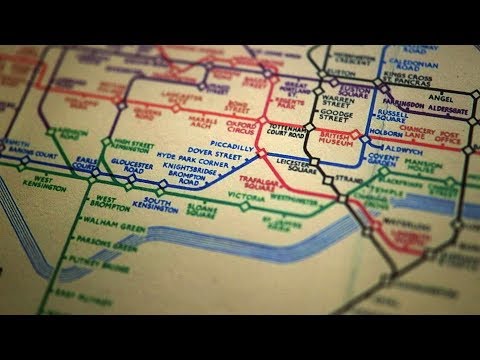
The genius of the London Tube Map | Small Thing Big Idea, a TED series
New Section
The history of maps and the impact of Harry Beck's design on the London Underground map.
The History of Maps
- Maps have played a significant role in understanding the world around us throughout the history of civilization.
- The London Tube Map, designed by Harry Beck, is one of the most famous maps that revolutionized how we perceive and navigate transportation systems.
Harry Beck's Design for the London Underground Map
- In 1908, multiple independent railways merged to create the London Underground system, requiring a map to represent this complex network. However, the initial map was geographically accurate but not user-friendly.
- Harry Beck, an engineering draftsman working for the London Underground, realized that passengers primarily cared about getting from one station to another rather than geographical accuracy. He simplified and redesigned the map accordingly.
- Beck's design focused on simplicity and clarity by using horizontal, vertical, and 45-degree lines to represent routes and equal spacing between stations. Each line had a corresponding color, making it easier for passengers to navigate. This transformed the map into a diagram rather than a traditional geographic representation.
- In 1933, after testing pocket-sized versions of Beck's map that were quickly distributed among passengers, the London Underground adopted his design as their official map. This design became influential worldwide and served as a template for metro maps in other cities like Tokyo, Paris, Berlin, São Paulo, Sydney, and Washington D.C., all converting complex geography into crisp geometry with distinct colors and symbols for different lines and station types.
Principles Derived from Harry Beck's Design
- Although he may not have known about user interfaces, Beck's design principles can be applied to various design problems.
- The first principle is focus, emphasizing understanding the needs of the target audience.
- The second principle is simplicity, finding the shortest and most efficient way to meet those needs.
- Lastly, thinking in a cross-disciplinary way allows for innovative solutions by approaching challenges from different perspectives.
By studying Harry Beck's map design for the London Underground, we can learn valuable lessons about user-centered design and simplifying complex systems into intuitive visual representations.
Timestamps are approximate and may vary slightly depending on the video version or source used.
Turn any video into a summary like this
YouTube links, meetings, lectures. With transcripts, search, and chat.