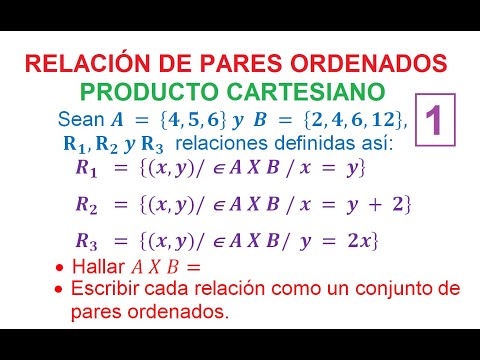
Parte 1. Relación de pares ordenados. Producto Cartesiano.
Resolving a Mathematical Exercise Involving Relations and Cartesian Products
Introduction to the Problem
- The exercise involves two sets: Set A with elements 4, 5, 6 and Set B with elements 2, 4, 6, 12.
- Three relations are defined between these sets: Relation 1 (x = James), Relation 2 (x = 2), and Relation 3 (y = 2x).
Cartesian Product Calculation
- The first step is to calculate the Cartesian product of sets A and B.
- A visual representation (diagrama sagital) is created to illustrate the mapping from set A to set B.
- Each element in set A is related to multiple elements in set B:
- Element 4 relates to 2, 4, 6, 12
- Element 5 relates to 2, 4, 6
- Element 6 relates to 2, 4, 6, 12
Forming Ordered Pairs
- The ordered pairs for the Cartesian product are formed as follows:
- From element 4: (4,2), (4,4), (4,6), (4,12)
- From element 5: (5,2), (5,4), (5,6), (5,12)
- From element 6: (6,2), (6,4), (6,6), (6,12)
Analyzing Relations
Relation One Analysis
- For Relation One where x = y:
- Valid pairs identified include:
- Pair (4 ,4) since both values equal.
- Pair (6 ,6) also satisfies this condition.
Relation Two Analysis
- For Relation Two where x = y + 2:
- Starting with pair (42) where x equals James plus two gives valid results.
- Pair (42) works because x equals y + two; thus it’s valid.
- Other pairs like (46) do not satisfy this condition.
Conclusion on Relations
- Only specific pairs meet the criteria for each relation.
- Further analysis shows that only certain combinations yield valid results based on their defined relationships.
Understanding Ordered Pairs and Relationships
Introduction to Ordered Pairs
- The discussion begins with the introduction of two ordered pairs, specifically (4, 2) and (6, 4), which are foundational for understanding relationships in mathematics.
- The speaker emphasizes the importance of identifying elements from set A that correspond to these ordered pairs.
Exploring Mathematical Relationships
- The concept of a relationship defined as y = 2x is introduced. This equation will guide the search for valid ordered pairs.
- The speaker examines various values for x . For instance, when x = 5 , it calculates y = 10 , leading to the ordered pair (5, 10).
Finding Valid Ordered Pairs
- Continuing with the exploration, when x = 6 , it computes y = 12 , resulting in the valid ordered pair (6, 12).
- The final conclusion highlights that (6, 12) is indeed part of the relationship defined earlier. The session wraps up with an invitation for viewers to subscribe and engage further.
Conclusion