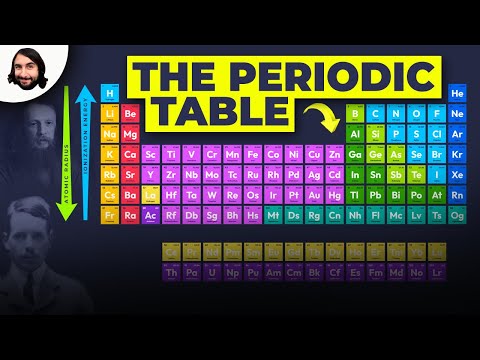
The Periodic Table: Atomic Radius, Ionization Energy, and Electronegativity
Introduction to the Periodic Table
In this section, Professor David introduces the periodic table and its significance in understanding the behavior of elements.
The Development of the Periodic Table
- Chemists in the mid-1800s attempted to create a table to depict all elements.
- Dmitri Mendeleev's arrangement of elements into rows (periods) and columns (groups) proved successful due to its correlation of data and predictive powers.
- Mendeleev's table helped identify existing elements and predict new ones.
Patterns in the Periodic Table
- Elements within the same group exhibit similar behavior because they have the same number of valence electrons.
- Atomic radius, or size, increases as you move down a group due to additional electron shells. It decreases as you move across a period due to stronger electromagnetic attraction from more protons.
- Ionization energy, or energy required to remove an electron, decreases as you move down a group but increases as you move across a period. Successive ionization energies increase with each electron removed.
- Exceptions to trends can be explained by discrepancies in orbital symmetry.
Conclusion
The periodic table is a powerful tool that reveals patterns and relationships among elements based on their atomic structure. Understanding these patterns helps explain various characteristics and behaviors of different elements.
Valence Electrons and Periodic Trends
This section explores how valence electrons determine many characteristics of elements and discusses some periodic trends observed in the periodic table.
Valence Electrons Determine Element Characteristics
- Elements in Group 1 have one valence electron, while those in Group 2 have two valence electrons, and so on.
- The number of valence electrons influences chemical properties such as reactivity and bonding behavior.
Periodic Trends
- Atomic radius increases as you move down a group due to the addition of electron shells. It decreases as you move across a period due to stronger electromagnetic attraction.
- Ionic radius, which considers electron repulsion, increases when an electron is added and decreases when one is removed.
- Ionization energy, the energy required to remove an electron, decreases as you move down a group but increases as you move across a period.
- Exceptions to trends can be explained by discrepancies in orbital symmetry.
Conclusion
Valence electrons play a crucial role in determining the characteristics of elements. Understanding periodic trends such as atomic radius, ionic radius, and ionization energy helps explain the behavior and properties of different elements within the periodic table.
Ionization Energy and Electron Affinity
This section discusses ionization energy and electron affinity, two important concepts related to the behavior of electrons in atoms.
Ionization Energy
- Ionization energy is the energy required to remove an electron from an atom's outermost shell.
- The trend for ionization energy is opposite to that of atomic radius. It increases as you move across a period and decreases as you move down a group.
- Elements with full outermost shells or stable configurations have higher ionization energies.
Electron Affinity
- Electron affinity refers to how much energy is released or absorbed when an atom gains an electron.
- Electron affinity generally follows the same trend as ionization energy but with some exceptions due to orbital symmetry.
Conclusion
Ionization energy and electron affinity provide insights into how atoms behave when gaining or losing electrons. These concepts help explain trends observed in the periodic table and contribute to our understanding of chemical reactions and bonding.
Exceptions in Ionization Energy Trend
This section explores exceptions observed in the trend of ionization energy and provides explanations for these deviations.
Nitrogen and Oxygen
- Nitrogen's ionization energy is higher than expected due to its half-filled 2p orbitals, which provide special stability.
- Oxygen's ionization energy is slightly lower than nitrogen's despite having one additional proton because losing an electron would result in a stable configuration.
Orbital Symmetry and Deviations
- Deviations from the ionization energy trend can be explained by discrepancies in orbital symmetry.
- Understanding the orbital configurations of elements helps explain variations in their ionization energies.
Conclusion
Exceptions to the trend of ionization energy can be rationalized by considering orbital symmetry. Elements with unique electron configurations may exhibit deviations from the expected pattern, providing further insights into their behavior within the periodic table.
Electron Affinity
This section focuses on electron affinity, which is the opposite concept to ionization energy, and explains how it relates to stability and electron behavior.
Electron Affinity vs. Ionization Energy
- Electron affinity refers to the amount of energy released or absorbed when an atom gains an electron.
- It follows a similar trend as ionization energy but with some exceptions due to orbital symmetry.
Stability and Electron Behavior
- Atoms tend to have stable outermost shells or configurations.
- Elements with full outermost shells or stable configurations have higher ionization energies and lower electron affinities.
- The closer electrons are to the nucleus, the more stable they are, resulting in higher ionization energies and lower electron affinities.
Conclusion
Electron affinity provides insights into how atoms behave when gaining electrons. Understanding this concept helps explain trends observed in the periodic table and contributes to our understanding of chemical reactions and stability.
New Section Atomic Properties: Electronegativity, Ionization Energy, and Atomic Radius
In this section, we will explore the atomic properties of electronegativity, ionization energy, and atomic radius. We will discuss their trends and exceptions.
Electronegativity
- Electronegativity is the ability of an atom to hold electrons tightly.
- Smaller atoms with more protons and higher effective nuclear charge have higher electronegativity.
- Noble gases are disregarded for this trend.
Ionization Energy
- Ionization energy is the energy required to remove an electron from an atom.
- Elements prefer to lose electrons rather than gain them.
- Exceptions to this trend occur for similar reasons as exceptions to the ionization energy trend.
- Noble gases are disregarded for this trend.
Atomic Radius
- Atomic radius refers to the size of an atom.
- Atomic radius increases in one direction.
- Noble gases are disregarded for this trend.
Let's check comprehension.
Turn any video into a summary like this
YouTube links, meetings, lectures — with transcripts, search, and chat.