El Universo es Hostil con las Computadoras
Understanding the Phenomenon of Mysterious Votes
The transcript delves into a peculiar incident during the Belgian elections in 2003, where an unknown candidate received an inexplicably high number of votes due to a mysterious phenomenon affecting computer systems.
Investigating the Anomaly
- During the election process, officials discovered irregularities in vote counts for a lesser-known candidate named Mariah Bin De Vogel.
- The voting system involved voters inserting magnetic cards into machines to cast their votes, which were stored both digitally and on the card for transparency.
- Upon recounting, it was found that Mariah had 4,096 more votes than mathematically possible, leading to confusion and scrutiny.
Unraveling the Mystery
- Experts examined the software and hardware but could not replicate the error that caused Mariah's inflated vote count.
- The anomaly was traced back to a specific bit in the computer system representing Mariah's votes, which unexpectedly changed from 0 to 1.
The Influence of Radioactivity on Computer Systems
This part explores how radioactive elements can impact computer systems through a historical perspective and scientific explanation.
Radioactive Interference
- Computers operate using binary systems with bits representing data; Mariah's extra votes were linked to a specific bit changing unexpectedly.
- Reports dating back to the 1970s highlighted similar issues caused by alpha particles emitted by radioactive materials affecting semiconductor memory chips.
Understanding Alpha Particle Impact
- Alpha particles emitted by uranium and thorium can create electron pairs in silicon chips, causing changes in bits known as single-event upsets (SEUs).
- Research showed that higher alpha particle activity directly correlated with more bit alterations, prompting chip manufacturers to avoid radioactive materials in production.
Measuring Radioactivity with Electrometers
This segment discusses methods used historically to measure radioactivity levels and their implications on scientific experiments.
Electroscopic Measurements
- Andrew Baker's discovery of radioactivity led scientists like Teodoro Wolf and Victor Hess to develop electrometers using gold leaf for radiation detection.
Tower Experiments
Cosmic Rays and Their Impact
The transcript delves into the discovery of cosmic rays, their nature, origins, and impact on various phenomena.
Discovery of Cosmic Rays
- Victor Hess observed no significant radiation changes in his first two balloon flights up to 1100 meters.
- Radiation levels increased with altitude, peaking several times higher than ground levels at 5200 meters.
Nature of Cosmic Rays
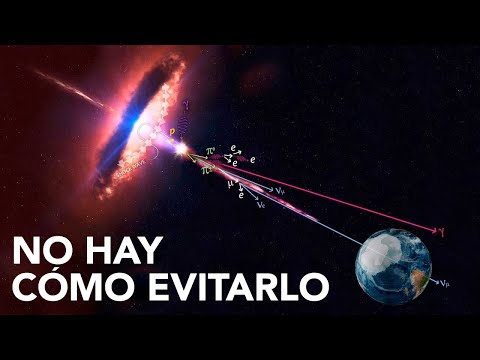
- Cosmic rays are high-energy radiation from space, primarily composed of protons, helium nuclei, and heavier nuclei.
- High-energy cosmic rays originate from supernovas within our galaxy and possibly supermassive black holes.
Impact and Detection
- A single cosmic ray particle carries immense energy equivalent to a baseball traveling at high speed.
- Cosmic rays create cascades of particles in the atmosphere without directly reaching the Earth's surface.
Influence of Cosmic Rays on Technology
This section explores how cosmic rays impact technology and everyday life.
Technological Impacts
- A cosmic ray-induced bit flip potentially affected a computer in Belgium during an election.
- Charles Wilson's cloud chamber allowed visualization of cosmic rays' paths around us.
Discovery of Antimatter
- Carl Anderson identified the positron (antielectron) using a cloud chamber with magnetic field deflection.
- Anderson's discovery led to the Nobel Prize for Physics in 1936 for uncovering antimatter through cosmic rays.
Cosmic Ray Effects on Electronics
This part discusses how cosmic rays can cause glitches in electronics and influence device functionality.
Electronic Glitches
- A Super Mario 64 player experienced an unexplained glitch attributed to a possible cosmic ray interaction.
Errores y Radiación Cósmica
This section discusses errors caused by cosmic radiation, particularly in electronic systems like supercomputers and airplanes, due to high-energy particles such as neutrons and cosmic rays.
Errors in Electronic Systems
- IBM estimated that for every 256 MB of RAM, a bit change occurs per month due to cosmic radiation.
- Toyota faced acceleration issues in vehicles, initially speculated to be caused by cosmic rays inducing bit changes in the electronic control system.
- Main issues identified were accelerator pedal malfunctions, poorly fitted floor mats, and driver error rather than cosmic rays.
- High-altitude locations like Los Alamos National Laboratory experience neutron-induced supercomputer failures; detectors are installed for mitigation.
- Cosmic radiation increases at higher altitudes; can lead to single-event upsets (SEUs), potentially critical in aircraft electronics.
Aircraft Electronics Failure Investigation
This part delves into an aircraft incident triggered by electronic system failure possibly due to a single-event upset from high-energy atmospheric particles impacting integrated circuits.
Aircraft Incident Analysis
- In 2008, a flight from Singapore to Perth experienced sudden descent due to an apparent inertial reference unit (IRU) failure.
- The IRU provided critical data but misinterpreted altitude as angle of attack due to a bit flip, leading to incorrect alarms and abrupt maneuvers.
- Investigations ruled out software corruption or hardware faults; a potential trigger was a high-energy particle causing an SEU in the computational module.
Resilience in Space Systems
This segment explores the resilience of space systems against single-event upsets caused by cosmic radiation through redundancy and robust design strategies.
Space System Resilience
- The 1992 Hermes A330 shuttle lacked specific regulations for resilience against SEUs compared to modern standards.
- Shuttle's four redundant computers with identical software could detect and correct bit errors during missions effectively.
Radiation Resistance in Mars Rover Computer
Discusses the radiation resistance design of the Perseverance rover's computer on Mars enabling it to withstand extreme conditions.
Mars Rover Computer Design
New Section
In this section, the speaker discusses the testing of power pieces in space missions and the impact of cosmic rays on electronic systems.
Testing Power Pieces in Space
- Used in over a dozen space missions since 2005.
- Testing involved exposing a system processor to particle rays to detect malfunctions (blue screen of death).
- Cosmic ray fluctuations due to solar activity affect Earth's radiation exposure.
New Section
This part delves into the role of cosmic rays, solar activity, and genetic variation influenced by cosmic particles.
Impact of Solar Activity on Cosmic Rays
- Solar cycle affects cosmic ray flux on Earth.
- Cosmic rays potentially alter genetic code, impacting natural selection processes.
New Section
The narrative shifts towards individual stories impacted by cosmic particles and their significance in the universe.
Individual Story Highlight
- Mariah De Vogel's journey exemplifies how cosmic particles shape destinies.
Turn any video into a summary like this
YouTube links, meetings, lectures. With transcripts, search, and chat.