Códigos de Hamming | | UPV
Explanation of Jamin Code
In this section, the speaker introduces the Jamin code, explaining its function as an error correction code that can detect single errors and identify double errors but cannot correct them. The practical application involves using matrices to represent the code.
Introduction to Jamin Code
- The Jamin code introduces redundancy bits distributed throughout a word to enable error correction.
- Notation for specifying a particular Jamin code includes two numbers in parentheses indicating total bits and information bits.
Mechanics of Jamin Code Algorithm
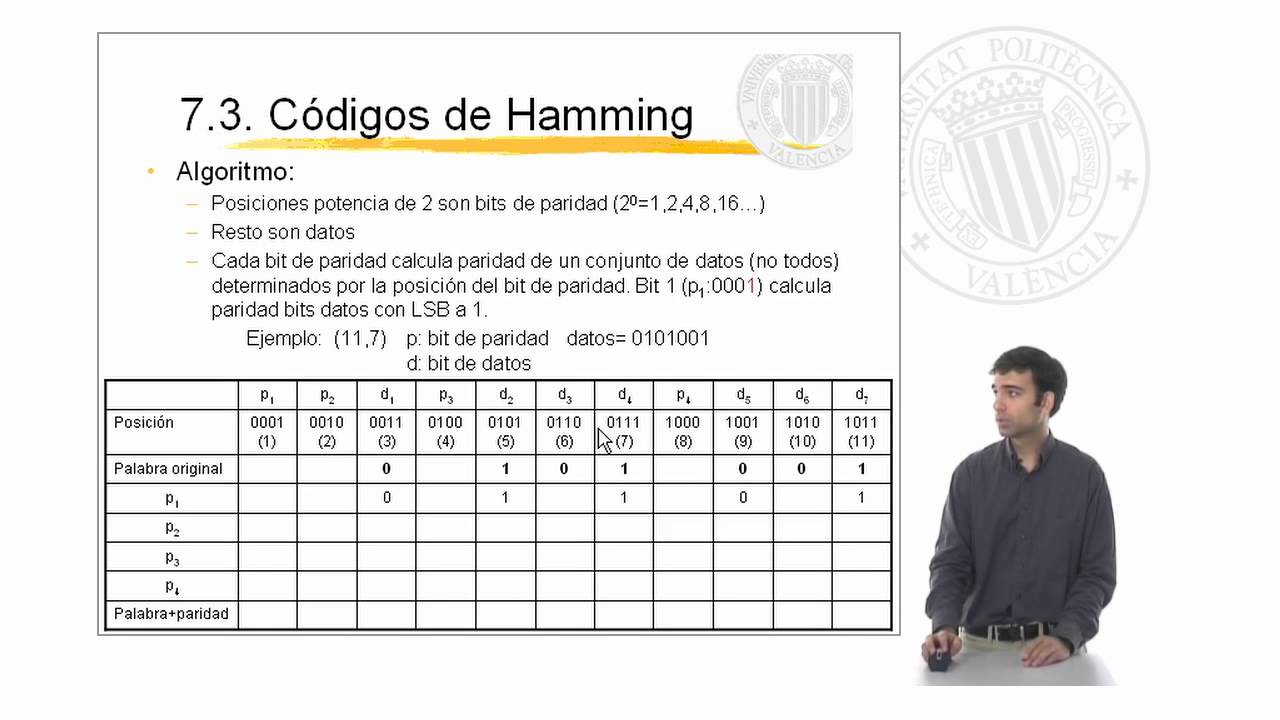
This part delves into the mechanical process of implementing the Jamin code algorithm through tables, illustrating how parity bits are positioned based on powers of 2 and filled with data bits.
Positioning Parity and Data Bits
- Parity bits occupy positions corresponding to powers of 2, while remaining spaces are filled with data.
- The algorithm involves filling the original data word with information and calculating parity bits based on specific rules.
Encoding Process of Jamin Code Algorithm
Here, the encoding process is detailed, involving filling data words, calculating parity bits sequentially based on bit positions, and ensuring even parity for error detection.
Calculating Parity Bits
- To calculate each parity bit, examine specific bit positions in binary representation.
- Determine parity by counting ones in relevant positions to ensure even parity for error detection.
Error Detection and Correction in Jamin Code Algorithm
This segment focuses on error detection and correction within the Jamin code algorithm by comparing received data with recalculated parities to identify errors accurately.
Error Detection Mechanism
- Recalculate parities from received data and compare them with calculated parities.
Understanding Error Correction in Binary Systems
In this segment, the speaker explains how to identify and correct errors in binary systems by converting them into decimal form.
Analyzing Error Location
- Converting binary to decimal reveals error location: 11 in decimal corresponds to the 11th bit.
- The error is situated at bit number 11, counting from the most significant bit.
- Correcting errors involves flipping the erroneous bit (bit number 11).