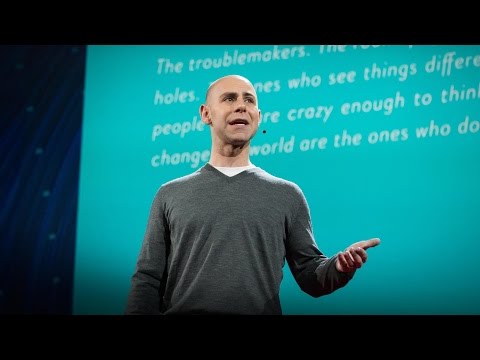
The surprising habits of original thinkers | Adam Grant | TED
Introduction and Background
In this section, the speaker introduces themselves and shares a personal anecdote about an investment opportunity they turned down.
An Investment Opportunity
- Seven years ago, the speaker was approached by a student who wanted them to invest in their internet-based company.
- The student and their friends aimed to revolutionize an industry by selling products online.
- However, the speaker declined the investment due to concerns about the company's progress and readiness for launch.
Understanding "Originals"
The speaker discusses their interest in studying "originals" - individuals who are unconventional, have new ideas, and take action to defend them. They highlight the importance of recognizing originals and becoming more like them.
Characteristics of Originals
- Originals are nonconformists who bring creativity and change to the world.
- They are individuals worth betting on.
- The speaker shares three things they have learned about recognizing originals and becoming more like them.
Reason for Rejecting Warby Parker
The speaker explains why they initially rejected investing in Warby Parker, a successful online eyewear company.
Delayed Launch
- The main reason for rejecting Warby Parker was their delay in launching the company.
- Despite being a website-based business, their site was not functioning properly even on the day before the planned launch.
Precrastination vs Procrastination
The speaker discusses their tendency to be a "precrastinator" - someone who completes tasks well ahead of deadlines. They explore whether procrastination or precrastination leads to greater creativity.
Precrastination Experience
- The speaker describes being a "precrastinator" who feels the panic of impending deadlines months in advance.
- They share a childhood example of waking up early to play Nintendo games and mastering them before anyone else.
Procrastination and Creativity
The speaker explores the relationship between procrastination, creativity, and innovation by conducting experiments.
Study on Procrastination
- A student named Jihae shared that she had her most creative ideas while procrastinating.
- The speaker challenged her to collect data on how procrastination affects creativity.
- Results showed that moderate procrastinators were 16% more creative than those who rushed or completed tasks immediately.
Finding the Balance
The speaker discusses the importance of finding a balance between procrastination and rushing tasks for optimal creativity.
Originals' Work Habits
- Originals seem to live in a middle ground between extreme procrastination and rushing tasks.
- It suggests that original individuals may have unconventional work habits that contribute to their creativity.
Conclusion
In this transcript, the speaker shares personal experiences and insights about recognizing originals, the impact of precrastination and procrastination on creativity, and finding a balance for optimal productivity.
Procrastination and Creativity
This section discusses the relationship between procrastination and creativity, as well as the advantages and disadvantages of being a pioneer in a market.
Procrastination and Creative Ideas
- Procrastination allows time for considering divergent ideas. In college, it was beneficial for generating creative ideas.
Being an Early Finisher
- Finishing tasks ahead of schedule can provide an advantage. The speaker finished their dissertation four months before the deadline while others were still struggling after six months.
The Myth of Being a Pioneer
- Being the first in a market is not always advantageous. Many companies that were pioneers lost their edge when others caught up.
- A study comparing pioneers to improvers found that improvers had lower failure rates and were considered more creative.
Procrastinators and Originality
- Procrastinators can be just as original as early finishers or pioneers. Originality does not require being the first; it requires being different and better.
- Chronic procrastinators may have unique approaches to managing their doubts and fears about creativity.
Doubts and Confidence
- Original individuals may appear confident on the surface but still experience doubts and fears internally, similar to everyone else.
- Doubting ideas can be energizing, motivating individuals to test, experiment, and refine them further.
Experiment on Creativity
- An experiment showed that moderate procrastinators were 16% more creative than those who completed tasks immediately or excessively delayed them.
- Doubts about oneself are paralyzing, while doubts about ideas can be energizing for creativity.
Conclusion
- Being a pioneer in a market is not always advantageous, and procrastination can lead to originality and creativity. Doubts and fears are common among creative individuals, but they can be managed differently.
A chave para ser original
Nesta seção, o palestrante discute a chave para ser original e como os pioneiros muitas vezes têm medo de fracassar.
Medo de fracassar
- Os originais também sentem medo.
- Muitas empresas têm medo de competir com outras já estabelecidas no mercado.
- Os pioneiros têm mais medo de não tentar do que de fracassar.
- A vantagem de ser pioneiro é um mito.
Arrependimentos e chances não aproveitadas
- Os maiores arrependimentos são pelo que deixamos de fazer.
- Pioneiros têm uma taxa de fracasso maior do que a dos aprimoradores.
- Exemplos como Elon Musk, Tesla, SpaceX, Facebook e Google mostram a importância de tentar mesmo com medo.
Ser original não requer ser o primeiro
- Não é necessário ser o primeiro para ser original.
- O julgamento não é baseado em ideias ruins, mas sim em ser diferente e melhor.
Dúvidas sobre coragem para ser original
Nesta seção, o palestrante aborda as dúvidas e medos que as pessoas têm ao buscar a originalidade.
Medo do ridículo
- Muitas pessoas têm medo de passar vergonha ou parecerem estúpidas ao expressarem suas ideias.
- Originais também têm muitas ideias ruins.
Administração do medo
- Originais administram seus medos e dúvidas de forma diferente.
- Ter dúvidas sobre si mesmo pode paralisar, mas duvidar das ideias é energizante.
Exemplos de compositores clássicos
- Compositores como Bach, Beethoven e Mozart tiveram que criar muitas composições para chegar a obras-primas.
- Quanto mais você produz, mais chances tem de fazer algo realmente original.
A importância da dúvida na criatividade
Nesta seção, o palestrante explora a importância da dúvida no processo criativo e como ela pode impulsionar a originalidade.
Produção e variedade
- Quanto mais você produz, maior é a variedade de suas criações.
- A dúvida sobre si mesmo e sobre as ideias pode levar a algo realmente original.
Dúvidas paralisantes vs. energizantes
- A dúvida sobre si mesmo pode ser paralisante.
- Duvidar das ideias é energizante e motiva a testar, experimentar e refinar.
Exemplo dos compositores clássicos novamente
- Compositores como Bach, Beethoven e Mozart tiveram que criar centenas de composições para chegar às obras-primas.
- Os maiores originais são aqueles que mais tentam e fracassam.
Conclusão: Ser original requer coragem para enfrentar o medo
Nesta seção final, o palestrante conclui destacando que ser original requer coragem para enfrentar o medo e duvidar das próprias ideias.
Coragem para enfrentar o medo
- Ser original exige coragem para enfrentar o medo do ridículo ou do fracasso.
- Originais têm muitas ideias ruins, mas isso não os impede de continuar tentando.
Duvidar das próprias ideias
- Duvidar das ideias é uma parte natural do processo criativo.
- A dúvida pode ser energizante e levar a algo realmente original.
Ser diferente e melhor
- Ser original não requer ser o primeiro, mas sim ser diferente e melhor.
- Não se preocupe com as ideias ruins, foque em buscar algo único e inovador.
Como este cara ficou famoso sem ter feito muito?
A question is posed about how someone became famous without doing much.
The Path to Fame
- The speaker raises the question of how someone became famous without doing much.
- This suggests that there may be individuals who have achieved fame despite not having accomplished significant things.
- The speaker expresses curiosity about the factors that contribute to such fame.
This section explores the concept of achieving fame without substantial achievements and raises questions for further discussion.
Transforme qualquer vídeo em um resumo como este
Vídeos do YouTube, reuniões, aulas. Com transcrição, busca e chat.