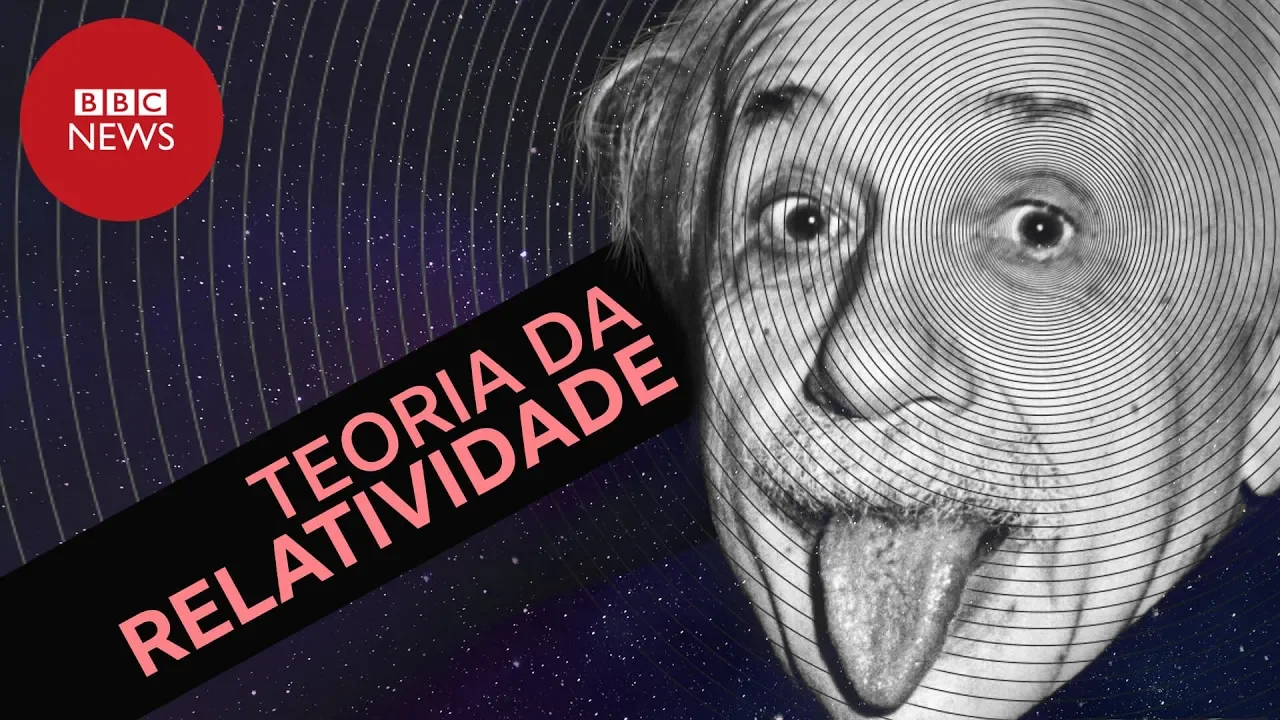
Para finalmente entender a Teoria da Relatividade de Albert Einstein
The Theory of General Relativity by Albert Einstein
This section introduces the revolutionary impact of Albert Einstein's General Theory of Relativity on our understanding of the universe, contrasting it with Newtonian physics and highlighting key concepts like space-time curvature.
Albert Einstein vs. Isaac Newton
- Newton's view: Gravity as an immediate force between masses causing attraction and planetary motion.
- Einstein's challenge: Light as the fastest entity, questioning how Earth would move if the Sun vanished instantly.
The Birth of General Relativity
- Einstein's innovation: Space and time as a unified fabric (space-time), deformed by mass presence.
- Curvature concept: Masses like the Sun bend space-time, creating gravitational effects on planets' orbits.
Reimagining Gravity
- New perspective: Gravity not a direct force but a result of space-time curvature affecting bodies' paths.
- Consequences: Solar disappearance would cause a gravitational wave traveling at light speed, altering Earth's orbit simultaneously.
Key Takeaways
- Revolutionary Shift: Einstein's theory transformed views on gravity from a force to a consequence of space-time curvature.
- Unified Framework: Space and time intertwined in the fabric of reality, reshaping how we perceive celestial mechanics.
- Predictive Power: General Relativity foresees phenomena like gravitational waves, challenging traditional notions of gravity.