Ramas de la Inteligencia Artificial
Detailed Analysis of Artificial Intelligence Branches
In this video, the speaker delves into various branches of artificial intelligence, discussing methodologies used in programming and formalization for developing AI systems. Each branch corresponds to a different methodology aimed at solving complex problems.
Networks of Petri - Precursor Branch
- Carlos Adán Petri introduced the precursor branch known as Networks of Petri in 1962, establishing a general theory for parallel discrete systems using graphical methods.
Expert Systems and Knowledge-Based Systems
- Derived from Petri's concepts are expert systems or knowledge-based systems that mimic human expert reasoning to solve specific problems and aid decision-making processes.
Natural Language Processing and Robotics
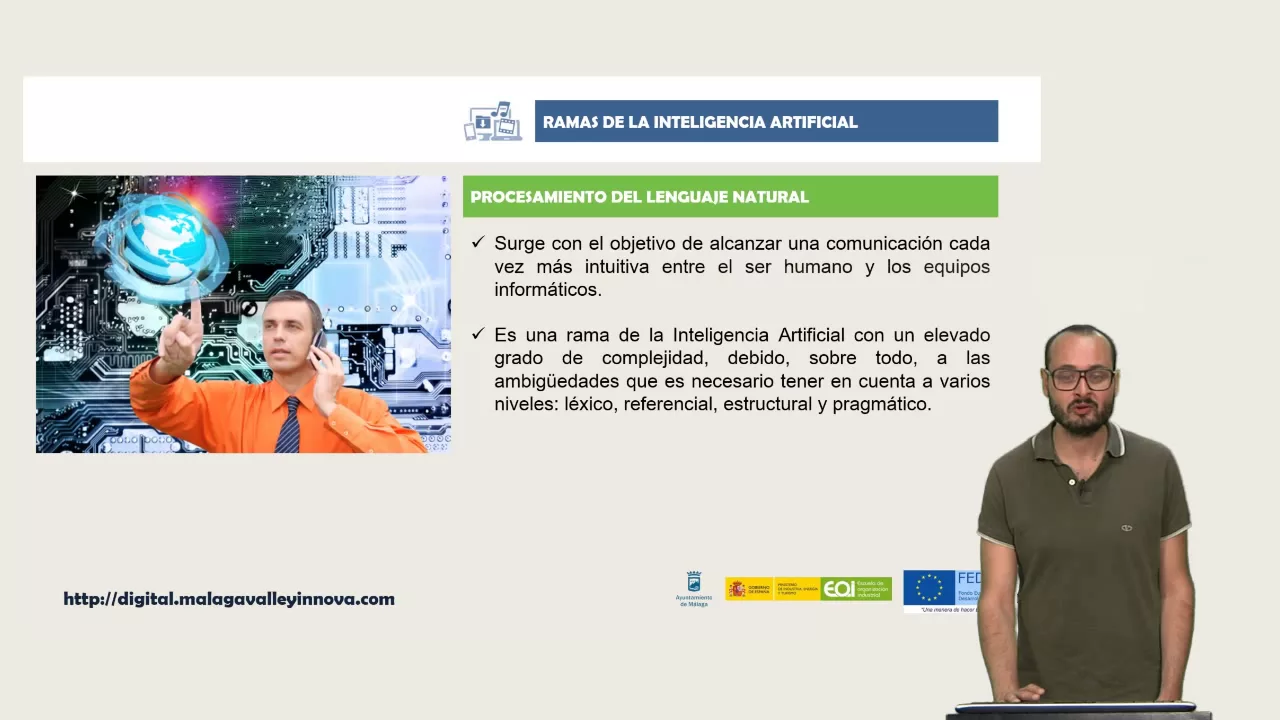
- Natural Language Processing (NLP) aims to enhance intuitive communication between humans and computers, facing challenges due to ambiguities at lexical, referential, structural, and pragmatic levels.
- Robotics is considered an essential AI branch requiring programming for adaptive responses to environmental changes through sensors and cameras, utilizing AI techniques like computer vision for pattern recognition.
Evolution Towards Modern AI Systems
The development of AI has paved the way for modern systems such as neural networks, agent-based technologies, and genetic algorithms.
Neural Networks
- Neural networks aim to replicate human learning processes through software and hardware by processing stimuli received by the network into mathematical functions via training data.
Agent-Based Technologies
- Agent programs analyze common actions performed by users or other systems dynamically constructing patterns; anomalies trigger predefined user actions based on these patterns.
Genetic Algorithms
Turn any video into a summary like this
YouTube links, meetings, lectures. With transcripts, search, and chat.