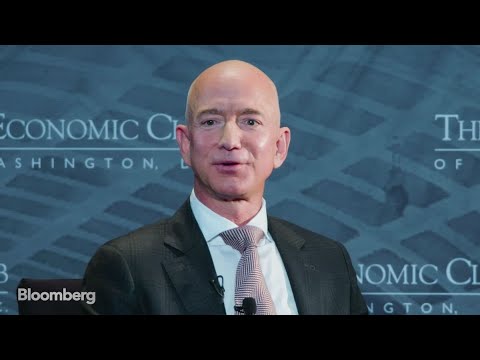
Amazon CEO Jeff Bezos on The David Rubenstein Show
New Section
In this section, Jeff Bezos discusses his journey to becoming the wealthiest man in the world and the concept of Amazon Prime.
Becoming the Wealthiest Man
- Jeff Bezos reflects on how he became the wealthiest man in the world.
- He mentions that being the second wealthiest person was also fine for him.
- The idea of selling anything online motivated him to expand beyond books.
- The concept of Amazon Prime is introduced, but it is not clear who came up with it.
Criticism and Identity
- Jeff Bezos addresses criticism towards The Washington Post without providing specific details.
- He humorously responds to a request to fix his tie, stating that people wouldn't recognize him if it was fixed.
New Section
This section focuses on Jeff Bezos' role as an interviewer and his thoughts on leadership and stock performance.
Role as an Interviewer
- Jeff Bezos states that he does not consider himself a journalist but rather an interviewer.
- Despite running a private equity firm, he has taken on the life of being an interviewer.
Leadership and Stock Performance
- Jeff Bezos discusses his definition of leadership and what drives individuals.
- He acknowledges that Amazon's stock has increased by 70% this year but attributes it to various factors rather than one specific reason.
- He emphasizes not getting too caught up in daily stock prices and advises against feeling smarter or dumber based on short-term fluctuations.
New Section
In this section, Jeff Bezos talks about wealth, entrepreneurship, and living near Bill Gates.
Wealth and Entrepreneurship
- Jeff Bezos expresses his belief in the power of entrepreneurial capitalism and free markets to solve many of the world's problems.
- He highlights that Amazon's success has generated significant wealth for others, amounting to approximately $840 billion.
Living Near Bill Gates
- Jeff Bezos mentions living near Bill Gates in Medina, a suburb of Seattle.
- He jokes about being the two richest men in the world living in such close proximity.
- The decision to locate Amazon in Seattle was influenced by the availability of technical talent due to Microsoft's presence.
New Section
This section delves into Jeff Bezos' personal life, including his shopping habits and philanthropic endeavors.
Shopping Habits
- Jeff Bezos confirms that he carries cash and uses credit cards for purchases.
- He humorously recalls instances when his credit card was denied and had to provide an alternative card.
Philanthropy
- Jeff Bezos discusses his philanthropic efforts and how he sought ideas from the public through social media.
- Over 47,000 ideas were received, covering various areas such as homelessness and education.
- The process involved reviewing and categorizing these ideas to determine where to allocate a $2 billion donation.
Montessori School Teacher Complaint and Future Plans
In this section, Jeff Bezos talks about his experience with a Montessori school teacher who complained to his mother about his task-focused nature. He also discusses his plans for a non-profit preschool and grant-making philanthropy.
Montessori School Experience
- A Montessori school teacher complained to Jeff Bezos' mother that he was too task-focused and had difficulty switching tasks.
- The teacher would physically move him by picking up his chair when he refused to switch tasks.
- Despite the complaint, the tendency to be task-focused still remains true for Jeff Bezos.
- He has not been in touch with any of his Montessori school teachers.
Future Plans: Preschool and Grant-Making Philanthropy
- Jeff Bezos is excited about operating a non-profit preschool that offers full tuition for children in low-income neighborhoods.
- The preschool will be inspired by the Montessori approach.
- Providing early education can give children a leg up and improve their chances of success in later grades.
- The other part of his gift will involve giving awards and grants to family homeless shelters through traditional grant-making philanthropy.
- He plans to start with an initial two billion dollars but expects to add more over time.
Starting Small and Day One Mentality
In this section, Jeff Bezos emphasizes the importance of starting small and maintaining a "day one" mentality. He shares examples from Amazon's growth trajectory as well as his vision for the Day One Foundation.
Starting Small
- Amazon started with just a couple of people, while Blue Origin began with five employees and a small budget.
- Over time, both companies grew significantly in terms of team size and budget.
- Despite their growth, Jeff Bezos believes in maintaining the heart and spirit of a small company.
Day One Mentality
- The Day One Foundation, like Amazon, will embody the day one mentality.
- It will start with specific ideas but also allow for exploration and wandering.
- Jeff Bezos believes in making decisions based on heart, intuition, and instinct rather than solely relying on analysis.
- Treating things as if they are small helps maintain focus and customer-centricity.
Customer Focus and Decision-Making
In this section, Jeff Bezos emphasizes the importance of customer focus in business success. He also discusses decision-making based on intuition and heart.
Customer Focus
- The secret sauce of Amazon's success is its obsessive-compulsive focus on the customer rather than being obsessed with competitors.
- Many CEOs and entrepreneurs talk about customers but often end up focusing more on competitors.
- Staying focused on the customer gives a significant advantage to any company.
Decision-Making with Intuition
- Jeff Bezos believes that important decisions in business and life are best made with heart, intuition, guts, taste, and instinct.
- While analysis has its place, critical decisions are often guided by intuition.
- The Day One Foundation will prioritize the child as the customer in their initiatives.
Second Headquarters Announcement
In this section, Jeff Bezos briefly mentions that the decision regarding Amazon's second headquarters will be announced before the end of the year.
Second Headquarters Decision
- The decision regarding Amazon's second headquarters will be announced before the end of this year.
- Tremendous progress has been made by the team working hard on it.
Media Demonization and Washington Post Acquisition
In this section, Jeff Bezos talks about media demonization and his acquisition of The Washington Post.
Media Demonization
- Jeff Bezos highlights the danger of demonizing the media and calling them lowlifes or enemies of the people.
- Such attacks erode trust and credibility around the edges.
Washington Post Acquisition
- Jeff Bezos initially had no intention of buying a newspaper, including The Washington Post.
- He was approached by his friend Don Graham, who asked if he would be interested in buying it.
- Initially, Jeff Bezos declined because he had no background or prior interest in newspapers.
How Jeff Bezos Decided to Buy the Washington Post
Jeff Bezos explains his decision-making process and why he decided to buy the financially struggling Washington Post in 2013.
Reasons for Buying the Washington Post
- Bezos made the decision based on intuition rather than analysis.
- The financial situation of the Washington Post was upside down due to the impact of the internet on traditional local newspapers.
- Bezos believed that the Washington Post was an important institution and felt a responsibility to get involved.
- He recognized the newspaper's crucial role in democracy as it is located in the capital city of the United States.
Transitioning the Washington Post into a National and Global Publication
Bezos discusses his optimism about transitioning the Washington Post into a profitable and globally distributed publication.
Strategy for Transitioning
- The internet provided an opportunity for free global distribution, which could be advantageous for newspapers.
- The goal was to switch from a business model with high revenue per reader but low readership to one with lower revenue per reader but a larger readership.
- The transition involved making less money per reader but reaching a much larger audience.
Success of Transition and Future Outlook
Bezos reflects on the success of transitioning the Washington Post and expresses pride in its profitability and growth.
Achievements after Transition
- The Washington Post is currently profitable, with its newsroom growing every year since Bezos took over.
- Bezos anticipates that helping navigate this challenging transition will be one of his proudest accomplishments when he looks back at age 90.
Acquiring the Washington Post without Negotiation or Due Diligence
Bezos explains how he acquired the Washington Post without negotiation or conducting due diligence.
Acquisition Process
- Bezos agreed to buy the Washington Post for $250 million without negotiating the price.
- He trusted Don Graham, the previous owner, and did not feel the need for extensive due diligence.
Defending the Washington Post and Freedom of Press
Bezos discusses his views on defending the Washington Post and emphasizes the importance of media and journalism in a democracy.
Defending Media and Journalism
- Bezos believes it is a mistake for any elected official to attack media and journalists.
- He considers media scrutiny as an essential component of democracy.
- While public figures may not always like their headlines, it is part of the process and should be accepted.
- Demonizing or undermining the media erodes societal norms that protect freedom of press.
Jeff Bezos' Academic Background and Early Life
Bezos reflects on his academic intelligence, different types of intelligence, and his early life in Texas.
Academic Intelligence and Types of Smartness
- Bezos acknowledges being academically smart but recognizes various forms of intelligence.
- There are many kinds of smartness beyond academic achievements.
Moving to Miami for High School Education
Bezos mentions moving to Miami for high school education before further discussing his academic abilities.
High School Education in Miami
- After initially growing up in Texas, Bezos moved to Miami for high school education.
- He was recognized as valedictorian during this period.
Laughing in the Library
The speaker talks about losing library privileges due to laughing too loudly and describes their distinctive laugh.
The Distinctive Laugh
- The speaker has had a distinctive laugh all their life.
- During a period of time, their brother and sister refused to watch movies with them because they found the laugh embarrassing.
Career Path and Decision Making
The speaker discusses their career choices and decision-making process.
From Physics to Finance
- Initially, the speaker wanted to be a theoretical physicist but later changed their major to electrical engineering and computers.
- They graduated summa laude phi beta kappa.
- Eventually, they entered the field of finance by working at a quantitative hedge fund run by David Shaw.
Starting Amazon
- Despite success in finance, the speaker decided to start a company selling books over the internet.
- They were inspired by the rapid growth of the World Wide Web in 1994.
- Books were chosen as the initial product due to their vast selection compared to physical bookstores.
- The goal was to build universal selection with millions of titles available online.
Support from Loved Ones
The speaker shares how their family reacted when they decided to quit their job and start Amazon.
Betting on People
- The speaker's parents and wife were immediately supportive of their decision, even though they didn't fully understand what the internet was at that time.
- They believed in betting on people rather than just ideas.
Early Challenges of Amazon
The speaker talks about delivering books themselves and making decisions for productivity improvement.
Packing Boxes on Hands and Knees
- In the early days of Amazon, the speaker personally delivered books to the post office.
- They also packed boxes on their hands and knees, which led to the idea of using knee pads and packing tables for increased productivity.
Making High-Quality Decisions
- As a senior executive, the speaker realized that they were paid to make a small number of high-quality decisions.
Expanding Beyond Books
The speaker explains how Amazon expanded its product offerings based on customer feedback.
Customer Feedback Drives Expansion
- After selling books successfully, Amazon started selling music and videos.
- To further expand, the speaker emailed randomly selected customers to ask what else they would like to see sold on Amazon.
- The answers received were diverse and long-tailed, indicating that customers wanted a wide range of products.
- This feedback-driven approach led to the realization that Amazon could sell almost anything.
Timestamps are provided in seconds.
Surviving the Internet Bubble
In this section, the speaker discusses how their company survived the internet bubble and shares insights on the relationship between stock price and business metrics.
Stock Price vs. Business Metrics
- The speaker's company experienced a significant drop in stock price during the internet bubble, going from $113 to $6 in less than a year.
- Despite the falling stock price, internal business metrics such as number of customers and profit per unit were improving rapidly.
- The company did not need to go back to capital markets for more money as they already had sufficient funds.
- Wall Street criticized the company for not making enough profits, but the speaker focused on positive gross margins and covering fixed costs.
The Survival of the Speaker's Company
This section explores what enabled the speaker's company to survive while many other internet companies went out of business.
Factors for Survival
- While most internet companies failed during the internet bubble, the speaker's company survived due to its focus on internal business metrics and financial stability.
- The stock price does not necessarily reflect the true state of a company; it is important to consider other factors such as customer base and profitability.
- The speaker emphasizes that progress within the company was going in the right direction despite a decline in stock price.
Challenging Wall Street Expectations
Here, we learn about how Wall Street questioned the lack of profitability in Amazon and how it responded to those criticisms.
Wall Street Criticisms
- Wall Street continuously questioned Amazon's lack of profitability and demanded higher profits.
- However, Amazon had positive gross margins from early on due to its fixed cost business model.
- The speaker highlights that growing revenues was not their primary goal; instead, they aimed to cover fixed costs at a certain volume level to achieve profitability.
The Birth of Amazon Prime
This section delves into the origin of Amazon Prime and how it became a successful venture for the company.
Invention Process
- The idea for Amazon Prime was developed through team collaboration and invention.
- A junior software engineer initially proposed the concept, which was not initially intended as a loyalty program.
- The idea was to offer customers an all-you-can-eat buffet of fast, free shipping.
- Despite initial financial concerns about offering unlimited shipping, the company saw positive trends and customer appreciation for the service.
Jeff Bezos' Approach to Decision-Making
Here, we gain insights into Jeff Bezos' decision-making process and his approach to meetings and sleep.
Decision-Making Philosophy
- Jeff Bezos values team collaboration and invention within Amazon.
- He enjoys brainstorming sessions where ideas are improved upon and objections are addressed.
- Mistakes are seen as part of the learning process, with successful ventures compensating for failed experiments.
Meeting Preferences and Sleep
- Bezos prefers to have his first meeting at 10 a.m. to allow time in the morning for personal activities like reading the newspaper and having breakfast with his children.
- He schedules mentally challenging tasks before lunch when he is most focused.
- Bezos prioritizes getting eight hours of sleep as it enhances his thinking abilities, energy levels, and mood.
The transcript provided is already in English.
The Future-Oriented Approach of Amazon
In this section, Jeff Bezos discusses the future-oriented approach of Amazon and how senior executives operate with a long-term perspective.
Focusing on the Future
- Amazon is no longer a startup company, and its senior executives operate with a focus on the future.
- Rather than being fixated on the current quarter, they work towards goals that will reveal themselves in two or three years.
- Making a few high-quality decisions each day is more important than making numerous decisions.
- Jeff Bezos emphasizes the importance of working towards long-term success rather than being solely focused on short-term results.
The Success Story of Amazon Web Services (AWS)
This section highlights the remarkable success of Amazon Web Services (AWS) and how it revolutionized the way companies buy computation.
AWS: A Business Miracle
- AWS was started within Amazon approximately 15 years ago and completely reinvented how companies purchase computing resources.
- For seven years, AWS faced no significant competition in its market, which was an extraordinary stroke of luck.
- Jeff Bezos compares this to other ventures where competitors emerged within two years, highlighting the unique advantage AWS had with its seven-year head start.
Customer Focus and Continuous Improvement
Here, Jeff Bezos emphasizes the importance of customer feedback and continuous improvement in delivering exceptional service.
Learning from Customer Feedback
- As an avid customer himself, Jeff Bezos understands the value of customer feedback.
- He treats his own experiences as a customer with equal importance to any complaints received by customers.
- By analyzing defects or issues raised by customers, he encourages his team to conduct case studies to identify root causes and implement effective fixes that benefit all customers.
Innovating in the Brick-and-Mortar Space
This section discusses Amazon's foray into brick-and-mortar retail and the need for a differentiated offering.
Differentiation in Physical Stores
- While Amazon is known for its online presence, it has also ventured into physical stores with acquisitions like Whole Foods.
- Jeff Bezos emphasizes that opening physical stores was always part of the plan, but only when they could offer something unique and different from existing competitors.
- Amazon Go and the integration of Prime with Whole Foods are examples of how they aim to provide a distinct customer experience by leveraging their resources, operational excellence, and technological know-how.
The Origin and Success of AWS
This section delves into the origin story of AWS and its significant impact on the computing industry.
The Birth of AWS
- AWS was started within Amazon approximately 15 years ago but remained behind the scenes until its eventual launch.
- It completely transformed how companies purchase computation services, making it a technologically superior company.
- The absence of like-minded competition for seven years gave AWS an unprecedented advantage in the market.
Pioneering Innovation at Amazon
In this final section, Jeff Bezos highlights Amazon's culture of pioneering innovation and staying ahead of competitors.
Pioneering vs. Me-Too Services
- Amazon's culture thrives on pioneering new ideas rather than imitating existing services.
- When they introduce something new, they strive to have a two-year head start over potential competitors.
- Having a seven-year head start with AWS was an exceptional stroke of luck that allowed them to establish dominance in the market.
Timestamps may vary slightly depending on the source video.
Regulatory Concerns and Business Impact
In this section, Jeff Bezos addresses concerns about potential regulatory interference in Amazon's business operations. He emphasizes the need for scrutiny of all big institutions, including governments and companies. Bezos believes that regulations will not hinder Amazon's ability to serve customers with low prices, fast delivery, and a wide selection. He urges politicians to understand the value that big companies bring and not demonize or vilify them.
Regulatory Scrutiny and Business Continuity
- All big institutions, including governments, educational institutions, non-profits, and companies, should be examined and scrutinized.
- Scrutiny is not personal but rather a normal and healthy part of society.
- Regulations will not prevent Amazon from serving customers' needs for low prices, fast delivery, and a wide selection.
- Politicians should recognize the value that big companies bring instead of demonizing or vilifying them.
The Importance of Space Exploration
Jeff Bezos discusses his passion for space exploration through Blue Origin. He explains that Earth is a unique planet worth preserving as it is the best one we have. Bezos highlights the need to move beyond Earth into the solar system to ensure humanity's long-term survival. He envisions a future where energy usage per capita increases significantly and population growth is not capped.
Earth's Significance and Future Challenges
- Earth is an exceptional planet compared to others in our solar system.
- Moving to Mars would be far less hospitable than living on Mount Everest.
- Humanity has reached a point where its impact on Earth can no longer be ignored.
- We face a choice between maintaining stasis with capped population and energy usage or embracing growth for future generations.
- Bezos desires his grandchildren's grandchildren to have access to abundant energy resources without population caps.
Reusable Space Vehicles and Heavy Lifting
Bezos explains his role in space exploration through Blue Origin. He compares the heavy lifting required for Amazon's success to the need for reusable space vehicles. By leveraging existing infrastructure, such as the credit card system and transportation networks, Amazon was able to thrive. Similarly, Bezos aims to build reusable space vehicles to facilitate affordable and sustainable space travel.
Leveraging Existing Infrastructure for Success
- Amazon's success was made possible by utilizing pre-existing infrastructure like the credit card system and transportation networks.
- The heavy lifting was already in place, allowing Amazon to focus on its core business.
- Bezos aims to apply a similar approach with Blue Origin by building reusable space vehicles.
- Reusable space vehicles will enable affordable and sustainable space travel.
Please note that these summaries are based solely on the provided transcript and may not capture all details or nuances from the video.
Legacy and Philanthropy
In this section, Jeff Bezos discusses his legacy and philanthropic plans.
Legacy
- Jeff Bezos sees both Amazon and Blue Origin as part of his legacy.
- He wants Blue Origin to be a thriving ecosystem, similar to UPS and FedEx.
- He aims to live a life with minimal regrets and is proud of the things he has accomplished.
Philanthropy
- Jeff Bezos intends to give away a significant portion of his fortune.
- While he plans to donate through non-profit models, he also acknowledges investing in ventures like Blue Origin that may not yield profits but are important to him.
- He mentions the possibility of converting Blue Origin into a non-profit organization in the future.
Personal Reflections
In this section, Jeff Bezos reflects on his life choices and personal experiences.
Living with Few Regrets
- Jeff Bezos strives to live his life in such a way that he has as few regrets as possible.
- He values moments of quiet reflection where he can look back on his life without remorse.
Giving Away Wealth
In this section, Jeff Bezos discusses his plans for giving away his wealth.
Amount of Giving
- Jeff Bezos plans to give away a substantial amount of money but is unsure about the exact extent.
- He intends to donate through non-profit models while also investing in projects like Blue Origin that may not be financially profitable.
Thriving Ecosystem vs. Non-Profit Conversion
In this section, Jeff Bezos talks about the importance of creating a thriving ecosystem with Blue Origin and the possibility of converting it into a non-profit organization.
Blue Origin's Importance
- Jeff Bezos considers Blue Origin to be super important, even if it may not be a profitable venture.
- He wants Blue Origin to become a thriving ecosystem similar to UPS and FedEx.
Non-Profit Conversion
- Jeff Bezos mentions the potential future conversion of Blue Origin into a non-profit organization.
- However, he expresses that he would prefer for it to remain a thriving ecosystem rather than solely being a non-profit entity.
Personal Life: Meeting His Wife
In this section, Jeff Bezos briefly talks about meeting his wife.
Meeting in New York City
- Jeff Bezos met his wife in New York City while working at D.E. Shaw & Co., an investment management firm.
Appreciation for Parents
In this section, Jeff Bezos expresses gratitude towards his parents and their impact on his life.
Unconditional Love from Parents
- Jeff Bezos had loving and supportive parents who always loved him unconditionally.
- He acknowledges that having such parents is a great gift in life.
The Gift of Having Supportive Parents
In this section, Jeff Bezos reflects on the importance of having supportive parents.
Admiration for Those with Difficult Childhoods
- Jeff Bezos admires individuals who break the cycle of difficult childhoods and create successful lives despite challenging circumstances.
- He recognizes that not everyone has the privilege of having loving parents like he did.
Challenging Circumstances Faced by His Mother
In this section, Jeff Bezos discusses the challenging circumstances his mother faced.
Young Pregnancy
- Jeff Bezos's mother became pregnant with him when she was 17 years old and still in high school.
- Being a pregnant high school student in Albuquerque, New Mexico, in 1964 was not socially accepted.
Unwavering Support from Grandfather
In this section, Jeff Bezos talks about the unwavering support he received from his grandfather.
Advocating for His Mother
- Jeff Bezos's grandfather stood up for his mother when the high school wanted to kick her out due to her pregnancy.
- He fought for her right to continue attending school and negotiated a compromise where she could stay but had limitations placed on her extracurricular activities.
A Fairy Tale Story
In this section, Jeff Bezos shares details about his family background and upbringing.
Family Background
- Jeff Bezos's father is Mike, who is not his biological father but raised him as his own.
- His father is a Cuban immigrant who received a scholarship to college in Albuquerque, where he met Jeff's mother.
Grandfather's Influence
In this section, Jeff Bezos highlights the significant role played by his grandfather in his life.
Summers on the Ranch
- From ages four to sixteen, Jeff Bezos spent every summer working alongside his grandfather on their ranch.
- His grandfather was resourceful and skilled at various tasks like veterinary work and even making needles for suturing cattle wounds.
Gratitude towards Parents and Grandfather
In this section, Jeff Bezos expresses gratitude towards his parents and grandfather.
Importance of Parents
- Jeff Bezos emphasizes the importance of having loving and supportive parents.
- He considers his parents and grandfather to be significant figures in his life.