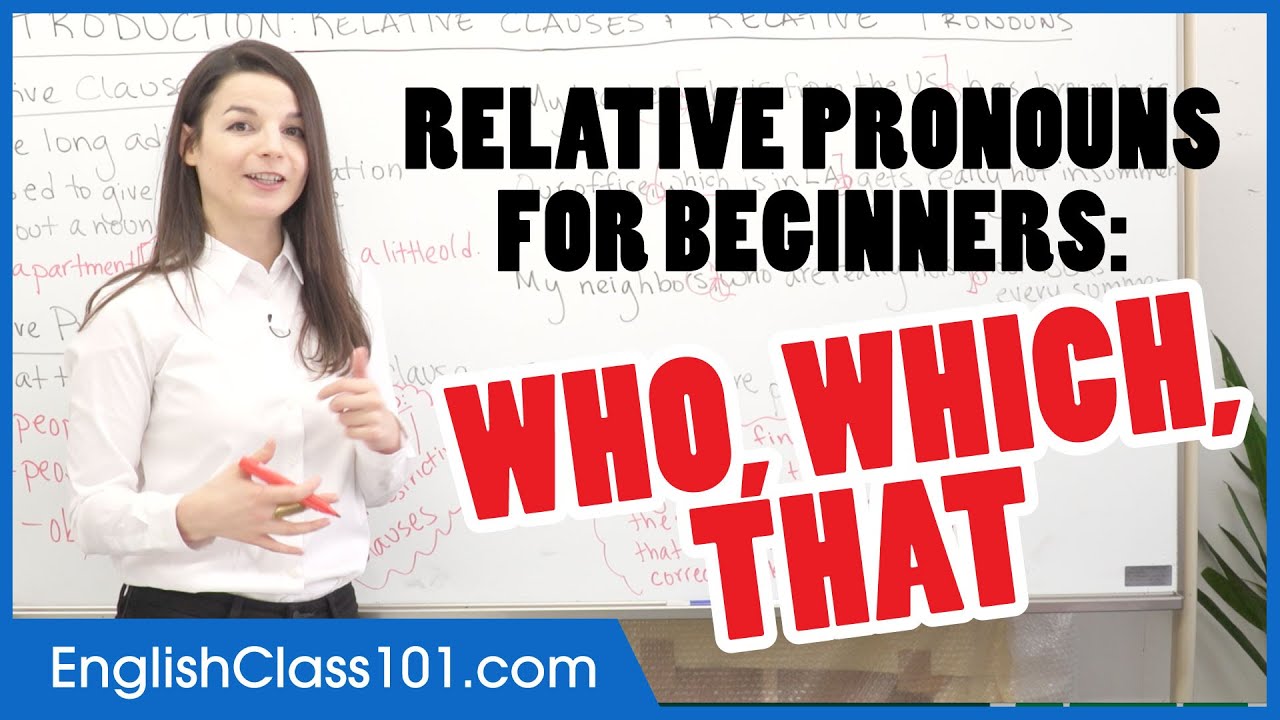
Learn English | Intro to Relative Pronouns
English Introduction and Overview
In this section, the instructor introduces the topic of relative clauses and relative pronouns, providing an overview of their usage in English grammar.
Relative Clauses and Their Function
- Relative clauses function as long adjectives, providing additional information about a noun or noun phrase.
- A relative clause is akin to a long adjective that offers more detailed descriptions.
Relative Pronouns Usage
- Relative pronouns like "which," "that," and "who" are used to introduce relative clauses.
- The instructor explains the use of "which" as a relative pronoun for objects in sentences.
Differentiation Between "That" and "Which"
- The choice between using "that" or "which" depends on formality; "that" is more casual while "which" is considered more formal or polite.
- Exploring the distinction between using "that" for casual situations and "which" for formal contexts.
Examples of Relative Clauses
This part delves into practical examples of how relative clauses are utilized in sentences.
Example Sentences Analysis
- Analyzing example sentences such as “my teacher who is from the U.S has brown hair” to understand how relative clauses work.
- Identifying the role of commas in indicating non-restrictive clauses within sentences.
Removing Relative Clauses Test
- Testing understanding by removing the relative clause from a sentence to ensure grammatical correctness.
Relative Clauses and Relative Pronouns
In this section, the speaker discusses relative clauses and relative pronouns, focusing on their usage in sentences.
Relative Clauses
- Relative clauses provide additional information about a noun in a sentence.
- The speaker explains using "who" in reference to plural nouns like neighbors is acceptable.
- Correcting sentences by removing the relative clause helps identify its structure and grammatical accuracy.
Relative Pronouns
- The use of "who" for animals as pets, like dogs, signifies a friendly or familiar relationship.
- Demonstrates how removing the relative clause can simplify the sentence while maintaining correctness.
Advanced Grammar Points
This part introduces advanced grammar points related to restrictive and non-restrictive clauses.
Restrictive vs. Non-Restrictive Clauses
- Explains the distinction between restrictive and non-restrictive clauses for more advanced grammar understanding.
- Mentions the importance of knowing when to use specific relative pronouns and how to punctuate with commas correctly.
Conclusion and Invitation for Engagement
The conclusion encourages viewers to engage further with examples or questions.
Viewer Engagement
- Encourages viewers to ask questions or create example sentences in the comments section.