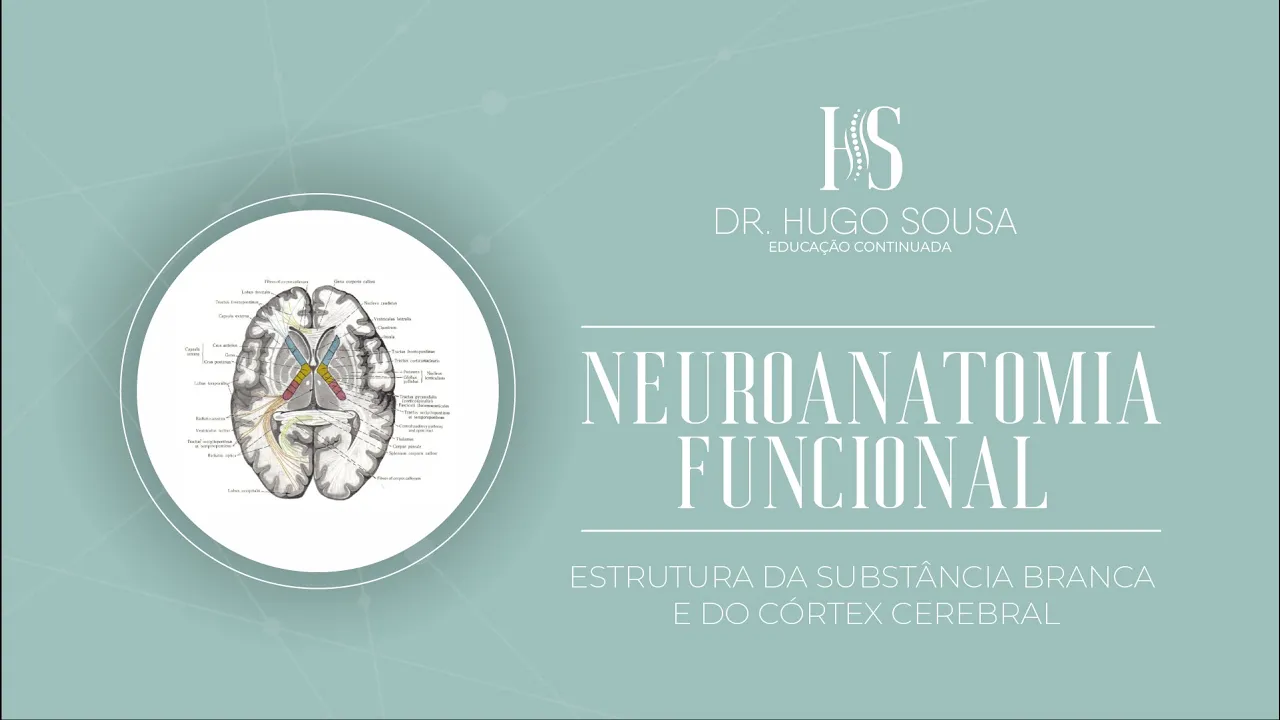
ESTRUTURA DA SUBSTÂNCIA BRANCA E DO CÓRTEX CEREBRAL - PARTE 1
Understanding the Structure of White Matter and Cerebral Cortex
Overview of Medullary White Matter
- The discussion begins with an introduction to the structure of white matter and the cerebral cortex, focusing on the medullary white matter center.
- The medullary white matter appears as an oval area in a horizontal section of the brain, also referred to as the semioval center for each cerebral hemisphere.
Classification of Fibers in White Matter
- White matter is composed of fibers classified into two main groups: projection fibers and association fibers.
- Projection fibers connect to subcortical structures beyond the telencephalon, such as basal nuclei and parts of the brainstem.
- Association fibers facilitate connections within a single hemisphere (intra-hemispheric) or between hemispheres (inter-hemispheric).
Types of Association Fibers
- Intra-hemispheric fibers are categorized into short and long types; short fibers connect adjacent cortical areas while long fibers connect distant regions.
- Short association fibers are known as arcuate or U-shaped fibers, linking neighboring gyri across sulci.
Major Long Association Fiber Bundles
Cingulum Bundle
- The cingulum bundle connects frontal lobe areas with temporal lobe regions, playing a role in emotional processing and memory.
Inferior Longitudinal Fasciculus
- This fasciculus links occipital lobe areas with temporal lobe regions, crucial for visual information processing like face recognition.
Superior Longitudinal Fasciculus
Understanding Language Processing and Brain Areas
Integration of Language Perception
- The interpretation of words involves a connection between their imagery, sound, and phonetic form, which is essential for processing information.
- A sensory area integrates reading and listening modalities, projecting to Broca's area responsible for planning speech expression.
Role of Broca's Area
- Broca's area is crucial for formulating the plan for verbal expression; it acts as a motor planning center for speech.
- This area connects with primary motor areas that control muscle movements necessary for writing and vocalization.
Impact of Brain Lesions on Language
- Damage to specific brain fibers can lead to severe language disturbances, highlighting the importance of intact neural pathways in communication.
Inter-Hemispheric Fiber Connections
- Inter-hemispheric fibers connect symmetrical areas across both hemispheres, forming three major commissures: fornix, anterior commissure, and corpus callosum.
Fornix Structure and Function
- The fornix links the hippocampus with mammillary bodies in the hypothalamus, playing a role in memory processing.
- It consists of columns that project towards mammillary bodies, facilitating interconnectivity within brain structures.
Anterior Commissure Functions
- The anterior commissure has an olfactory portion connecting olfactory bulbs and plays a role in linking temporal lobes.
- Olfactory signals cross midline through this structure to reach the contralateral hemisphere.
Corpus Callosum Overview
- The corpus callosum connects cortical areas symmetrically across hemispheres except for some temporal lobe regions linked by the anterior commissure.
Learning Across Hemispheres
- This interconnectivity allows skills learned on one side (e.g., left hand movement) to influence abilities on the other side (right hand), demonstrating functional harmony between hemispheres.
Structural Components of Corpus Callosum
- The corpus callosum comprises four parts: rostrum, genu (knee), body, and splenium (posterior part), each contributing to its overall function in communication between hemispheres.
Hypothalamic Mammillary Nuclei and Internal Capsule Overview
Structure and Function of the Internal Capsule
- The internal capsule is a projection fiber structure located between the striatum (caudate nucleus, putamen, globus pallidus) and the thalamus.
- It connects various brain regions, including the hippocampus and mammillary bodies, which are integral to memory circuits within the limbic system.
- Lesions in these structures can impair short-term memory and learning processes, highlighting their role in cognitive function.
Importance of the Internal Capsule
- The internal capsule is crucial as it contains most fibers entering or exiting the cerebral cortex; its integrity is vital for proper brain function.
- This region is often affected by cerebrovascular accidents (strokes), leading to significant functional impairments.
Anatomical Features of the Internal Capsule
- Above the lentiform nucleus lies a structure known as the corona radiata, which continues from the internal capsule.
- Below this area are cerebral peduncles that facilitate communication between different parts of the brain.
Ascending Pathways through the Internal Capsule
- The internal capsule has three sections: anterior limb, genu (knee), and posterior limb. Each section carries distinct ascending pathways.
- Anterior limb contains thalamic fibers directed towards sensory areas; posterior limb includes projections to somatosensory cortex.
Descending Pathways through the Internal Capsule
- Similar to ascending pathways, descending tracts also traverse through anterior limb, genu, and posterior limb of the internal capsule.
- Key tracts include fronto-pontine fibers in anterior portion and corticospinal tract in posterior portion; both are essential for motor control.
Clinical Implications of Internal Capsule Damage
- Disturbances in this area can lead to sensorimotor deficits on contralateral sides due to crossing over of neural pathways within CNS.
Turn any video into a summary like this
YouTube links, meetings, lectures. With transcripts, search, and chat.