Standard deviation (simply explained)
What is Standard Deviation?
Understanding Standard Deviation
- Standard deviation measures how much data scatters around the mean, indicating the variability of responses in a dataset.
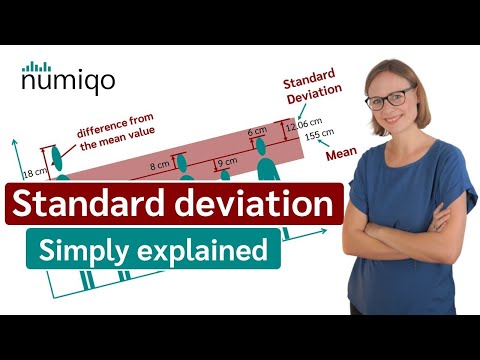
- To calculate the mean, sum all individual heights and divide by the number of individuals. For example, if the mean height is 155 cm, deviations from this mean are assessed for each individual.
- The standard deviation provides an average measure of how much individuals deviate from the mean value; in this case, it was found to be 12.06 cm.
Calculating Standard Deviation
- The formula for standard deviation (σ) involves calculating square deviations from the mean and taking their root: σ = √(Σ(xi - x̄)² / n).
- Each individual's height is subtracted from the mean, squared, summed up, divided by the total number of individuals (n), and then square-rooted to find the standard deviation.
Different Formulas for Standard Deviation
- There are two formulas for standard deviation: one uses n (the population size), while another uses n - 1 (for sample data). This distinction arises when estimating population parameters based on samples.
- If you have complete population data, use n; if only a sample is available to estimate population characteristics, use n - 1 to account for bias.
Standard Deviation vs. Variance
Key Differences Between Standard Deviation and Variance
- The variance represents the squared average distance from the mean while standard deviation is its square root. Thus, variance can be harder to interpret due to differing units.
- Using standard deviation simplifies interpretation since it retains original measurement units (e.g., centimeters), making it more intuitive than variance.
Practical Tip for Calculation