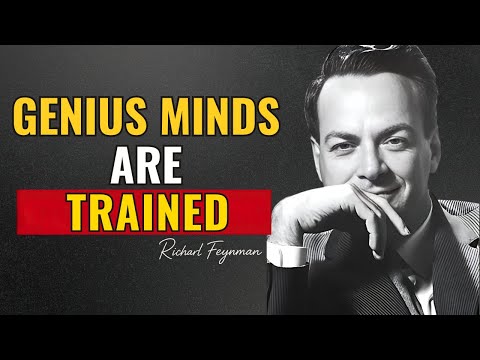
How to TRAIN Your MIND Like a GENIUS | Richard Feynman
What If Genius Is Backwards?
Rethinking Intelligence
- The concept of genius may be misunderstood; brilliance might stem from learned techniques rather than innate gifts.
- Intelligence is often perceived as fixed, but true understanding involves training the brain to think actively rather than passively.
The Illusion of Knowledge
- Common study habits, like underlining and rereading, create a false sense of learning; students struggle to explain concepts in their own words.
- Genuine understanding requires reconstructing knowledge instead of merely absorbing information.
Active Learning Techniques
- Understanding complex ideas means being able to explain them from foundational principles, not just memorizing facts or conclusions.
- Engage with concepts by breaking them down and reassembling them in your own terms for deeper comprehension.
Testing Your Understanding
- Familiarity does not equate to understanding; testing oneself without notes reveals gaps in knowledge.
- Teaching others or writing out explanations can highlight areas needing further exploration and solidify understanding.
Embracing Discomfort in Learning
- Many avoid discomfort associated with testing their knowledge; however, seeking this discomfort is crucial for genuine learning.
- After studying, challenge yourself to recall main ideas without looking at materials to ensure true comprehension.
Playfulness in Learning
- Curiosity enhances learning; exploring concepts through "what if" scenarios deepens understanding beyond rote memorization.
- Experimenting with ideas helps build intuition about their applications and limitations, fostering a more profound grasp of the material.
Understanding Knowledge Through Connections
The Web of Associations
- Knowledge becomes retrievable and useful when ideas are connected through a web of associations, similar to how skilled mathematicians recognize patterns rather than just memorizing formulas.
Simplifying Complex Ideas
- True understanding is demonstrated by the ability to explain concepts simply, without jargon. Complexity often masks confusion, indicating a lack of true comprehension.
- For example, entropy can be simplified to the universe's tendency toward disorder, illustrating that complex ideas can often be distilled into fundamental concepts.
Active Learning Techniques
- Engaging in active reconstruction of knowledge changes how the brain processes information. This includes building stronger neural pathways through testing oneself and simplifying information.
- Developing intellectual independence involves questioning established knowledge rather than accepting it blindly. This skepticism fosters deeper understanding and critical thinking.
Practical Application in Learning
- In studying physics, instead of merely memorizing laws like Newton's laws of motion, one should visualize scenarios (e.g., friction on ice vs. space), which enhances comprehension and retention.
- By actively engaging with concepts—like exploring circular motion in relation to inertia—learners can distill complex principles into core insights that resonate more deeply.
Transforming Historical Understanding
- When studying history, instead of rote memorization of dates and events, learners should explore underlying causes and interactions between factors for a richer understanding.
- This approach transforms historical facts into interconnected narratives that are easier to remember because they relate to broader themes rather than isolated data points.
How to Master Learning Techniques
The Foundations of Deep Learning
- Mastering a craft involves techniques such as active reconstruction, brutal self-testing, playful exploration, and ruthless simplification. These methods are universally applicable across various fields.
- As you practice these techniques, your mind strengthens rather than the material becoming simpler. You develop mental tools that enhance confidence in tackling difficult subjects.
- The distinction between those who seem brilliant and those who struggle lies not in innate intelligence but in how they utilize their cognitive abilities. Understanding is a skill that can be cultivated.
Rethinking Educational Approaches
- Many educational systems promote memorization over genuine understanding, discouraging questioning and presenting knowledge as static facts instead of dynamic ideas to explore.
- Real learning transforms information into understanding rather than merely absorbing it. This shift allows learners to break free from traditional constraints.
Practical Steps for Effective Learning
- Start small by applying these principles to one subject you're currently learning. Test yourself rigorously and engage with the material actively.
- Embrace discomfort during the learning process; it indicates real cognitive engagement and growth. Building this habit will lead to compounding understanding over time.
The Nature of True Understanding
- Genuine understanding provides profound satisfaction compared to rote memorization. It involves discovering truths rather than just accepting conclusions from others.
- Knowledge is accessible to anyone willing to put in the effort. Reality follows comprehensible patterns that can be understood through diligent work and critical thinking.
Challenging Perceptions of Intelligence
- Shift your focus from questioning your intelligence to evaluating the depth of your thinking processes. Genius is not magical; it's a methodical approach that can be learned by anyone willing to engage deeply with their studies.